







Honest, paywall-free news is rare. Please support our boldly independent journalism with a donation of any size.
In a makeshift structure made of worn-out fabric in Al-Mawasi, Khan Younis, 25-year-old Samira Abdel Hamid is trying to build a life for her two children, 3-year-old Mohammad and 18-month-old Issa.
Abdel Hamid does not call the place where she lives a tent. As she describes it, it is “a place where the most basic necessities of life are unavailable, and where a person cannot feel that they are living a normal life.” While trying to meet her children’s needs, Abdel Hamid is also carrying the burden of a court case, waiting for a decision that could determine the shape of her and her children’s lives in the coming period.
“I never imagined my life would end up like this,” Abdel Hamid told me, recalling her life before the war. She married Salim Al-Astal on June 1, 2023, and lived with him in their apartment in northern Gaza, while he worked in a metalworking workshop. But after the war began, the family was forced to flee on October 11, 2023. Their home was bombed that same day, as was the metalworking workshop on which her husband depended for his livelihood.
“In one day, we lost our home and our work, and there was nothing left for us to return to,” Abdel Hamid said. The family fled to Deir al-Balah, where the harsh conditions of displacement and the lack of stability began to affect their marriage. With the loss of their income and the mounting pressures of war, Abdel Hamid said her relationship with her husband deteriorated. She said he no longer treated her as he had before and eventually stopped providing financial support for her and their children.
“I tried to endure it for the sake of my children, but I reached a point where I felt I could not continue,” Abdel Hamid said. As married life became an additional source of pressure, she decided to separate from him, hoping to raise her children away from the pressures she had been experiencing in the relationship.
“I didn’t choose separation because it was easy. On the contrary, I knew my situation was already difficult, but I wanted to have some peace and raise my children without having another person constantly pressuring me,” she said.
But her decision did not end her suffering. Between displacement, the lack of a stable source of income, and the responsibility of caring for two young children, Abdel Hamid also found herself waiting for a legal process with no clear end in sight.
“I just want the case to be over and to know what my future is. Every time the hearing is postponed, I feel like I’m still stuck in the same situation.”
“Every day that passes while I wait, my children and I pay the price,” she said, alluding to the difficulty of supporting her children while in legal limbo.
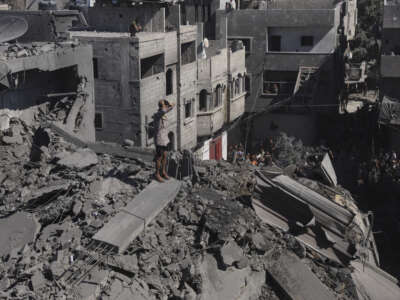
The legal delays faced by Abdel Hamid are an obstacle that many other Gaza residents are facing as well. Israel’s war on Gaza, which has killed more than 72,000 Palestinians according to the latest figures cited by the United Nations from Gaza’s Ministry of Health, has not only destroyed homes and livelihoods but has also caused extensive damage to civilian infrastructure and essential services, including the judicial system. Gaza’s judicial system operates through two complementary tracks: regular courts, which handle civil, criminal, and other legal disputes, and religious Sharia courts, which primarily handle personal-status matters such as marriage, divorce, custody, and alimony. The two systems operate within the broader Palestinian justice system, with distinct areas of jurisdiction.
To obtain a divorce and secure the legal and financial rights arising from it, Abdel Hamid had to turn to the Sharia court and substantiate her case. But she began the proceedings while the judicial system was operating under extraordinary conditions imposed by the war, including damage to court buildings, mass displacement, the dispersal of staff and litigants, and difficulties accessing files and documents. UN reports have indicated that access to legal remedies in parts of Gaza has been severely disrupted, while courts have faced significant pressure due to displacement and the influx of large numbers of litigants.
For Abdel Hamid, the delay in her divorce proceedings has become an ongoing obstacle to ending her marriage and starting an independent life with her children. “I just want the case to be over and to know what my future is. Every time the hearing is postponed, I feel like I’m still stuck in the same situation,” she said.
Personal-status cases have been among those most affected by delays, particularly cases involving alimony, child custody, and divorce.
Because Abdel Hamid wanted to end her marriage permanently, she filed for a legal remedy known as khul’ before the Sharia court. Under khul’, a wife relinquishes her financial rights arising from the marriage, but this does not extinguish the children’s financial rights; the father remains responsible for supporting them.
For Abdel Hamid, khul’ was a way out of a marriage she could no longer continue. “I gave up my rights so I could end the marriage and have some peace, but my children have nothing to do with it. He is their father and he has to provide for them,” she said.
But she said her husband does not support their two children, Mohammad and Issa, leaving her to shoulder their expenses alone amid harsh displacement conditions.
“I didn’t want anything from him for myself. I just wanted him to provide for his children. He is their father, and I cannot provide everything they need on my own,” Abdel Hamid said.
Lawyer Mustafa Diab said the war has severely disrupted the work of courts in Gaza. He told me that several courts and prosecution offices were destroyed and thousands of case files and documents were damaged or lost, leading to postponed hearings and the suspension of proceedings in many cases.
Diab said personal-status cases have been among those most affected by delays, particularly cases involving alimony, child custody, and divorce. “In general, the adjudication of all cases has been halted, but personal-status and Sharia cases have faced the most serious delays,” he said, explaining that the enforcement department of the courts has not resumed work, leaving those entitled to alimony “completely lost.”
Diab described to me how these delays are affecting the lives of women and children, saying: “The postponement of alimony, custody, and divorce cases has worsened the living, psychological, and legal conditions of families, particularly women and children.” He added that delays in alimony deprive families of money needed for food, medicine and shelter, while unresolved family disputes increase instability and can prevent some children from maintaining contact with one of their parents.
The enforcement department of the courts has not resumed work, leaving those entitled to alimony “completely lost.”
Delays in divorce cases, Diab said, can also leave women in a legally and socially uncertain position and postpone their access to rights arising from the end of a marriage, including alimony, custody, and other rights provided by law.
When I contacted Hassan Al-Joujou, head of the Supreme Council of the Sharia Judiciary, for comment, he painted a rosier picture of the legal situation in Gaza, asserting that courts in Gaza continue to operate despite the exceptional circumstances created by the war. He told me that 9 out of 10 courts have reopened, and that the judiciary continued providing essential services even during periods when court buildings were closed, including marriage and divorce procedures and other services for citizens.
Al-Joujou acknowledged, however, that courts are operating with limited resources. He said some courts have only one computer, alongside frequent power cuts and shortages of printing supplies and other basic necessities. According to him, the priority at present is “maintaining the provision of services rather than developing them.”
Al-Joujou said there is currently no clear prospect for implementing broader development plans to improve existing courts’ capacity to handle cases and provide services, adding that any development efforts will remain dependent on the political situation and what happens on the ground.
In Gaza, delayed justice is not simply about postponed hearings. It leaves entire families in limbo, waiting for rulings that will determine their rights and their futures amid a war that has disrupted so many aspects of life.
Media that fights fascism
Truthout is funded almost entirely by readers — that’s why we can speak truth to power and cut against the mainstream narrative. But independent journalists at Truthout face mounting political repression under Trump.
We rely on your support to survive McCarthyist censorship. Please make a tax-deductible one-time or monthly donation.









+ There are no comments
Add yours