







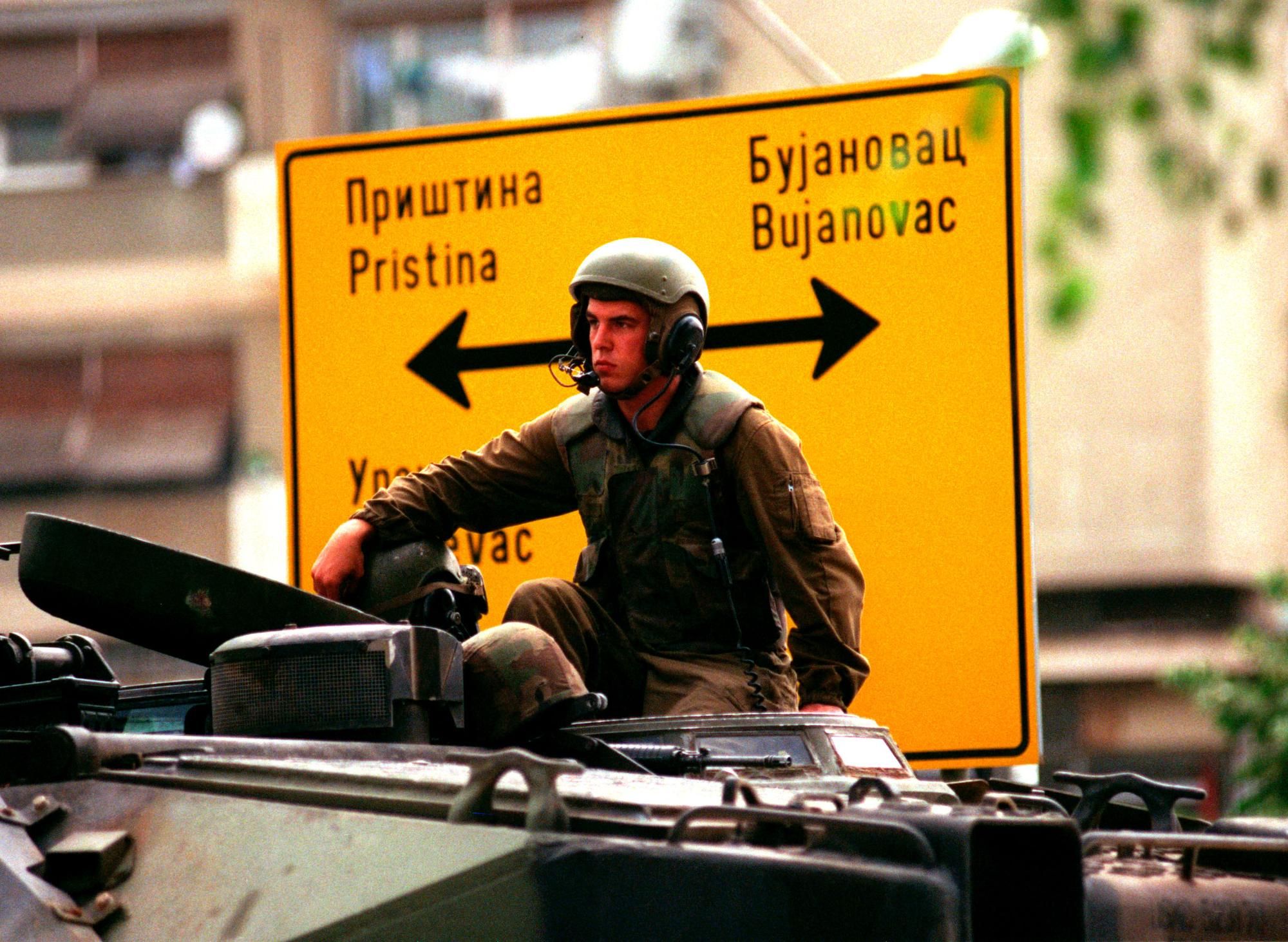
This summer, tensions in Kosovo have spiked even as a NATO-led peacekeeping mission began to withdraw from the country.
In July, police detained 37 Serbs at a commemoration in Gazimestan, and days later searched worshippers at a monastery near Prizren. Later that month, a Serb farmer from the village of Dren was pulled from his home by Kosovo Police, tied to a tree and beaten badly enough to require intensive care in Belgrade. Then, in August, a state-owned excavator demolished seventeen Serb-owned houses, claiming they were illegal.
The European Union called the conduct of the Kosovo state in all of these cases concerning, but it did nothing to stop them.
It was against this background that the KFOR mission — the NATO-led peacekeeping mission created in the wake of the Western intervention in Kosovo in 1999 — announced its gradual withdrawal from the bridge in Mitrovica, which has become a symbol of the division between ethnic Serbs in the country’s north and ethnic Albanians in the south. Justifying the move, KFOR cited an improved security situation in the country. Serbs protested, while Belgrade called the move premature.
After nearly three decades of international administration, why should KFOR’s stepping back cause such fear?
Kosovo has been the site of one of the most ambitious international state-building projects undertaken by the United Nations, with more than $2 billion spent in the first decade alone; per capita, it has received 25 times more money and 50 times more troops than Afghanistan did. NATO held the security framework in place, and the United States stood behind the effort, having pushed its allies to bomb Yugoslavia in 1999 and later backed Kosovo’s independence. After 27 years, what is it leaving behind?
What the bridge held back
In the months after NATO’s intervention in 1999, Kosovo saw major ethnic violence. By most estimates, some 200,000 Serbs and other non-Albanians were driven from their homes in reprisals. Those who remained faced killings and harassment, while churches were burned, and homes and land seized.
Much of this happened in front of an international presence that did little to stop it. At the time it was called reprisal for what Albanians had endured under Serbian President Slobodan Milošević, a framing that made the violence appear justified while deflecting attention from the mission’s failure to prevent it.
One part of Kosovo escaped this. As the Yugoslav state withdrew, residents of North Mitrovica organized their own defense. As violence spread across Kosovo, they blocked the bridges to the south, keeping it from reaching the last urban area in Kosovo from which Serbs had not been driven out. Violence never reached the north.
The “bridge watchers” succeeded largely because KFOR accepted the river as the defense line, placing tanks at the crossings and backing their effort. The arrangement, tailored to the security context, has been criticized ever since for reinforcing Kosovo’s ethnic divisions and tolerating what critics called the “bridge gang,” though critics have failed to offer workable alternatives.
By 2001 a separate political order had consolidated in the north, resisting the state structures emerging under UNMIK, the United Nations interim civil administration in Kosovo. Behind the bridge, those who had organized the defense preserved and reorganized the remnants of the Yugoslav administration, including its courts, municipalities, university, and medical system. The UN came to call them “parallel institutions.”
Dismantling the north
Although the UN had declared the northern institutions illegal from the outset, it also tolerated them for years, recognizing their role in maintaining order and providing services for a population it could not otherwise reach.
Following Kosovo’s declaration of independence in 2008, Washington backed the EU to take the lead in Kosovo, seeing the leverage of EU membership as a means to broker a political compromise. The EU assumed the UN’s role as state-builder and mediator, adopting a more radical approach. Declaring the north a “black hole,” it made dismantling the order a central objective of the Brussels-led dialogue between Belgrade and Pristina.
While justified by Brussels on security grounds, this was effectively a step in consolidating Kosovo’s sovereignty. The legal ambiguity surrounding Resolution 1244, which authorized KFOR and UNMIK, and the fact that five EU member states did not recognize Kosovo did not slow the process. By 2011, dismantling the north had become conditio sine qua non of Kosovo’s state building.
This required a partner in Belgrade, which had not yet established diplomatic relations with Kosovo. No Serbian government was willing to make such a bargain, even as the country sought EU membership. The north depended on Belgrade, but that dependence never translated into political obedience. Its population had been united in resisting integration into the Kosovo state, leaving little room for Serbia to maneuver. Giving up the north would also have been politically unsurvivable at home.
The EU’s partner arrived in 2012. The newly elected SNS government led by Aleksandar Vučić embraced the Brussels agreement in 2013 while continuing to campaign at home on nationalist slogans. In return, Belgrade was given a free hand to monopolize Serb political life in north Kosovo through Srpska Lista, effectively the party’s local branch, sidelining anyone opposed to the deal.
In exchange for dismantling their institutions, Serbs in the north were promised the Association of Serb Municipalities, a limited form of self-government inside Kosovo’s legal system. It was a thin substitute for what was being removed, but even that was never delivered. Priština offered successive reasons for not implementing its side of the agreement, while Belgrade could do little more than complain.
The situation deteriorated further when Albin Kurti returned to power in 2021. He rejected the Brussels framework and pursued the extension of Kosovo’s authority in the north through a series of coercive measures, including the phaseout of the Serbian dinar, enforcement of Kosovo license plates, the seizure of municipal buildings, and the installation of Albanian mayors after local Serbs boycotted the elections. Kosovo also increasingly deployed special police units in the north, leading to repeated confrontations and arrests of Serbs.
Then came Banjska. On September 24, 2023, an armed Serb group clashed with Kosovo Police in the village of Banjska, killing one Kosovo police officer. Three attackers were also killed in the ensuing exchange of fire. The operation was organized by the deputy leader of Srpska Lista, Milan Radoičić, who crossed into Serbia and remained there. The population was left to pay the price. Pristina used the attack to harden its position, turning the north into a place of constant policing and increasingly coercive state control.
What is left behind
Throughout all of this, KFOR remained, the last layer of protection in case something went wrong. Its announced departure therefore unsurprisingly alarmed the remaining Serb community.
The mission was never meant to be permanent, and the timing has little to do with the north itself. In May, Washington declared in its Report to Congress on U.S. policy in the Western Balkans that it no longer intends to act as the region’s overseer. For twenty years, however, American pressure was one the few things constraining Priština.
Europe, which had taken over the Kosovo file, produced statements throughout the latest crisis, but few of them stopped Priština from tightening its grip on the north. Belgrade had signed away the north a decade ago and had little left to trade for it. The Brussels agreement was hailed as a major success of EU policy in the Balkans, but the security situation only got worse.
People have little choice but to leave, and increasingly, they do. What remains after NATO, then, is a question. Will northern Kosovo become yet another emptied area in the Balkans? And how many people have to go before anyone reassesses what was built in Kosovo?
From Your Site Articles







+ There are no comments
Add yours