






Honest, paywall-free news is rare. Please support our boldly independent journalism with a donation of any size.
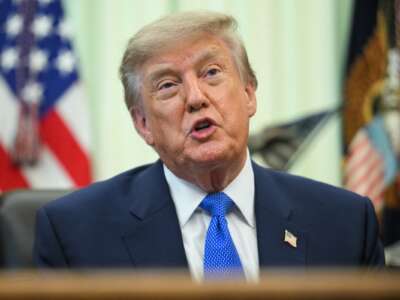
The Washington Post reported Monday that due to an alleged Iranian threat to assassinate President Trump, he secretly swapped planes before departing the July NATO summit in Turkey — leaving senior administration officials, staff and members of the press corps on board.
“The Israelis passed a tip, a concern, that the plane and potentially the president was under threat,” says Dan Lamothe, one of the Washington Post reporters who broke the story. But it turns out the “CIA had low confidence” in the Israeli tip, according to a more recent Post story Lamothe co-authored on Thursday. “I think that kind of leaves the Secret Service in a tough spot of assessing: What do you do in this zero-fail mission to keep the president safe?”
TRANSCRIPT
This is a rush transcript. Copy may not be in its final form.
NERMEEN SHAIKH: We begin today’s show looking at how an alleged Iranian threat to assassinate President Trump led to a secret operation last month that possibly endangered the lives of journalists and White House staffers. The Washington Post reported on Monday that President Trump secretly switched planes before departing a NATO summit in Turkey.
Ahead of his departure from Ankara on July 8th, President Trump announced on Truth Social that he would not be flying on the newly refurbished Boeing 747-8 jet gifted by Qatar, but instead on the older Air Force One “for old time’s sake,” he said. That announcement led to revelations that the Qatari plane lacked some of the safety features of the legacy Air Force One — leaks that angered the White House and led to subpoenas of New York Times reporters.
AMY GOODMAN: But the Post revealed Monday the president actually departed on a third plane. President Trump was seen boarding the old Air Force One, but then secretly left through another door and was shuttled in an airport catering truck along with several aides to a third plane. The press was asked to lower their shades before the operation, presumably so they would not see the president’s exit. Senior officials who were left on the plane along with the staff and reporters included Secretary of State Marco Rubio, Treasury Secretary Scott Bessent. The White House never revealed the secret operation.
On Tuesday, President Trump was asked by reporters about the plane switch and the risk posed to the reporters on the decoy flight.
PRESIDENT DONALD TRUMP: It’s only up to Secret Service. I just follow what they like to do. So, I go by Secret Service, and the military. …
REPORTER 1: Mr. President, on the midterms —
REPORTER 2: Why was it too dangerous for you to fly on Air Force One, but not too dangerous for the press?
PRESIDENT DONALD TRUMP: I don’t know. I think, actually, the plane that I flew on was at greater risk. I think it was at greater risk.
REPORTER 2: Why do you say that?
REPORTER 1: Mr. President —
PRESIDENT DONALD TRUMP: Because that would be the plane, I think, they’ll be — that they would be more likely to go for.
NERMEEN SHAIKH: White House Correspondents’ Association President Jacqui Heinrich of Fox News met privately with senior White House officials Tuesday to convey concerns from the press corps. In an internal memo to members afterwards, she said, quote, “I … asked the White House to work with us on a protocol … that recognizes the Secret Service’s responsibility to respond to genuine threats while protecting press safety, preserving independent coverage of the president, and providing a mechanism to correct the record after the fact when necessary.”
AMY GOODMAN: For more, we’re joined by the reporter who broke the story: national security writer for The Washington Post, Dan Lamothe. But his latest piece is headlined ”CIA had ‘low confidence’ in Iranian threat before Trump switched planes in Turkey.” In it, Lamothe reports the intelligence about the assassination threat against President Trump had come to the CIA from the Israeli government but was not seen by the CIA as highly credible.
Dan, before you talk about the president believing he was threatened and moving to a third plane, first the Qatar jet, then the old Air Force One and then this military jet, before you talk about him leaving it and presumably leaving the press in the endangered plane, you now have this new story that the U.S. CIA didn’t even think Israeli intelligence, because that was the source of the information about the assassination threat to Trump, was viable.
DAN LAMOTHE: That’s right. We reported last night — my colleagues Warren Strobel, John Hudson and I combined on a story that kind of laid out how they came to the decision to make these extraordinary moves in July. The Israelis passed a tip, a concern, that the plane and potentially the president was under threat. The CIA had low confidence in it.
And I think that kind of leaves the Secret Service in a tough spot of assessing: What do you do in this zero-fail mission to keep the president safe, but at the same time, you know, manage the additional pieces? They went with the more extreme option of removing the president and then keeping it secret after.
NERMEEN SHAIKH: So, Dan Lamothe, if you could put this in also historical context? In other words, in the past, the Secret Service has used decoy motorcades and planes for presidents. Why is this incident different? On previous occasions, were the press corps and other senior officials also taken off the plane?
DAN LAMOTHE: The most direct example we’ve seen is probably President Clinton landing in Pakistan in 2000. The Post had another piece earlier this week from Scott Nover where, you know, it was acknowledged and reported that at least the chief of the White House Correspondents’ Association at the time had been brought in quietly. They kind of laid out what they needed to do, or what they thought they needed to do. And in that case, the president followed in Air Force One on a second plane.
But I think the most significant difference here is that in that case, moments after landing, President Clinton popped out of the other plane, and it became very apparent what had happened. So, you know, within minutes, it becomes clear. Everybody knows there’s the decoy. It was reported at the time, basically what happened and why. And in this case, you’ve got — you know, it was handled very differently — I mean, a month’s worth of secrecy. Presumably, that would have continued had it not been for some news reporting.
AMY GOODMAN: Wondering if you have thoughts on — I mean, here, the White House subpoenaed New York Times reporters. They were the ones who exposed the lack of whatever defense, enough defense on the Qatari plane that was gifted to Trump. So, all the attention in these last weeks has been on that. They were ultimately forced to drop those subpoenas. But maybe the White House was most concerned that it was this that would come out, that he left the jet, left the reporters on the jet and moved onto a third plane. And yes, Marco Rubio was apparently on that plane, as was Scott Bessent. He was with his personal aides, like Walt Nauta, who was indicted along with him a few years ago, though those indictments were dropped. Your thoughts?
DAN LAMOTHE: Yeah, I mean, when this tip came to me, I was struck by the extraordinary nature of it. I initially kind of looked at it as, like, this seems kind of surreal. And if we’re going to report this out, we better be damn sure before we publish. So, it took time to run this down, multiple conversations, multiple source interviews. And I thought really helpful here, you know, that initial story, we got our visual forensics team involved. We got our investigations team involved. We combed through airport tracker data, you know.
And really, I thought one of the remarkable things in that initial story, and something that made it hard to deny, was you had video in the airport that basically followed a lot of this right through. If you’re looking at that catering truck as just another random day, it didn’t stick out. But when you look through it through the lens of the other reporting, it looked pretty extraordinary.
NERMEEN SHAIKH: And, Dan, finally, on another topic, you’ve been reporting on impacts of the Iran conflict on munitions, military personnel and on U.S. facilities in the region. Could you talk about some of that reporting and what you found?
DAN LAMOTHE: Yeah, I mean, really, this has been an enduring concern throughout this conflict, that really grows by the day as the conflict kind of meanders on. The United States has a large number of munitions broadly. The problem here is they do not have enough of very specific and very important munitions. So, over time, things like Tomahawk missiles, Patriot interceptor missiles, things that have really played a key role in this particular conflict and have also been important in the Ukraine conflict, and would be important in any kind of conflict with China or some other adversary, are dwindling. And they cannot be built quickly. And this was a known thing going back not only through the Trump administration, but into the Biden administration, as well. Some steps were taken to fix this. However, one [inaudible] they haven’t been able to really resolve that issue, and really, they’ve just tried to downplay it.
AMY GOODMAN: Dan Lamothe, we want to thank you for being with us, national security writer at The Washington Post. We’ll link to your exclusive that exposed the secret flight, is headlined “Contradicting public statements, Trump took secret flight from Turkey amid Iranian threat.” His latest piece with other Washington Post reporters, ”CIA had ‘low confidence’ in Iranian threat before Trump switched planes in Turkey.”
Coming up, as the U.S. rapidly expands its use of artificial intelligence, we’ll look at how AI is changing the way wars are fought. We’ll speak to Heidy Khlaaf. She co-authored the new report “Anatomy of an AI Kill Chain.” And then we’ll talk about race and AI. Stay with us.
[break]
AMY GOODMAN: “Eclipse” by François Gout. Yes, I am here in London, and that’s exactly what Londoners and people in so many countries in Europe experienced yesterday: a solar eclipse.
An important fundraising appeal: 7 Days to raise $42,000
Truthout is one of only a few platforms for justice-oriented, grassroots journalism. Today, as political censorship from the right intensifies, we have no choice but to ask for your help.
We are fundraising right now to cover our basic operating expenses. If you can support Truthout with a one-time or monthly donation, you will make a significant impact on our work. Anything you can do makes a difference — we appreciate your support.


+ There are no comments
Add yours