







Truthout is an indispensable resource for activists, movement leaders and workers everywhere. Please make this work possible with a quick donation.
It has been 250 years since the U.S. declared independence at one of the most tenuous moments in our history. We now stand at another tenuous moment. With an autocrat firmly in the White House, a sycophantic legislative branch, and a judiciary dominated by far right conservatives, it feels hard to celebrate the United States and its “democracy,” which hangs by a thin thread.
In the run-up to this anniversary, patriotic reflections have abounded, whitewashing U.S. history and seeking to erase its more sinister chapters. This pageantry has also erased any mention of a positive practice that has run throughout American history — the practice of safe abortion.
That’s right, abortion has been a part of American life since the very beginning. Despite attempts by far right extremists to eradicate it out of existence and erase its history in U.S. colonial and republican history, safe abortion has been a consistent throughline over the past 250 years and beyond.
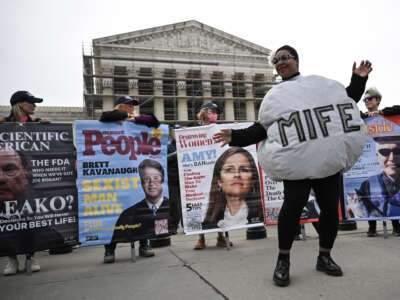
Abortion access has been decimated in recent years. Before the Supreme Court overturned Roe v. Wade in 2022, Republican-dominated state legislatures successfully forced the closure of more than 160 abortion clinics from 2012 to 2019 alone. States like Alabama and Texas passed draconian early abortion bans, designed to force the Supreme Court to test and potentially end the constitutional right to an abortion. Finally, in June 2022, after Donald Trump successfully appointed three far right justices during his first term, Roe v. Wade fell in Dobbs v. Jackson Women’s Health Organization.
Writing for the majority in the Dobbs ruling, Justice Samuel Alito argued that abortion is “entirely unknown in American law,” and the right to a legal abortion is “not deeply rooted in the Nation’s history and tradition.” In this interpretation, Alito, as he so often finds himself, is flat-out wrong.
Abortion, a matter of individual liberty and personhood, isn’t just foundational based on the U.S. Constitution and the Declaration of Independence, which established the right to “life, liberty, and the pursuit of happiness.” It was also common, legal, and acceptable across communities and states throughout the colonial era and the first half-century of the U.S. republic.
Benjamin Franklin, the man who graces our $100 bill, didn’t just endorse safe abortion — he helped teach people how to do it themselves.
Colonial American life included abortion. It was so common and acceptable that the venerated Benjamin Franklin intentionally added information on how to perform an at-home abortion to a reference book he published, The American Instructor, reprinting within it recipes for herbal abortifacients and contraceptives from a 1734 medical handbook entitled Every Man His Own Doctor: The Poor Planter’s Physician. Benjamin Franklin, the man who graces our $100 bill, didn’t just endorse safe abortion — he helped teach people how to do it themselves.
In the late 18th century and early 19th century, abortion was legal and acceptable to the point of quickening, or when the pregnant person can feel the fetus move. This occurs during the second trimester of pregnancy, typically from 16-20 weeks into a pregnancy. With little in the way of scientific methods for determining how long a pregnancy was, quickening was the most common and often the only surefire way to determine whether a person was pregnant. And because abortions were largely performed by midwives or Indigenous healers — trusted, community-based experts and providers of care — abortion was typically kept in the realm of women’s work. This also helped enslaved women inhibit pregnancy and have abortions through their private use of cotton; enslavers knew little to nothing about the herbal remedies for unwanted pregnancy that were known among African and Indigenous healers. Enslaved women would chew cotton root and bark to resist childbearing following sexual assault by their enslavers. Abortion was a key means of asserting the little independence that enslaved women could claim.
The nation’s first abortion ban was not enacted until 1821, nearly a half-century after the U.S. declared independence, when Connecticut passed a law that banned the use of “poison” to cause a miscarriage. This could have been targeted at midwives and Indigenous healers who had, for centuries, used natural herbs to induce abortions. Regardless of its target, it marked the first time in U.S. history that abortion, in any way, had been criminalized.
Abortion bans began to spread not because of hostility to the procedure, but hostility to those who provided them. Midwives and Indigenous healers were the trusted experts, and as physicians began to establish themselves as the sole health care authorities, abortion came under scrutiny. With the establishment of the American Medical Association in 1847, physicians began a coordinated campaign to smear midwives and criminalize abortion, a procedure they were unable to perform. It took time, but by 1910, abortion was banned nationwide.
For as long as this country has been here, and even before its founding, people on this land have been providing and having safe abortions. That is a history worth celebrating.
However, that means that for more than 130 years after the nation’s founding, abortion was legal in some parts of the country. That’s more than half of our entire history. Add to that the years that abortion was protected nationwide by Roe v. Wade, from 1973 to 2022, and abortion has been legal in some or all parts of the country for more than 180 years of U.S. history. And yet Justice Alito and far right ideologues have erased this overwhelming part of the country’s history from our story.
It is essential that people in the U.S. embrace the real history and legacy of abortion, one that is foundational to realizing the much-lauded ideals of liberty and independence. If this milestone feels difficult to celebrate, remember this: For as long as this country has been here, and even before its founding, people on this land have been providing and having safe abortions. That is a history worth celebrating.
Press freedom is under attack
As Trump cracks down on political speech, independent media is increasingly necessary.
Truthout produces reporting you won’t see in the mainstream: journalism from the frontlines of global conflict, interviews with grassroots movement leaders, high-quality legal analysis and more.
Our work is possible thanks to reader support. Help Truthout catalyze change and social justice — make a tax-deductible monthly or one-time donation today.









+ There are no comments
Add yours