





Truthout is a vital news source and a living history of political struggle. If you think our work is valuable, support us with a donation of any size.
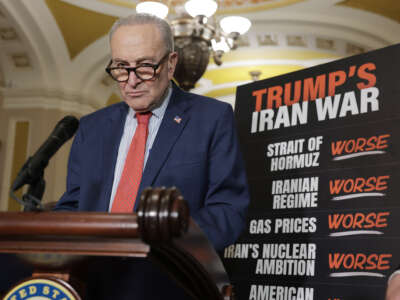
The Republican Party’s staggering losses in the November midterm elections have prompted speculation about the future of the U.S.-Israeli war against Iran, which is overwhelmingly unpopular with voters. Democratic leaders have portrayed President Donald Trump’s military offensive as an unconstitutional fiasco and an economic disaster driving inflation.
But their choreographed outrage conceals a long tradition of bipartisan support for aggression, which President Masoud Pezeshkian of Iran denounced in his UN address this September. For decades, the United States and Israel have referred to Iranians as terrorists, “but we are the victims of terrorists,” Pezeshkian underscored. His speech outlined a record of hypocrisy: U.S. and Israeli officials talk about peace, but plot to assassinate political leaders and negotiators. Most notably, both states command nuclear arsenals, yet impose debilitating sanctions on Iran’s atomic energy program.
As Pezeshkian emphasizes, the war is the latest episode in a turbulent history of energy and imperial assertion that contradicts U.S.-Israeli claims about proliferation risks and regional security. During the Cold War, Western powers shattered Iran’s democracy, before consolidating a brutal petromonarchy to guarantee access to its oil reserves. While undercutting Iranian energy sovereignty, they allowed Israel to become a nuclear-armed occupier, spreading dirty weapons and armed conflicts across the Middle East. This tangled history of oil and atoms is essential to understanding the war’s causes and contradictions, as two rogue states with thermonuclear weapons attack Iran under the pretext of nonproliferation.
Iran’s Open Veins
Since the nineteenth century, Western powers have attempted to curb Iran’s sovereignty or seize its vast energy reserves. By 1914, Great Britain controlled its oil industry, after extorting concessions from the Iranian government. Over the following decades, the Anglo-Iranian Oil Company (AIOC) turned its refinery in the southwestern city of Abadan into the main energy supplier for the British Empire. Winston Churchill called the gushing wells “a prize from fairyland.” Yet AIOC officials warped Iran’s economic development by handpicking politicians and shamelessly exploiting workers. British personnel at Abadan lived in segregated splendor with swimming pools and servants, while local laborers inhabited parched slums.
After World War II, Iran attempted to improve its contract with the AIOC in order to raise government revenue and living standards. But company officials refused to compromise. In April 1951, Mohammad Mosaddegh became prime minister and initiated a series of ambitious reforms, which included nationalizing the oil industry.
Privately, the U.S. government lambasted the AIOC for behaving like a “typical nineteenth-century colonial exploiter,” while dealing “ineptly and disastrously” with Iran. Secretary of State Dean Acheson was scathing: “Never had so few lost so much so stupidly and so fast.” Nevertheless, U.S. leaders colluded with Britain to undermine nationalization. They feared that Mosaddegh’s policy set a destabilizing precedent, sapping British imperial power, upending the Cold War balance, and compromising Western control over strategic resources.
“I fought the fascists and Nazis,” one CIA adviser ruminated. “My lesson was that we were becoming just like them.”
Posing as a mediator, the State Department pressed Iranian leaders to make concessions, yet privately conceded that Britain’s demands were unreasonable. British negotiators advocated paying “lip service” to the principle of nationalization, while “keeping effective power … in our hands.” Ratcheting up pressure, the United States and Britain organized an oil embargo to suffocate Iran’s economy. Officials also bribed dozens of legislators, who physically assaulted Mosaddegh’s allies in parliament. And they launched a global propaganda campaign, pumping what one British operative called “a steady supply of suitable poison” into the press.
Mosaddegh held out until August 1953, when the CIA and British intelligence orchestrated a coup. From the shadows, foreign agents helped disloyal officers and paid rioters take Tehran, before assaulting the prime minister’s house. After a blistering shootout, Mosaddegh and his allies fled across his rooftop as his home dissolved into rubble. He would spend three years in solitary confinement and the rest of his life under house arrest.
Pressing their advantage, U.S. leaders broke Britain’s energy monopoly after the coup, securing the right to market 40 percent of Iranian oil. CIA Director Allen Dulles, whose law firm represented the AIOC, supervised a transition to unabashed authoritarian rule under Shah Mohammad Reza Pahlavi. The CIA bragged that it was “very active” in selecting parliamentary deputies, and the shah exclaimed to one American spymaster: “I owe my throne to God, my people, my army and to you!” Notoriously, U.S. agents helped establish the intelligence service, SAVAK, which tortured countless dissidents. “I fought the fascists and Nazis,” one CIA adviser ruminated. “My lesson was that we were becoming just like them.”
During the Mosaddegh administration, the United States and Britain portrayed Iran as a fanatical state tottering on disorder. Before international audiences, they fielded legal arguments opposing nationalization, claiming that Iranian leaders were hotheaded, breaking inviolable contracts, and flirting with communism. But the goal of U.S. and British stakeholders was always control: unfettered access to Iran’s bountiful oil and the suppression of demands for resource sovereignty across the Global South.
Atomic Colonialism
As Mosaddegh languished in prison, Israel launched a nuclear program that reflected the colonial double standards of Western energy policy. In July 1956, Egypt nationalized the Suez Canal, which French and British investors controlled. Outraged, Paris and London conspired with Tel Aviv to invade the Sinai Peninsula and retake the waterway. During secret talks, the diplomat Shimon Peres leveraged cooperation to secure French assistance for Israel’s atomic energy program. “I finalized,” Peres wrote in his memoirs, “an agreement for the building of a nuclear reactor at [the Israeli city of] Dimona.”
That October, the tripartite invasion of Egypt incensed both the Soviet Union and United States, which forced its Western allies to withdraw. Afterward, French Prime Minister Guy Mollet deepened his commitment to Israel’s nuclear program, portraying it as a consolation prize. “I owe them the bomb,” Mollet insisted. Within a decade, Western capital investment allowed Israel to join the nuclear club. Beersheba became a francophone enclave with 2,500 French citizens and Renault cars cruising its streets as guest workers constructed the Dimona plutonium plant.
Experts feared that the atom bomb would embolden Israeli aggression, undercut peace negotiations, and trigger a world war.
Meanwhile, both states exploited colonial Algeria as an arms range. Between 1960 and 1966, French authorities conducted nuclear tests in the Sahara, spreading radioactive fallout across North Africa while sharing their findings with Israeli observers and the Zionist state’s scientific establishment. The experiments spawned a toxic nightmare, reportedly poisoning 30,000 Algerians in 1962 alone.
Fearing nuclear weapons proliferation, U.S. President John F. Kennedy pressed Israeli leaders to accept inspections at Dimona. Yet Zionist activists succeeded in reducing them to a political charade. “I fought the strongest battle of my career to keep them from full inspection,” the lobbyist Abe Feinberg recalled. “I violently intervened … half a dozen times.” Under pressure, U.S. officials agreed to announce visits beforehand and forgo using their own testing equipment. Feinberg boasted that his political campaign turned inspections into “a scam job,” while secretly collecting funds for Israel’s nuclear weapons program from American Zionists.
In The Samson Option, journalist Seymour Hersh reveals that Israel went to extraordinary lengths to deceive inspectors. Before visits, the Israeli military covered paths and bunkers at Dimona with dirt and grass, relandscaping the complex to conceal its awesome scale. Officials also constructed a false control room with rigged computers, pretending to operate a modest 24-megawatt reactor. And an Israeli “cover up team” plugged information leaks. One member recalled scolding engineers who divulged secrets. “‘Listen, you mother-fucker, don’t answer that question,’” the official interjected in Hebrew. “The Americans would think I was translating.”
Privately, U.S. leaders suspected that Israel was building a bomb. Yet hostility toward the Arab powers, sympathy for Zionism, and electoral considerations encouraged them to tolerate its duplicity. Off the record, Kennedy was irate, confiding that Israeli “sons of bitches lie to me constantly about their nuclear capability.”
After acquiring nuclear capabilities, Tel Aviv invaded its Arab neighbors in June 1967, occupying the Sinai Peninsula, Gaza Strip, West Bank, and Golan Heights. Increasingly, the Pentagon regarded Israel as the world’s greatest proliferation threat. Experts feared that the atom bomb would embolden Israeli aggression, undercut peace negotiations, and trigger a world war. In his classic study, Israel and the Bomb, Avner Cohen unveiled a dangerous cycle, arguing that Washington boosted conventional arms shipments to reduce the appeal of nuclear weapons.
Anxieties peaked in 1968 when Secretary of Defense Clark Clifford sought Israel’s commitment to the Non-Proliferation Treaty in exchange for F-4 Phantom jets. After tense negotiations, the Israeli embassy again mobilized Feinberg to press President Lyndon B. Johnson’s hand. The maneuver worked. A tenacious lobbyist, Feinberg was also a major Democratic Party fundraiser with a direct line to Johnson, which he used to bypass the Pentagon.
“Clifford called Johnson and LBJ said, ‘Sell them anything they want,’” an aide to the senior U.S. negotiator claimed. He recalled that the secretary of defense was stunned, replying, “‘Mr. President, I don’t want to live in a world where the Israelis have nuclear weapons.’” Johnson simply told Clifford to not bother him anymore before hanging up.
Read together, the history of U.S. policy toward Iran and Israel offers surreal contrasts. Western empires crushed Mosaddegh’s attempt to achieve economic sovereignty, demolishing Iranian democracy in the process. Yet afterward, they helped Israel become a nuclear-armed occupier, while combating Arab nationalism. Repeatedly, they prioritized power over nonproliferation, opening a nuclear umbrella over the Middle East.
Selling the Apocalypse
In October 1973, Clifford’s worst fears materialized, as Egypt and Syria launched a coordinated offensive to reclaim land that Israel had seized in 1967. Prime Minister Golda Meir’s government panicked, apparently mobilizing Israel’s nuclear arsenal. To calm Israel’s nerves, the U.S. government airlifted 22,318 tons of materiel to the Israeli military. According to Hersh’s reporting, Secretary of State Henry Kissinger told a colleague that Meir blackmailed him, implying that “if they didn’t get military equipment, and quickly, they might go nuclear.” As tempers flared, both Kissinger and Soviet leaders, who backed the Arab powers, engaged in nuclear brinkmanship, escalating the most dangerous standoff since the Cuban Missile Crisis.
Although averting Armageddon, American officials triggered an Arab energy embargo that boosted oil prices fourfold, upending the global economy and again elevating Iran’s strategic significance. Over the 1970s, the United States sold staggering quantities of high-tech weapons to the shah, in order to guarantee access to petroleum and “petrodollar recycling” — ensuring that oil-producing states reinvested the U.S. dollars flooding the region into Western banks and financial markets.
In particular, U.S. policymakers helped develop the monarch’s nuclear program, which became a symbol of his overbearing ego. The Massachusetts Institute of Technology established a special arrangement, which educated dozens of Iranian personnel and, consequently, helped raise the Atomic Energy Organization of Iran’s staff of scientists from 67 to 862 within three years. Pushing back, professors and students claimed that the agreement strengthened the shah’s “fascistic dictatorship” and organized a sit-in at the Nuclear Engineering Department in April 1975. One faculty member warned that MIT was potentially “training engineers to build bombs.”
Yet U.S. cooperation continued and was no outlier. Without exception, the European countries now spearheading sanctions against Tehran previously supported the shah’s drive for nuclear mastery, training scientists, building reactors, and selling sensitive technologies.
Until 1979, Israeli leaders also regarded Iran as an essential lifeline and helped build the shah’s military-industrial complex. At times, the monarchy was Israel’s sole oil supplier and a leading market for its defense exports. Revamping relations, Israeli military officers reportedly maintained regular contact with Iranian staff, and the shah helped them develop missiles capable of carrying nuclear warheads. Their relationship set a new pattern, as Israel helped authoritarian regimes build advanced weapons — including nuclear bombs — to secure hard currency. Prioritizing oil and petrodollars, Israeli leaders respected the shah’s ability to “stifle any resistance.” Any “change in this government will,” Ambassador Uri Lubrani stressed, “be to the detriment of our relations.”
Ultimately, U.S.-Israeli support for the shah backfired. In 1978, military and nuclear spending accelerated an economic crisis, which spiraled into a revolution. Israeli diplomats favored “extreme toughness” and “the establishment of a military regime” to crush protests. But it was too late: The shah fled Iran in January 1979. That same year, evidence emerged that Israel tested a nuclear bomb in the Atlantic, underscoring the failure and hypocrisy of U.S. nonproliferation policy.
Déjà Vu
In recent decades, American and Israeli officials have portrayed Iran as an existential menace bent on nuclear conquest. In 1992, Prime Minister Yitzhak Rabin warned that Iran was only years away from procuring a nuclear bomb, a claim his successors have repeated ever since. For Tel Aviv, demonizing the Iranian government served two purposes: It justified sending unrivaled levels of U.S. military aid to Israel and diverted attention from the occupation of Palestine.
Following the 2003 invasion of Iraq, President George W. Bush’s administration declared Iran a member of the “axis of evil,” labeling it a proliferation threat while preparing for war. Senior officials were “literally levitating off the ground in pure excitement,” the EU diplomat Alastair Crooke recounted. They boasted that “‘only the wimps … went to Baghdad,’” but “real men” would attack Iran. Over the following decade, U.S. and Israeli policymakers laundered false intelligence, manipulated the International Atomic Energy Agency, and spread unsubstantiated claims about an Iranian bomb program to promote regime change.
For Tel Aviv, demonizing the Iranian government justified sending unrivaled levels of U.S. military aid to Israel and diverted attention from the occupation of Palestine.
Upon taking office in 2009, President Barack Obama maintained pressure through sanctions and cyberattacks. He also tolerated Israel’s assassination program against Iranian nuclear experts; in one case, an undercover operative murdered a scientist in front of his infant daughter. Notoriously, Prime Minister Benjamin Netanyahu took their propaganda campaign to the United Nations, where he brandished a poster of a cartoon explosive. Drawing a red line below the fuse, Netanyahu warned that Iran was approaching “the second stage of nuclear enrichment to make a bomb.”
To avert war, Obama concluded a nuclear agreement with Iran in 2015. But three years later, President Donald Trump arbitrarily scrapped the accord, initiating the latest wave of false accusations to justify unconditional support for Israel and a reinvigorated sanctions regime.
This February, U.S. and Israeli leaders finally launched a full-scale military offensive against Iran. With unintended irony, Trump has threatened to “annihilate the Islamic Republic” while insisting Iran threatens regional stability. Rehashing three-decade-old arguments, Netanyahu also asserts that the war is necessary to forestall disaster. “We have prevented Iran from carrying out a plan to annihilate us, and today they would have had … an atomic bomb to do so,” he informed a press summit.
That propaganda not only justifies the ongoing offensive but disfigures the historical record. Israel, not Iran, has thermonuclear weapons. The illegal offensive has killed thousands of civilians, upended the global economy, and undermined Republican dominance in Congress. The midterm election results represent a stinging repudiation of the war. But its implications remain unclear, as senior Democrats such as House Minority Leader Hakeem Jeffries have asserted that Iran is “a bad actor” that “must be aggressively confronted.”
Since the 1950s, U.S. and Israeli leaders have repeatedly subverted Iranian sovereignty, threatened nuclear war, and destabilized the Middle East. As under Mosaddegh, Iran once again confronts unapologetic Western aggression, while fighting the latest incarnation of its colonial past.
An important fundraising appeal: 10 Days to raise $50,000
Donations are down for Truthout at a time when media is under immense pressure. Google’s AI search has driven our traffic down by 15 percent, Trump is arresting journalists, and many independent media organizations face heartbreaking cutbacks and closures.
At the same time, movement media is vital in the fight against Trump’s authoritarian reign. Our mandate to tell the truth, share strategies for resistance, and speak against fascism is ever more urgent in this deluge of political censorship and misinformation. Yet, we are struggling to meet our publishing costs when our work is so urgently needed.
We are fundraising right now for those basic operating expenses — we need $50,000 in the next 10 days. If you can support Truthout with a one-time or monthly donation, you will make a significant impact on our work. Anything you can do makes a difference.




+ There are no comments
Add yours