






| Updated:
Once a symbol of Bacchanalian excess, the all-you-can-eat buffet seemed destined for the culinary dustbin. But Anna Moloney discovers a breed of chefs refusing to let go
In East Ewell, the suburb of a suburb where I grew up, there is one place to eat. Come out of the station, walk the only direction you can, and you’ll find it, hemmed in from the A road with a greige picket fence: the Toby Carvery.
The budget British carvery chain, distinctive for its mock Tudor stylings, opened in the late 1970s, but to my child’s eye it may as well have been around since Henry VIII was on the throne. Housed partly in a former Victorian pub, the building itself – big, clean and white – had an awe-inspiring loftiness, while inside there were thick, burgundy carpets, solid wooden chairs and black and white portraits hanging on the wall.
Had any doubt of opulence remained, a trip to the counter would quickly dispel it. There awaited heavy cast dishes brimming over with peas, potatoes and stuffing, glossy and plentiful, with big spoons you had to prise out of the cornucopia to serve your own helpings. Behind them, a second row of replica dishes, lids closed and steam pouring out, stood in reserve should anything run dry. At the end of the table, piping hot vats of gravy stood so tall I would have to tiptoe to peer over the great greasy horizon, my arm reaching up above my head to precariously ladle it out.
It was my first taste of a buffet and it was intoxicating.
In the years that followed, I would gain a reputation among my family not just for my love of buffets – be that hotel breakfasts, Friday lunches at Pizza Hut or all-you-could-eat Chineses – but for my ability, striking for a little girl, to eat so voraciously. On one holiday, my brother, then 17 and already six feet tall, challenged me, 10 and tiny, to a contest at the all-you-could-eat breakfast; each course matched plate to plate until one of us surrendered. To this day, my victory, secured by a seventh plate of pancakes, is revered in family lore.
The appeal of the buffet is easy to understand. The impulse is primal; the permission to fulfil all of one’s food fantasies, at a set price and no judgement. Tim Lee, a buffet fanatic who has toured more than 400 for his Youtube channel TimLeeLetsGo, says he believes the magic lies in the buffet’s invitation “to experience excess and abundance for just one brief moment of time”. That you are empowered to help yourself at the buffet, rather than tell the waiter what to bring you, is surely key to the pleasure.
It is hardly surprising the buffet was born in Las Vegas, Sin City, where a casino proprietor in the 1940s found that offering unlimited food for a single dollar was an effective tool for making gamblers stay longer. It was a discovery that would go on to shape the whole Strip, which by the millennium was stuffed with multiple ‘grande buffets’ ready to feed holidaymakers hungry for escape. If the symbol of gluttony weren’t clear enough, how the casinos deal with the problem of food waste – feeding it to the hogs on nearby livestock farms – makes for a lucid, and reflective, image.
A death foretold again and again and again
Yet despite all this, the buffet is a format whose death has long been prophesised.
During the pandemic, as government guidelines forbade the sharing of benches, let alone the sharing of food, forecasts that the buffet was dead became almost as abundant as the feasts they obituarised. Even before that, worries over sustainability seemed to summon the Grim Reaper’s scythe – a format that prides itself on never running out is, after all, an inherently wasteful one.
Despite those objections, the buffet has struggled on, but its erosion cannot be denied. On the Vegas Strip, once home to some 35 buffets, only seven now live on. Just this May, the closure of the MGM Grand Buffet, open since 1993, caused fretting that the Vegas buffet was now a relic of the past, and some even spared a thought for the pigs (now forced to feed on supermarket scraps).
Across the rest of the Western world (the buffet is still central to dining culture in the Middle East and much of Asia), the story is much the same. Hospitality expert James Hacon, founder of Think Hospitality, says the traditional buffet has seen “sustained decline across almost every segment of hospitality”, with cost, waste and Covid building a composite case for their gradual phaseout.
More generally, it can be argued that, culturally, buffets have become passe. Over the last 10 years, the public appetite has arguably become more refined, nourished by a better culinary education that has made quality, not quantity, more sought after. Gluttony, too, has gone out of style. Long gone are the Middle Ages, where being fat was a sign of wealth. Today, quiet luxury, minimalism and a general belief that less is more has facilitated shrinking appetites.And then there is the rise of GLP-1s. In the Ozempic age, can buffets survive?
The rise of the posh buffet
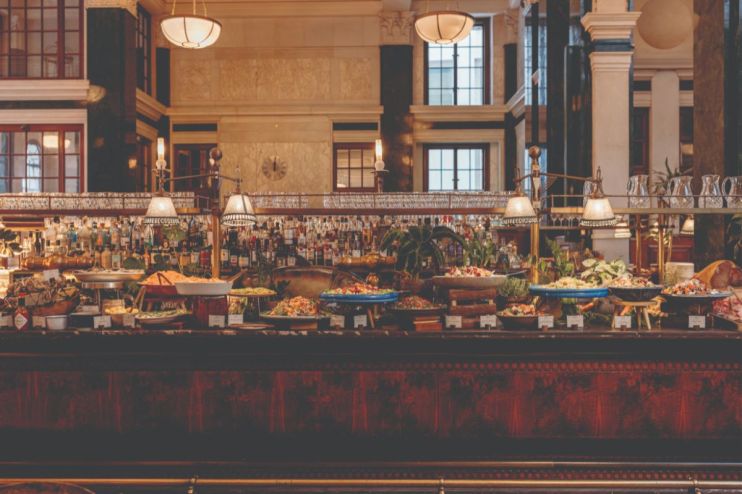
One lifeline is poshification. In London, especially, there is a growing scene for buffets targeted at a luxury audience. At The Ned, one of the City’s most glamorous locales, you will find a roaring weekend service for the £120-a-head Sunday buffet (though they call it a ‘feast’). Originally conceived as a lure to get customers in on a Sunday – notoriously difficult in the Square Mile – it has become so successful it stretches across both Millie’s Lounge and Cecconi’s in the Grand Banking Hall, and currently has a three month waiting list.
There’s a carvery, but it’s certainly not Toby’s, and cuts of meat are served alongside limitless lobster and oysters, as well as champagne (for a £70 supplement). When I visited, I was particularly starry-eyed at the desserts table, overflowing with plump sponges, caramel-topped brownies and big bowls of tiramisu administered by head pastry chef Darian Schmidt (last year’s winner of Bake Off: The Professionals).
With over 600 covers, keeping everything full is the name of the game, with the operation requiring around 25-30 chefs as well as a radio system from front of house to keep tabs on what needs replenishing. “We want to make sure it doesn’t seem as though things are running out because, in essence, we never really run out of things,” The Ned’s food and beverage director Jack Cohn tells me, hastening to add this is due to a careful ordering system based on years of data, rather than the creation of excessive waste. This is also economically important: “If it’s not controlled properly, it can get out of hand and become incredibly un-cost effective,” says Cohn.
Success spawns imitation, and Cohn says he’s now seen a number of luxury buffets pop up in The Ned’s wake. Bocconcino, for example, the upscale Italian restaurant in Mayfair, runs its own Grande Sunday Buffet for a premium audience, though for a more humble £80-a-head – and it was explicitly inspired by The Ned. Operations director Luca Reghenzani tells me they originally launched it at a lower price, with less premium ingredients, but found it wasn’t working. “Guests nowadays, they’re very, very clever,” he tells me. “They understand if something is cheap.” After a couple of recces to The Ned, Bocconcino upped the price – and the lobsters. Now, on a typical Sunday, they feed 150-200 customers, with dishes including 60 truffle eggs, 80 lobsters and 300 oysters per service.
The visual element, Reghezani adds, is extremely important, with the aesthetic composition of food, plants, and even the crockery all highly considered. “Once you take out all the plants, all the veggies, all the garlic from the net, there’s not that much going on,” he says. Rather, the abundance is visual and psychological – “the feeling that you see loads of food makes you willing to eat more, in a way.”
It’s true, our eyes can be bigger than our bellies, but at a buffet there’s a drive to prove otherwise, to get one’s money’s worth even when the pleasure is gone. Indeed, many economists delight in the buffet as a model for demonstrating the law of diminishing marginal utility, which states that satisfaction decreases with each additional unit consumed. Anyone who’s been to a buffet knows this to be true, and yet the animal impulse to eat until we are sick still overwhelms.
The luxury buffet is perhaps a sign of the economic times – as the cost of living affects even the wealthy, they are an unapologetic celebration of pleasure and excess. For me, though, even amid the glitz and glam of The Ned’s silver service, there will never be anything that comes close to the indulgence of ladling out that gravy at the Toby Carvery in East Ewell.






+ There are no comments
Add yours