







| Updated:
With three times more Brits supporting increasing international rail services over expanding airports, connecting Stratford to Europe is a no-brainer, writes Sadiq Khan
The story of the East End is one of total transformation. Twenty-five years ago, one of this area’s most infamous landmarks was ‘Fridge Mountain’ – a massive mound of discarded white goods that was 20 feet tall and almost a kilometre long. Look for it now, though, and Fridge Mountain is nowhere to be seen. In its place stands the Queen Elizabeth Olympic Park, transformed over the last 10 years.
In Stratford, which has become one of Europe’s largest and most successful regeneration projects, stories like this aren’t the exception – they’re the rule. The Queen Elizabeth Olympic Park alone now supports more than 38,000 jobs, generating around £3.5bn for the economy annually and attracting 20m visits each year. But this success story isn’t over yet – I want to bring cross-channel rail services to Stratford International so we can take this diverse, dynamic corner of London to a whole new level.
Visit Stratford today, and you’ll find a hotbed of innovation and entrepreneurship. In Here East, founders are building exciting start-ups harnessing the power of tech to transform our world. A short walk down the river, the £1.1bn East Bank is now home to an array of world-class cultural and educational institutions including UCL, London College of Fashion, V&A East and Sadler’s Wells East, with BBC Music Studios soon joining them.
Connecting East London to Europe
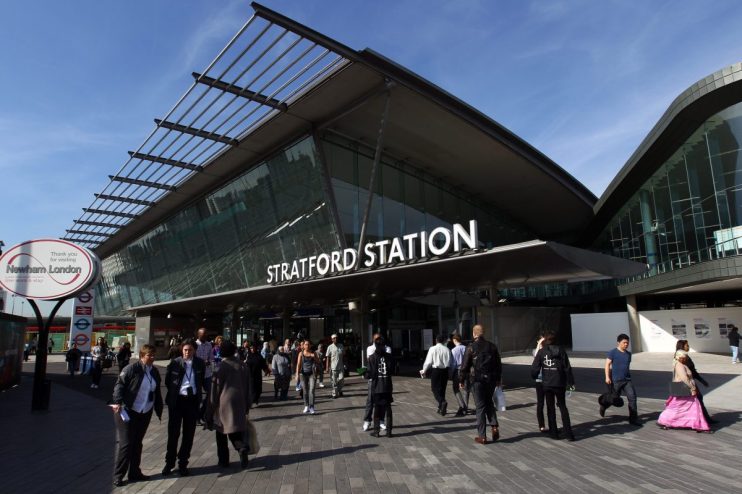
It’s no surprise, then, that people say London’s centre of gravity is moving east – and it’s public transport that’s making it possible. Stratford’s renaissance over the last quarter of a century has been driven by two of London’s best-connected stations. Today, Stratford station is served by the Underground, the Overground, the DLR, and the Elizabeth Line, alongside national rail services to towns and cities across Norfolk, Suffolk, and Essex. Meanwhile, at nearby Stratford International, passengers can board both the DLR and high-speed rail services which run between St Pancras and Kent.
The growth of these stations into booming rail hubs has, quite literally, put Stratford on the map. There are two problems, however. Stratford station is already struggling to manage with the estimated 100m passengers passing through it every year. And Stratford International is not, and has never actually been, international. The station was built with almost all the infrastructure required to become a bustling gateway to mainland Europe. But it has been mothballed due to a lack of ambition and action. As a result, the passport desks remain unused, and the arrivals hall stands empty. In short, the potential of international services to further transform this part of London remains untapped.
It’s impossible to overstate the size of the prize in Stratford. The evidence shows that, by 2035, the Olympic Park area alone could support more than 11,000 additional jobs, generating a further £2bn in annual economic output. The wider East London area, meanwhile, is expected to create more than 200,000 jobs by 2050. From advanced manufacturing and digital technology to the creative industries and professional services, this is where Britain’s future is being built.
Stratford is also a crucial part of the UK Innovation Corridor, linking London with Cambridge and some of the world’s leading centres of science and research. And it is the entrance to the Thames Estuary, where our plan to build a world-class centre for creative and cultural production could create more than 50,000 new jobs.
The ongoing development of Stratford is one of London’s most impressive economic revivals, but it is only by upgrading Stratford station and opening up Stratford International to cross-Channel rail services that we’ll be able to seize this opportunity fully.
The case for creating a Stratford International worthy of the name is clear and compelling. The popularity of international rail continues to grow in the capital, with passenger numbers on some routes increasing by up to 18 per cent in a single year, and operator demand for international services at Stratford is strong.
Brits want international rail more than a third runway
There is also an environmental argument to be made. A third runway at Heathrow Airport would undermine our climate goals and risk reversing the impressive progress we’ve made cleaning up the capital’s air. A 58 per cent increase in flights isn’t just completely incompatible with any viable path towards net zero, it would also result in an additional 22m car journeys every year, with the potential to create chaos and congestion on London’s roads. The impact on noise pollution would also be massively detrimental. Travelling by high-speed rail, on the other hand, can reduce carbon dioxide emissions by up to 96 per cent compared to flying on equivalent routes. It’s not hard to understand why three times more Brits support increasing international rail services over expanding airports.
Ultimately, bringing cross-Channel services to Stratford is about writing the next chapter in East London’s economic miracle. Connecting Stratford to the continent would transform this area from a busy London interchange into a genuine European gateway. As Sir Stephen Timms MP – who has been campaigning tirelessly for this for almost four decades – has pointed out, it could be life-changing for local communities. But its benefits would stretch far beyond the M25. The data shows that bringing international services to Stratford would bring in an additional £1.3bn in tourist spending across the UK.
My team and I have been lobbying for this for years – and I’m proud to say that our efforts are close to paying off. Over the last few months, my team and I have been working with this new government to make Stratford International truly ‘international’ for the first time and we’re now within touching distance of getting our plans over the line.
At the turn of the millennium, few Londoners could have predicted the cultural and economic powerhouse that Stratford would one day become. Yet, on the abandoned land once home to Fridge Mountain, our city built something extraordinary. Stratford today is a testament to what we can achieve with vision, energy and ambition. If we can summon that spirit once again, I’m convinced that the future of East London will be brighter still.
Sadiq Khan is the Mayor of London









+ There are no comments
Add yours