






Active Citizens, Africa, Armed Conflicts, Civil Society, Conferences, Crime & Justice, Featured, Headlines, Human Rights, Peace, Religion, TerraViva United Nations
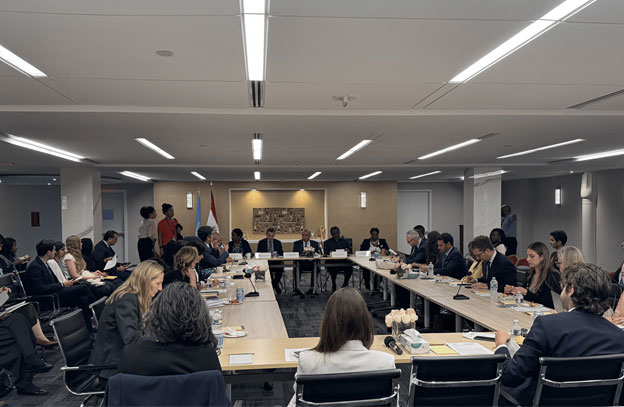
A UN Peacebuilding Week Event held in Egypt’s Permanent Mission to the United Nations, New York. Credit: Maximilian Malawista
– As the United Nations held its first-ever Peacebuilding Week (June 22-26), UN officials and developmental partners gathered at Egypt’s Permanent Mission on June 23 to hold a dialogue on the main question that emerged from the 2025 Peacebuilding Architecture Review (PBAR): “How can global commitments to peacebuilding translate into tangible results on the ground?”
This event, hosted by Egypt at the sidelines of Peacebuilding Week, titled “Strengthening National Peace Infrastructures in Africa: Lessons Learned and the Way Forward,” brought together representatives from African governments and regional organizations, as well as members of the UN system, to discuss how nationally-owned institutions can mitigate and prevent conflict, manage effects and sustain peace long after such situations have ended.
To open the event, Egypt’s Permanent Representative to the United Nations, Ihab Moustafa Awad Moustafa, emphasized that the 2025 PBAR negotiations repeatedly asserted a fundamental concern: ensuring that policy discussions in New York produce measurable impact on the ground, whether in Africa or in any other peacekeeping sites.
“One of the clearest answers that emerged during those discussions was the need to strengthen national capacities and institutions,” Moustafa said. “We are serious about peacebuilding, sustaining peace, and primarily prevention. We must invest in national peace infrastructure.”
The PBAR, which was adopted in November of 2025, reaffirmed that nationally led and nationally owned endeavors remain at the core of sustainable peace. The PBAR actively calls on Member States, regional organizations, development partners, international financial institutions, and the UN system to strengthen the institutions capable of preventing conflict, fostering social cohesion, and managing risk.
Throughout the discussion, speakers agreed that contemporary conflicts are rooted in security threats but also pointed to institutional fragility, governance deficits, and declining trust of public institutions between citizens as an additional threat.
Brian James Williams, Chief of the Peacebuilding Fund at the Peacebuilding and Peace Support Office (PBPSO), explained that the review provides a clear mandate for the international community to follow nationally identified priorities.
“Prevention and sustaining peace need stronger national capacities, stronger institutions and better alignment of international support behind those national priorities,” Williams said.
Williams detailed the UN Peacebuilding Fund’s increasingly important role in helping governments operationalize existing national mechanisms, rather than creating new parallel structures. Williams cited examples such as support for peace and reconciliation committees in Chad and local peacebuilding mechanisms in the Central African Republic.
“These committees bring together administrative authorities, traditional and religious leaders, women, young, and marginalized groups,” Williams said, relaying the efforts to connect national peace architectures with local institutions and provincial actors.
Participants of the dialogue repeatedly emphasized that national ownership must extend beyond central governments. Effective peace infrastructures require civil society organizations; participation of local authorities, women, youth, religious leaders, and representatives of the community; and capability of identifying tensions or risks before they can escalate into violence.
Permanent Representative of Nigeria to the United Nations, Ibrahim F. Jimoh, highlighted his country’s model to strengthen peacebuilding through institutions such as the Institute for Peace and Conflict Resolution and through reintegration, demobilization, disarmament, and reconciliation programs tailored to specific local conditions.
“Such infrastructures provide the framework through which countries can anticipate risks, address grievances, and support recovery,” Jimoh said. “Their effectiveness depends on inclusive participation, institutional resilience, and strong national ownership.”
Sierra Leone, Ghana, Côte d’Ivoire, and The Gambia also shared examples where local mediation structures, national peace councils, reconciliation commissions, and traditional institutions of justice have contributed to conflict prevention and social cohesion.
Jacqueline Seck, Chief of Staff, Office of the Under-Secretary-General for Political and Peacebuilding Affairs (DPPA), pointed to Ghana’s Peace Council as an example of nationally owned institutions providing trusted platforms to have dialogue, mediation, and electoral conflict prevention. Similarly, in The Gambia and Sierra Leone, the role of dedicated peace institutions in helping support post-conflict reconciliation and manage political tensions was discussed.
Among the major challenges, financing emerged as a recurring topic throughout the duration of the dialogue. While the catalytic role of the Peacebuilding Fund was praised by the speakers, many emphasized that sustained peace ultimately requires a long-term political commitment to peace as well as continuous domestic investment.
Williams warned that developing institutions often takes a lot of time and is a gradual process.
“Institutions take time to develop,” he said. “Results often require support at a certain scale, across the country, and across different parts of an institution to make meaningful impact.”
Throughout the discussion, participants pointed to a broader shift in peacebuilding strategy, from responding to crises after violence has already erupted to investing in preventative institutions designed to address risks before conflict happens.
IPS UN Bureau Report







+ There are no comments
Add yours