





Author
Ahmed Barakat
Author

Share

Fact Checked by
CryptoNews Editorial Team
Author
The Senate did not invoke cloture on the motion to proceed to H.R. 3633, the Digital Asset Market Clarity Act, on September 15, 2026. That vote did not kill the bill, pass it, or send it anywhere near a presidential signature. It left the measure exactly where the record shows it now sits: passed House. But what’s next for the CLARITY Act?
The procedural record is unambiguous even where the political story around it isn’t. Rep. J. French Hill introduced the bill on May 29, 2025, and the House passed it 294-134 on July 17, 2025, a lopsided, bipartisan margin that made it the most credible market-structure vehicle to reach the Senate in years, a point worth remembering amid the broader market anxiety around stalled regulatory progress.
Jurisdiction split across the House Financial Services and Agriculture committees, with the Senate assigning the bill to Banking, Housing, and Urban Affairs.
Earn $50 and Enter $300K Prize Draw on EdgeX
What the Congressional Record Says
On June 1, 2026, the Senate Banking Committee reported the bill out with an amendment in the nature of a substitute from Tim Scott, the committee chair. That single procedural fact carries real weight: it shows Senate Banking reported a substitute amendment, but the record does not establish that the September floor version was a rewrite of the House text. The latest listed action after the failed cloture vote is a motion by Sen. Thom Tillis to reconsider – a procedural door left open, not a closed one.
What the bill itself would actually do is spelled out plainly in the Congress.gov summary. It hands the CFTC primary authority over digital-commodity transactions, exchanges, brokers, and dealers, with qualification tied to whether a blockchain is mature or has reached defined decentralized control, or whether an issuer files specified reports.
| Milestone | Date | Outcome |
| Introduced (Rep. Hill) | May 29, 2025 | Referred to House Financial Services & Agriculture |
| House floor vote | Jul 17, 2025 | Passed, 294-134 |
| Senate Banking markup (Scott substitute) | Jun 1, 2026 | Reported to full Senate |
| Cloture on motion to proceed | Sep 15, 2026 | Not invoked; Tillis’ motion to reconsider entered |
The SEC retains jurisdiction over designated broker-dealer, alternative-trading-system, and national securities exchange activity involving digital commodities, and every digital-commodity intermediary would fall under Bank Secrecy Act anti-money-laundering obligations. The same illicit-finance terrain keeps surfacing in enforcement cases like the one detailed in recent crypto money-laundering prosecutions.
None of that legislative text explains why cloture failed. The primary record doesn’t identify ethics provisions, stablecoin yield, or developer protections as the deciding factors in the vote. Those are negotiating themes reported around the bill, not causes established by the bill’s own procedural history.
Trade Crypto on Bybit and Get a Chance to Win Our $1,000 USDT Airdrop
What Are The Next CLARITY Act Draft’s Pressure Points?
Any rewrite still has to clear the same architecture already baked into the bill. Things like mature-blockchain criteria, issuer disclosure, trade-monitoring and recordkeeping rules, customer-asset segregation, and registration mechanics for exchanges, brokers, and dealers.
Those provisions aren’t in dispute in the public record; the fights are over how they get amended around the edges. A joint statement from the American Bankers Association, Bank Policy Institute, and several other banking trade groups following the cloture vote pushed for targeted changes to stablecoin-yield policy specifically, framing it as the price of continued industry support for a durable framework. This is a dispute that dovetails with the broader debate over how stablecoins compete with traditional payment rails.
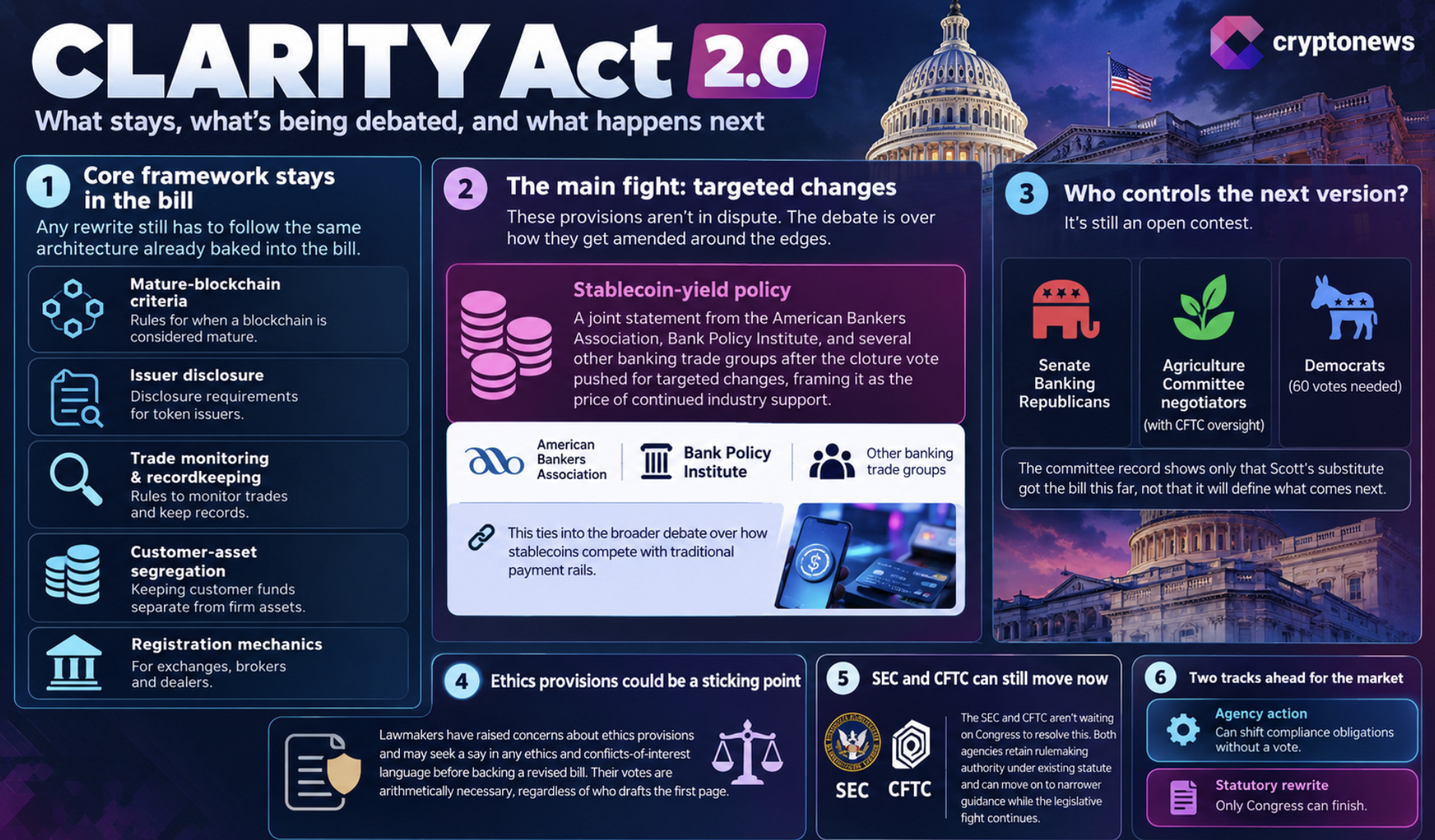
Whether Senate Banking Republicans, Agriculture Committee negotiators with CFTC oversight, or Democrats whose votes are needed to clear 60 end up controlling the next text is an open contest. The committee record shows only that Scott’s substitute got the bill this far, not that it will define what comes next.
Lawmakers have raised concerns about ethics provisions and may seek a say in any ethics and conflicts-of-interest language before backing a revised bill, and their votes are arithmetically necessary regardless of who drafts the first page. The SEC and CFTC aren’t waiting on Congress to resolve any of this; both agencies retain rulemaking authority under existing statute and can move on to narrower guidance while the legislative fight over CLARITY Act continues.
For now, this leaves the market with two tracks running in parallel, agency action that can shift compliance obligations without a vote, and a statutory rewrite that only Congress can finish.
Discover: The Best Token Presales