




| Updated:
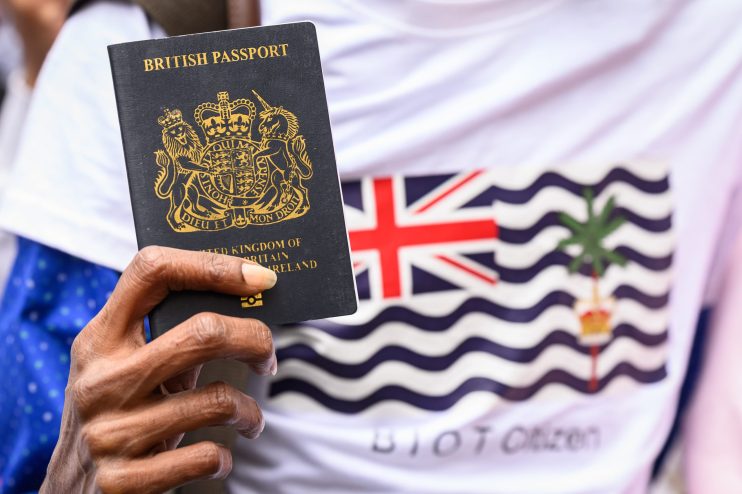
The proposal to cede sovereignty over the Chagos Islands to Mauritius and pay for the privilege appeals to no voters and has lost the support of Donald Trump. Andy Burnham should pull the plug, says Eliot Wilson
It became clear early in Sir Keir Starmer’s brief premiership that here was a leader of unusual political clumsiness. He was the sort of man who would get run over twice while crossing a road, by traffic from each direction. He promised new protections for renters and tough measures for landlords, only to find that 44 of his own MPs were landlords.
Even taking that haplessness into account, it was extraordinary when his government unveiled an “historic agreement” with Mauritius over the future of the British Indian Ocean Territory (BIOT), which comprises the seven atolls of the Chagos Archipelago in the Indian Ocean. There are more than 1,000 islands, of which Diego Garcia is the largest.
Diego Garcia is home to a Permanent Joint Operating Base which, under an agreement signed in 1966, is shared with the United States: owned by HM Government, it is leased to America which operates it as Naval Support Facility Diego Garcia, which provides logistical support to US forces in the Indian Ocean and the Persian Gulf. Crucially, the facilities can be used by the US Air Force’s long-range strategic bombers, and it has been used in the past to launch air strikes against Afghanistan and Iraq.
The Republic of Mauritius has for many years asserted a logically implausible but politically modish claim to sovereignty over the BIOT: that the United Kingdom illegally “separated” the Chagos Archipelago from Mauritius when the BIOT was established as a separate Crown Colony in 1965. This claim is contained in Article 111 of the Constitution of Mauritius.
The Mauritian claim is supposedly underpinned by UN General Assembly Resolutions against “the partial or total disruption of the national unity and the territorial integrity of a country”. But Mauritius and the Chagos Archipelago – which are more than 1,300 miles apart – have never meaningfully been a country. Both came under British sovereignty, having been French possessions, thanks to the Treaty of Paris in 1814 but were governed together purely for administrative convenience. The Chagos Archipelago had been uninhabited until 1776.
If it’s hard to explain, it’s because it makes no sense
The BIOT became independent outside the Crown Colony of Mauritius in 1965, and Mauritius itself became independent as a Commonwealth realm in 1968. So the historic ties between the two territories rely wholly on French then British colonial jurisdiction. Logically, the claim must be that the UK breached international law by disrupting “the national unity and the territorial integrity” of a country, Mauritius, which did not yet exist.
In 2019, the International Court of Justice issued a non-binding advisory opinion in favour of the topsy-turvy Mauritian claim. It was at least in part a political rather than a judicial act, continuing to beat the drum of “decolonization” in a context where it made no sense. But the Starmer government decided this legal uncertainty was an intolerable threat to the future of the Diego Garcia joint operating base.
The agreement reached was this: the UK would surrender sovereignty of the BIOT to Mauritius, which had never exercised it before; but would remain “authorised to exercise the sovereign rights of Mauritius on Diego Garcia”, initially for 99 years. What this means in practice is anyone’s guess, but it is certainly considerably less than sovereignty. That 99-year leaseback would involve the UK paying an average of £101m per year to Mauritius, potentially a total of £10bn; other estimates have ranged between £3.4bn and £35bn.
Then-foreign secretary David Lammy proudly declared the agreement “secures this vital military base for the future”. Likewise, loading all six chambers of a revolver “secures the future” of a game of Russian roulette. The UK would be giving away sovereignty of a vital territory to a country which had never possessed it, and, incredibly, paying many billions of pounds for the privilege.
While Starmer remained in a dogged embrace with the treaty, it became clear that Parliament would not agree the Diego Garcia Military Base and British Indian Ocean Territory Bill before the end of the last session. More seriously, the US administration having previously assented to the treaty as required by the 1966 exchange of notes, President Trump finally read its contents and made clear his visceral opposition. In January he called it “an act of great stupidity”, and by April the government, still maintaining the treaty “is the best way to protect the long-term future of the base”, agreed it would need to be paused.
Now we have a new Prime Minister. Andy Burnham is supposed to have better political antennae than Starmer. They could hardly be worse. Burnham’s obvious course of action would be to drop the treaty altogether and walk away, citing changing geopolitics, American recalcitrance or profound respect for the will of Parliament. Defence secretary Wes Streeting has acknowledged that the treaty “can’t go ahead without US support”.
The treaty appealed to no constituency or voting bloc, only to Mauritius and to those for whom anti-Western legal opinions are a form of erotica
The treaty appealed to no constituency or voting bloc, only to Mauritius and to those for whom anti-Western legal opinions are a form of erotica. Speak to MPs and ask them how the issue plays on the electoral doorstep, and their faces fall. Giving away British territory and paying the recipient billions of pounds is like paying to have the council remove refuse, but enormously valuable refuse we still want. Sometimes if a policy is difficult to explain, it is because it makes no sense.
President Trump reiterated at the UN General Assembly last week that the treaty with Mauritius was “a terrible deal”. It is the kind of one-sided, exploitative, grievance-advertising arrangement he despises viscerally. Burnham said at the UN that the government would “work hard” to find a “resolution between the different sides”, but it is hard to imagine bridging that gap.
The original treaty did enormous reputational harm to the UK. Labour’s 2024 election manifesto said:
“Defending our security… means protecting the British Overseas Territories and Crown Dependencies… Labour will always defend their sovereignty.”
The world has seen the shakiness and timidity of our grasp on the Overseas Territories, and it is not coincidental that President Javier Milei has been emboldened to rekindle Argentina’s equally bogus claim to the Falkland Islands.
The Prime Minister can still claim a honeymoon period, with Labour enjoying a narrow lead in some opinion polls. Essentially uninterested in international affairs, he should make it clear that, for principled as well as practical reasons, the treaty with Mauritius has been filed away under “learning experiences” and is not a priority this side of a general election. At worst there might be opposition from a handful of hand-wringing Labour backbenchers.
Burnham could demonstrate that he sees how bizarre this appears to ordinary votes, and how fundamentally unjust. He has a reputation for being all things to all men. Dismissing Mauritius’s claim over the BIOT would show he understands when the people-pleasing has to stop.
Eliot Wilson is a writer and historian; senior fellow for national security at Coalition for Global Prosperity; contributing editor, Defence on the Brink





+ There are no comments
Add yours