





Part of the Series
Struggle and Solidarity: Writing Toward Palestinian Liberation
Honest, paywall-free news is rare. Please support our boldly independent journalism with a donation of any size.
When I went to meet Rasha Swerki, I couldn’t find a place to sit except for the tombstones. So I stood during the whole interview.
Swerki, 41, lives with her two sisters in a tent set up on the edge of Sheikh Radwan Cemetery, west of Gaza City. She cooks on a hearth among the graves and spreads her laundry on a tightrope among the gravestones.
I asked Swerki why she chose to live in a cemetery. She said she didn’t choose to: “We lived in the Zeitoun area … of Gaza City. But because of social customs and traditions, our relatives refused to let us stay with them since my sisters and I were on our own without a man.” Then her brother told her that he had found a place near him for them to set up a tent and drove them to it. “I found myself getting out of the car and into the cemetery,” Swerki said.
Since the ceasefire took effect in October 2025, many Gazans have had nowhere to return. According to the United Nations Office for the Coordination of Humanitarian Affairs, more than 85 percent of the Gaza Strip is now under evacuation orders or inside military zones, including along the so-called “Yellow Line,” which bars Palestinians from returning to the rubble of their homes. As a result, hundreds of thousands of people are crammed into less than 15 percent of the territory. With no empty ground left to pitch a tent, the overcrowding has spread to the walls of Sheikh Radwan Cemetery, turning graves from a resting place for the dead into a last refuge for the living.
While there are no official exact figures on how many displaced people are currently sheltering inside Gaza’s cemeteries, many families have been forced into grave sites across the Strip, according to photos and my own observations. From Rafah and Deir al-Balah to Gaza City, living among the dead has become a repeating reality as every single square meter of livable space disappears under relentless displacement.
Swerki lives with her two sisters, Nariman, 60 years old, and Islam, 37 years old. She says they have been orphans since before the war, and no one supports them financially except her brother when his salary comes in every month. She describes their daily lives: “I cook among the graves, and everyone looks at me from the street. There is no privacy. We are afraid of rodents at night, and we have no light in the tent. There is no life, and there is not even money to support ourselves.”
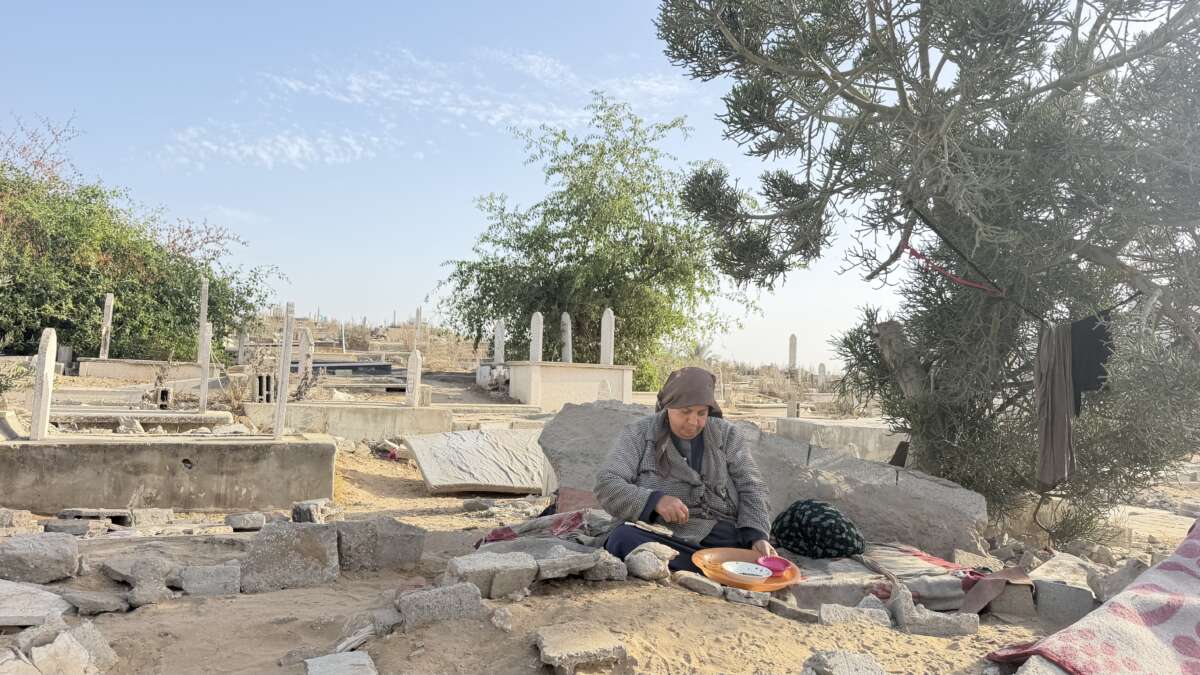
Swerki pointed to her sister Nariman, who was sitting and eating among the graves. She said in a voice full of sadness, “As you can see, my sister sits among the graves all day. She gets up from the tent at 5:00 in the morning at sunrise and stays right there until sunset. It has taken a heavy psychological toll on her.”
During my time with Swerki and Nariman, I observed how Nariman barely spoke, offering only a one-word reply in response to my question about her welfare. The only full sentence she uttered in my presence was, “This is the grave of Abdullah Al-Mohandes” — a phrase she uttered while pointing at a nearby grave. Then she stopped talking completely.
“Before the war, we lived the best life,” Swerki said. She now fears what winter brings: “The tent is torn. We will flood, and the tent will fall on us without anyone caring about us. Life is very tragic.”
In a nearby tent, the story of Khader Abo Khader, 62, and his wife, Kamila, 59, is similar.
When their grandchildren and married daughters visit them, Kamila said they say to her, “We are afraid to sleep here. How do you live in the cemetery?”
Khader said, “There is no other place to go. I didn’t leave a shelter, school, or camp without going and asking for an empty place. They all refused.” He explained that in each of these places, the overcrowding was so severe that the tents were already pitched right up against each other.
“We and the dead are one and the same. Not even stray dogs would accept living like this.”
Khader once owned a three-story house, but it was destroyed in the 2023 war on Gaza. Now, he has been living in the cemetery for nearly a year, having already endured an entire winter amid the graves. Because of the sloped construction of the cemetery, rainwater flows from the graves and accumulates in the area where his tent is pitched. Moving the tent is not an option because others’ tents are already pitched in the rest of the available space.
“The ground here isn’t flat, so we were drowning,” he said. “Rainwater flooded over us, leaving us to literally swim through it.”
The struggle for survival extends far beyond the elements; recently, Khader awoke to the terrifying sound of a snake sliding inside his tent: “If I hadn’t woken up, which one of us would have been killed by its venom?”
For Khader, the boundaries separating the displaced from the dead have completely dissolved. “This is a miserable existence,” he said, looking across the crowded grave markers. “We and the dead are one and the same. Not even stray dogs would accept living like this.”
His wife, Kamila, describes the unbearable weight of survival: “Winter is terrifying, but summer is infinitely harder. I can’t handle the heat, the mosquitoes, and the rodents.”
She speaks of rodents gnawing through their meager bags of flour and lentils and of the grim reality of what she cooks each day: “I am still living through famine. I cook famine food because it’s all that’s available. I don’t have a single onion or a tomato.”
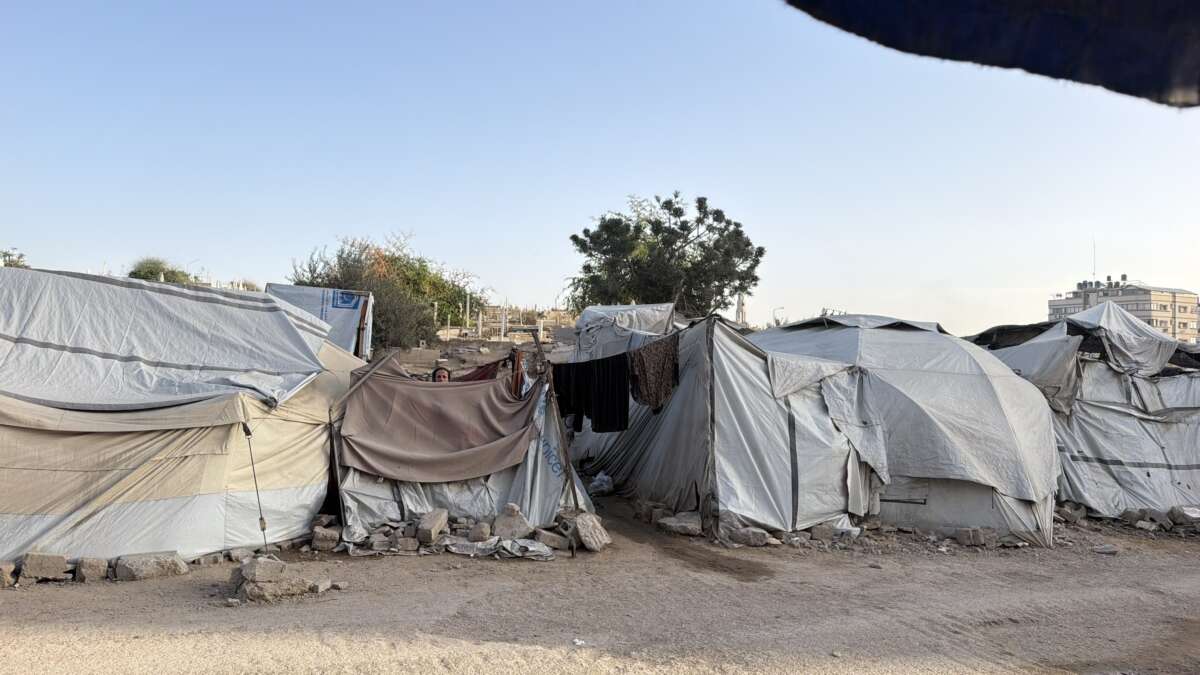
Reflecting on how life has completely collapsed, Kamila recalls when 10 shekels could sustain a person for a whole day in Gaza. Today, “even the 10 shekels have vanished from our lives.” When the suffocation of displacement peaks, she said, “I envy the dead. At least they died and found rest.”
When Basma Hammouda, 29, and her husband first arrived at the cemetery in October 2025, it looked nothing like it does today: “It was a mountain of rubble,” she said.
Her husband dug a massive pit and buried the debris just to level the ground enough to pitch their tent. “I had no other choice,” he said. “There is no space left for us in Gaza except this cemetery. We live beside the dead; they are the ones who went before us, and we are the ones to follow.”
Hammouda is in her final month of pregnancy, expecting to give birth very soon. “I don’t know how I’m going to protect my baby in this tent,” she said, anxiety etched across her face. “I haven’t been able to buy him any clothes to protect him from the cold, and we don’t have winter blankets.”
“There is no space left for us in Gaza except this cemetery. We live beside the dead; they are the ones who went before us, and we are the ones to follow.”
This will be her third child. One of her children is in kindergarten, her other child is almost 3 years old, and her husband is unemployed. Their toilet is nothing more than a crude plastic hole in the ground. Hammouda describes what she is enduring as severe prenatal depression. On the day of my visit, her sister brought her a kilogram of flour.
“I don’t want to complain, because complaining to anyone but Allah is a humiliation,” her husband said. “But these are the raw details of our lives.”
Animals walk freely into the tent because there is no door. Just the night before, he woke up to a stray dog standing right at the entrance. “Dogs have turned predatory after the war,” he said. “What would that dog have done if I hadn’t woken up?”
Staring blankly into the distance, Hammouda adds, “The cemetery constantly reminds me of my family. My entire family was killed in the war, except for me and my sisters. I just keep crying for the dead and praying for them. If my parents were still alive, they would have never let me live beside graves. But who is going to help me now that I’m an orphan?”
She mentions that her young son dreams of simply eating chicken and that they are waiting to sell their single cooking gas canister just to buy food. “Nobody feels our pain,” Hammouda said. “All I wish for, before I give birth, is for someone to at least buy me a proper tent.”
As I left the tents behind, I couldn’t shake the image of Nariman eating among the gravestones. I used to pass by this cemetery, feeling a quiet sorrow from afar for the tents scattered across it, but I never truly knew what lay within.
In Gaza, people used to say that the grave is one’s final home. But in Sheikh Radwan, the grave has become an immediate neighbor. People who lost their homes, their families, and their sense of safety have found themselves forced to live beside the dead, simply because the land of the living had no space left for them.
In Gaza, people used to say that the grave is one’s final home. But in Sheikh Radwan, the grave has become an immediate neighbor.
Hammouda’s third child will arrive in this world inside a tent surrounded by tombstones. All his mother asked of the world was for someone to buy her a proper tent before her delivery. How has the basic “right to a tent” become the absolute ceiling of human ambition in Gaza in the 21st century?
Don’t the living have the right to exist above ground with both body and soul, rather than being reduced to suffering bodies above the earth while their spirits already dwell among the graves? Who will relieve the people of Gaza from this ongoing tragedy?
The question remains open. But as long as the tents of the living stand pitched beside the dead, it is a question addressed to the entire world, not to Gaza alone.
An important fundraising appeal: 5 Days to raise $39,000
Donations are down for Truthout at a time when media is under immense pressure. Google’s AI search has driven our traffic down by 15 percent, Trump is arresting journalists, and many independent media organizations face heartbreaking cutbacks and closures.
At the same time, movement media is vital in the fight against Trump’s authoritarian reign. Our mandate to tell the truth, share strategies for resistance, and speak against fascism is ever more urgent in this deluge of political censorship and misinformation. Yet, we are struggling to meet our publishing costs when our work is so urgently needed.
We are fundraising right now for those basic operating expenses — we need $39,000 in the next 5 days. If you can support Truthout with a one-time or monthly donation, you will make a significant impact on our work. Anything you can do makes a difference.


+ There are no comments
Add yours