




Part of the Series
The War That Was Never Meant to End: 25 Years of the War on Terror
Honest, paywall-free news is rare. Please support our boldly independent journalism with a donation of any size.
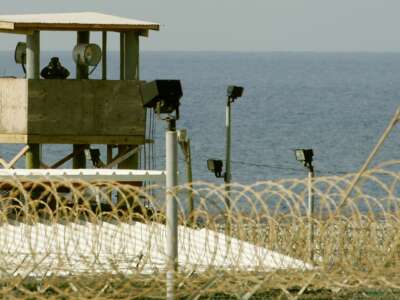
Guantánamo Bay has repeatedly made headlines in recent months. In August, the Trump administration sent 12 Somali men to the remote prison, several of them from Minnesota, where the community has faced relentless harassment. Some of the men have since been deported to Somalia, while others remain in detention.
Dr. Maha Hilal, a scholar of institutionalized Islamophobia and the “war on terror,” told Truthout that the recent transfers have brought “renewed attention to Guantánamo and the prison as a site of carceral violence.” But, she added, “this isn’t the first time migrants have been held at Guantánamo. There’s a historical component.”
Guantánamo’s Long History of Migrant Detention
Guantánamo’s use for migrant detention predates its role in the war on terror. Following Haiti’s 1991 coup, the U.S. detained thousands of Haitian asylum seekers intercepted at sea. In the mid- to late-1990s, tens of thousands of people fleeing Cuba on makeshift rafts were also detained there. The offshore location allowed the government to circumvent its humanitarian and legal protections to asylum seekers.
The Guantánamo Migrant Operations Center, operated by the Department of Homeland Security (DHS) and Department of State with support from private contractors, has continued to detain migrants intercepted at sea. During Donald Trump’s first term, DHS proposed housing migrant children at the base as a solution to overcrowded immigration jails on the U.S. mainland. At the start of his second term, Trump signed an executive order directing the expansion of the Migrant Operations Center to hold up to 30,000 “high-priority criminal aliens.” For the first time, immigrants arrested within the United States were being transferred to Guantánamo for detention.
An August 2026 congressional oversight visit found that 852 immigrants had been flown to the facility since January 2025. Sen. Dick Durbin of Illinois condemned the administration’s policy as “cruel, immoral, and an abuse of taxpayer funding.”
Although Guantánamo’s newest arrivals are being held under a different legal pretext than their predecessors, the instrumentalization of national security and racialized suspicion remains unchanged.
Guantánamo Bay and the War on Terror
Two months after the September 11 attacks, President George W. Bush issued a military order authorizing the detention and military trial of certain noncitizens suspected of terrorism. The first 20 detainees arrived at Guantánamo Bay on January 11, 2002, as “unlawful enemy combatants,” a label that limited their ability to challenge their detention and placed them beyond the reach of habeas corpus protections. The Bush administration capitalized on the fear and national trauma that followed 9/11 to not only suspend the rule of law, but to create a geographic and legal space that existed entirely outside of it.
“Guantánamo’s significance is not in its size or scope, but in what it represents — the right to place people outside of the law.”
Since opening, Guantánamo has held approximately 780 Muslim men and boys, the youngest of whom, Omar Khadr, was just 15 years old at the time of his detention. The vast majority of the prison’s detainees have never been charged with a crime. Many were kidnapped and captured abroad, transferred from CIA black sites, or sold to U.S. forces by bounty hunters for sums ranging from $3,000 to $25,000.
In the context of the U.S. prison system where a staggering 2 million people are incarcerated, 780 men seems like a relatively small number, but as Hilal argues, “Guantánamo’s significance is not in its size or scope, but in what it represents — the right to place people outside of the law. In that sense, it’s a problem of great magnitude.”
Guantánamo Bay quickly became synonymous with human rights abuses during the Bush administration. The Department of Justice authorized the use of “enhanced interrogation techniques,” a euphemism that described practices like waterboarding, sleep deprivation, and prolonged isolation, despite longstanding prohibitions against torture under international law.
In 2006, a UN report found that the United States had violated its international human rights obligations, and called for Guantánamo’s closure and the trial or release of detainees. In December 2008, the Senate Armed Services Committee concluded an 18-month investigation into the abuse of detainees in military custody. The committee’s final report refuted the Bush administration’s claim that the abuse was the result of a “few bad apples.” Following the report’s release, Sen. Carl Levin released a statement: “How did it come about that American military personnel stripped detainees naked, put them in stress positions, used dogs to scare them, put leashes around their necks to humiliate them, hooded them, deprived them of sleep, and blasted music at them?”
The answer was damning: what had been allowed to happen at Guantánamo directly influenced the abusive treatment of prisoners in Iraq and Afghanistan. In February 2003, a U.S. military task force preparing for the invasion of Iraq adopted an interrogation policy previously developed in Afghanistan, changing little more than the letterhead. In July, an interrogation officer at Abu Ghraib submitted a nearly identical policy for approval. Just over a year later, photographs exposing the physical torture, psychological humiliation, and sexual abuse of detainees at Abu Ghraib sparked international outrage. But Abu Ghraib was not an aberration. The Department of Defense’s failure to hold senior officials accountable for their role in authorizing torture at Guantánamo had institutionalized a system of brutality and a culture of impunity.
The Long Struggle to Close the Prison
Guantánamo was meant to be a temporary solution to what the Bush administration deemed an extraordinary threat. Instead, it became one of the most enduring legacies of the war on terror.
Barack Obama campaigned on closing the prison in 2008. Two days after taking office, he signed an executive order directing its closure within a year. The order was met with fierce opposition in Congress. By the end of his presidency, he reduced Guantánamo’s prison population from 242 to 41, but failed to deliver on his campaign promise.
The struggle to close Guantánamo has not been confined to courtrooms, campaign trails, and congressional hearings. It has been sustained by movements in Cuba, the U.S., and within the prison itself.
In 2018, Donald Trump revoked Obama’s order and reaffirmed the government’s authority to detain future “enemy combatants” at the facility. Joe Biden also campaigned on closing the prison. In 2021, seven former detainees who had been held without charge or trial made a personal appeal to the president: “Many of us were abducted from our homes, in front of our families … Some of us had children who were born in our absence and grew up without fathers … waiting in vain for news of our return.”
At the end of Biden’s presidency, he had only managed to secure the transfer of 11 Yemeni detainees to Oman, reducing the number of prisoners at Guantánamo to 15. These 15 men remain imprisoned: three have been approved for transfer, and three others have been dubbed “forever prisoners” — men who are allegedly too dangerous to be released but have not been brought to trial. Human rights groups criticized the Obama and Biden administrations, arguing that the failure to close the prison was not due to a lack of political power, but a lack of political will.
The struggle to close Guantánamo has not been confined to courtrooms, campaign trails, and congressional hearings. It has been sustained by movements in Cuba, the U.S., and within the prison itself. Those imprisoned there have routinely resisted their indefinite detention and the physical and psychological abuse that they endure.
Since its opening, hunger strikes have been a regular occurrence within the prison, happening on a large-scale and coordinated level. Tariq Ba Odah of Yemen undertook the longest hunger strike in Guantánamo’s history, lasting for eight years. In retaliation, he was force-fed twice a day, a practice condemned by medical professionals and human rights groups. Upon his release to Saudi Arabia in 2016, he weighed 75 pounds.
In Cuba, opposition to the prison is inseparable from the broader struggle for national sovereignty and an end to the U.S. occupation. Following the Spanish-American War, the Platt Amendment imposed conditions on Cuban independence, granting the United States the right to intervene in national affairs and lease naval bases on the island. Although the amendment was repealed in 1934, the lease on Guantánamo Bay remains in place despite the Cuban government’s demands for the territory’s return.
In February 2025, the Cuban Institute of Friendship with the Peoples condemned Trump’s plan to send immigrants to Guantánamo, calling it “a flagrant violation of human rights and an affront to human dignity.” Thousands of people also rallied in Guantánamo City to oppose both Trump’s plan and the U.S military presence on the island.
Onyesonwu Chatoyer, an organizer with the Venceremos Brigade and the National Network on Cuba, told Truthout that the impact of the U.S. military base on the residents of Guantánamo Province is often overlooked by those who don’t live on the island. The naval base has economic and environmental consequences for the communities who live there under a “high degree of surveillance.”
“The base blocks fishermen from accessing marine resources. It causes pollution. It’s a drain on the countryside,” Chatoyer said.
She invites people to visit the island so that they can see the truth for themselves: “The U.S. is constantly accusing Cuba of being a dictatorship, of persecuting its own people, and yet they are the ones torturing people and holding them indefinitely without charge on illegally occupied Cuban land.”
In Cuba, opposition to the prison is inseparable from the broader struggle for national sovereignty and an end to the U.S. occupation.
From the Mirador de Malones observation point, Chatoyer says visitors can see the “full scale of the occupation.” Through a telescope “cookie-cutter suburban houses” come into view and form a dystopian picture, replete with white picket fences, American flags, and the only McDonald’s on the island.
“It’s a scar on the land,” Chatoyer said.
For Chatoyer, the prison is emblematic of the new world order imposed across much of the Global South: “The places that are under the boot of U.S. imperialism are building massive mega-prisons, are massacring land defenders and poor working-class people, are building huge police forces, and are going all-in on AI for military technology.”
The stakes of the struggle to end the occupation and uphold national sovereignty are clear: “Guantánamo is the vision of the world that these people want,” she said.
As Above, So Below
Dr. Hilal has long warned that the government’s expansive and malleable definition of terrorism would eventually extend beyond its original targets. Guantánamo can no longer be seen as an anomaly, but as a model for U.S. detention at home and abroad.
“The construction of parts of Guantánamo was modeled after a supermax prison in the United States,” Hilal told Truthout. Federal communication management units (or CMUs) are restrictive prison units established in the post-9/11 counterterrorism era that isolate certain prisoners deemed “high-risk” and restrict their communications. CMUs are often referred to as “Little Gitmo” or “Guantánamo North” by those detained there and their advocates. While these units have disproportionately been used to hold Muslim prisoners, they have increasingly held people with “unpopular” political views, including environmental and animal rights activists.
As the boundaries between military and civilian systems of control grow increasingly porous, portraying entire populations as threats to national security has helped normalize state violence and shield it from accountability. A war without clear geographic limits or defined rules of engagement blurs the line between combatant and civilian, extending the battlefield into everyday life.
When Hilal first saw images of Venezuelan men being sent to Guantánamo, she was struck by their resemblance to photographs of Muslim detainees taken by the Department of Defense two decades earlier: “They look exactly the same. The same posture. The same forms of control,” she said.
The resemblance underscores Guantánamo’s enduring symbolic power and the ease with which its logic can be imposed on new targets. “The government can convince us that we are dealing with a different manifestation of the same threat. And that threat must be dealt with in the exact same way,” Hilal told Truthout.
Although several of the Somali men recently sent to Guantánamo had no criminal records, a DHS spokesperson described them as the “worst of the worst.” The phrase echoes former Vice President Dick Cheney’s description of the prison’s first detainees as “the worst of a very bad lot.” While previous presidents may have reduced the prison’s population, they did little to dismantle the legal and political architecture that sustained it. Arguably, their failure to take meaningful action to close Guantánamo facilitated the Trump administration’s ability to expand its use to detain immigrants. Across five administrations, Guantánamo’s legacy, and the narratives that fuel it, have only become more deeply entrenched.
Whether in the war on terror or Trump’s war on immigrants, what was sold to the American public as an exception has become the rule. The detention of immigrants at Guantánamo is the latest chapter in a familiar playbook. Dehumanize, detain, disappear. All that has changed is the enemy du jour.
An important fundraising appeal: 5 Days to raise $39,000
Donations are down for Truthout at a time when media is under immense pressure. Google’s AI search has driven our traffic down by 15 percent, Trump is arresting journalists, and many independent media organizations face heartbreaking cutbacks and closures.
At the same time, movement media is vital in the fight against Trump’s authoritarian reign. Our mandate to tell the truth, share strategies for resistance, and speak against fascism is ever more urgent in this deluge of political censorship and misinformation. Yet, we are struggling to meet our publishing costs when our work is so urgently needed.
We are fundraising right now for those basic operating expenses — we need $39,000 in the next 5 days. If you can support Truthout with a one-time or monthly donation, you will make a significant impact on our work. Anything you can do makes a difference.





+ There are no comments
Add yours