







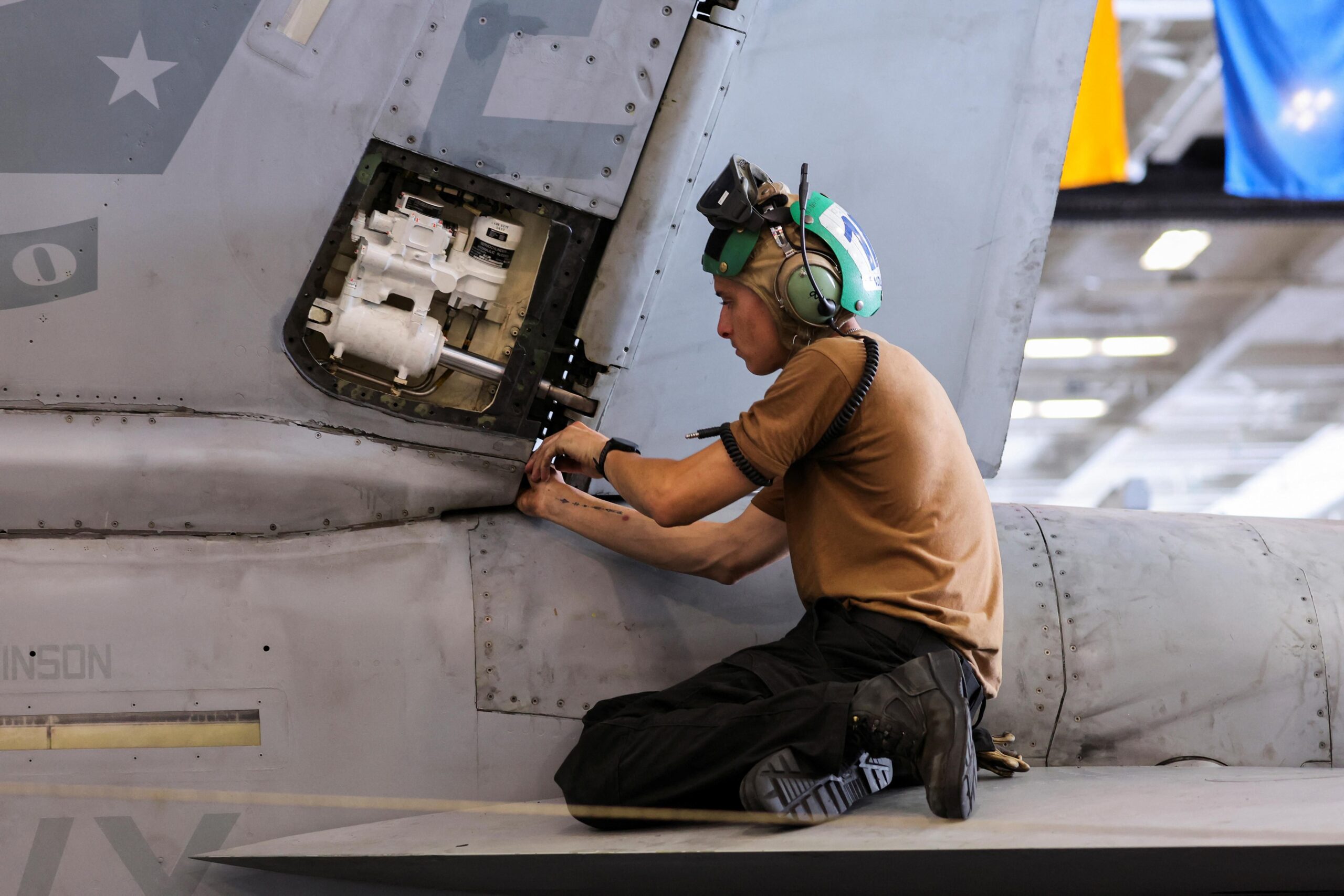
Because defense contracts often prevent the military from repairing its own equipment, critics say weapons companies are price-gouging the Pentagon at every turn.
As experts and observers tell RS, the military’s lack of a “right to repair” doesn’t just allow defense contractors to charge thousands of dollars, for fixes that could be done for free or very cheaply. Rather, the Pentagon’s dependence on weapons makers for maintenance undermines military readiness. Namely, contractors’ extensive repair delays and sweeping decisions about whether to service gear routinely leave warfighters without critical equipment and weapons systems — even while deployed.
Defense contractors rake in the dough
Until the early 1990s, the Pentagon often purchased complete technical data packages for its equipment, allowing the military to handle its repairs as needed. But, as the number of major weapons contractors shrank during that time from dozens to just five major defense “primes,” the Department of Defense ultimately ceded some leverage over the issue.
Consequently, many DoD contracts now leave repair and maintenance, which can make up as much as 70% of a military program’s lifetime cost, to the vendors.
“It’s a cash-cow for them,” Ben Freeman, director of the Quincy Institute’s Democratizing Foreign Policy Program, tells RS. “They can charge literally thousands of dollars to replace things that service members could replace for pennies.”
Take the RQ-11 Raven drone, for example. After hard landings, it often has trouble starting back up again. But due to contractual restrictions, the military is barred from making repairs and must ship the drone to the contractor at a cost of $26,000, regardless of the issue. When an extensive repair backlog meant service members were temporarily allowed to fix the drone themselves, however, they found they could solve the problem — a broken connector — for free with hot glue.
Sikorsky’s Black Hawk helicopter screen control knobs are also prone to breakage. Due to vendor repair restrictions, however, the military cannot fix the knobs. It instead must buy the knob from Sikorsky, which only sells it as part of an entire screen display assembly for the helicopter, for $47,000. The knob itself could be manufactured for about $15.
Even repair and maintenance instructions are a chance for profit. Lockheed Martin has charged $900 per page for biannually updated maintenance manuals for the AC-130J Ghostrider program. And in 2020, the U.S. paid Boeing $84 million for Air Force One flight and maintenance manuals.
Trade secrets at risk?
Weapons contractors say that giving the DoD the information it needs for its own repairs may compromise their private intellectual property (IP) and trade secrets. But Freeman says that argument is “usually a load of crap.”
“A lot of what we’re talking about with right-to-repair, is stuff that service members already know how to do – there’s no secret,” Freeman told RS in a written statement. “The only mystery is why they’re not allowed to fix their own equipment.”
What’s not a mystery is that contractors have pushed back fiercely against legislative reform.
In a bipartisan effort, Sens. Elizabeth Warren (D-Mass.) and Tim Sheehy (R-Mont.) introduced the Warrior Right to Repair Act last year — which would have made contractors hand over the technical data and other materials necessary for troops to fix their own gear. But weapons contractors successfully lobbied to remove it from the National Defense Authorization Act (NDAA) for FY2026.
“The truth is, the manufacturer has very little incentive to solve problems like this,” Nathan Proctor, a senior director at the Public Interest Research Group’s Right to Repair campaign, said at a recent virtual briefing on military right-to-repair. Contractors have “got quite a racket going on.”
Saving money
Renewing their push for the Warrior Right to Repair Act this year, Sens. Warren and Sheehy contend that a military right to repair will save the Pentagon, and taxpayers, billions of dollars.
Recent examples of the military making its own parts and repairs support their argument. Now that the Marines can 3D print a communications antenna it needs, for example, its cost has dropped from $5600 to just $10 each. And the Marines can make the antenna immediately, rather than wait the 220 days the vendor typically takes to provide one.
At the Association of the United States Army (AUSA) Annual Meeting & Exposition last year, Army Secretary Dan Driscoll likewise explained that his team was able to 3D print a Black Hawk fuel tank prototype, which the vendor charges $14,000 to replace, for only $3,000.
As Driscoll told War on the Rocks last year: “We’ve given away our right to repair our own equipment some of the time, which [means] we will have exquisite pieces of equipment sitting on the sidelines for 8 to 12 months, when we know how to 3D print [them much more cheaply]. That is a sin, and we’ve done it to ourselves.”
Risks to military readiness
Beyond weapons contractor profiteering, the DoD’s lack of right-to-repair threatens military readiness.
Relying on vendors for repairs can often lead to equipment delays. For example, T-38 Talon engine repair delays in 2023 postponed Air Force pilot trainings, often by six months or more.
Meanwhile, the F-35 fighter jet program repair backlog has grown so large — sometimes exceeding 10,000 parts — that the DoD has sometimes resorted to buying new parts from the contractor, rather than waiting for the planes to get fixed.
The problem has also left armed service members without critical equipment while deployed.
In 2019, former Marine logistics officer Elle Ekman wrote in The New York Times that Marines in Japan waited months for engine repairs because the engines had to be shipped back to the U.S. for repairs.
Retired U.S. Army Master Sergeant Wesley Reid told RS that a vendor stopping him from repairing a military CT scanner while deployed in Afghanistan, had “significant impacts [on service members’] patient care, and…on the commander’s ability on the battlefield.”
During his deployment, Reid lost access to key diagnostic capabilities when the scanner’s microcontroller deactivated. The microcontroller’s one-year operational period, as per an agreement between the military and the vendor, Philips, had expired.
But when Reid, who was trained to service the scanner, asked about getting a new microcontroller, Philips refused to send one. Philips insisted the scanner was too old and had to be replaced, despite how arduous doing that would be in a combat zone.
Reid was still able to perform some diagnostic scans on wounded soldiers with the scanner, though it was much harder without the microcontroller. But “being told that [you’re] not able to work on something…that’s very disappointing, especially when you’re upholding your nation’s promise to the other soldiers and sailors and airmen,” he stressed.
From Your Site Articles
Related Articles Around the Web










+ There are no comments
Add yours