







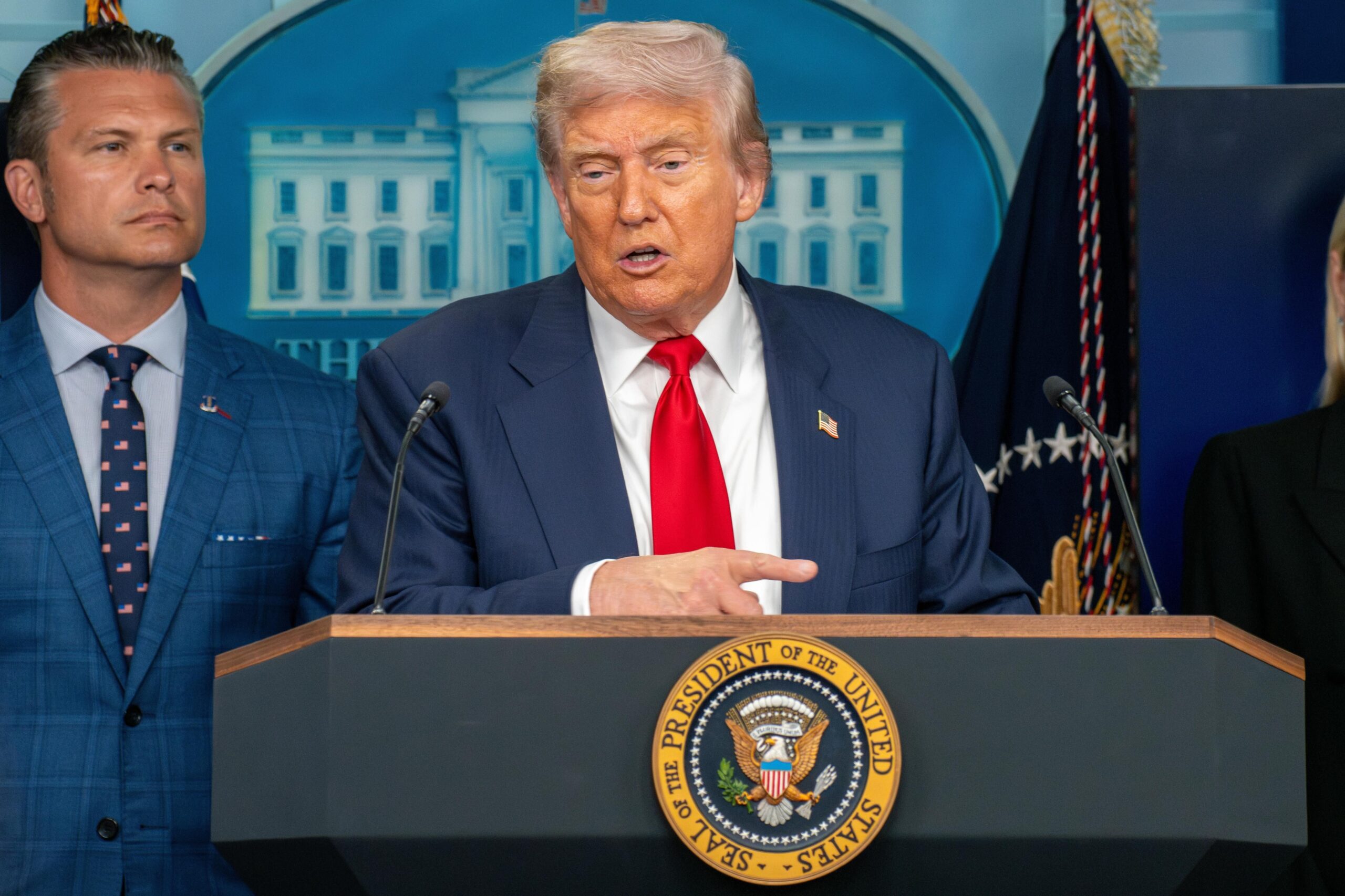
As President Donald Trump considers the path forward in Iran, Americans’ economic troubles are apparently not a concern. “I don’t think about Americans’ financial situation,” Trump said in response to a reporter’s question last week about efforts to end the conflict. “Not even a little bit.”
President Trump’s lack of concern will surprise many given an almost 50% rise in gas prices, rising grocery costs, job losses, and other economic pain since the start of the U.S.–Israeli war on Iran.
Rather than focusing on addressing Americans’ economic insecurity, Trump has shown repeatedly that he wants to focus the wealth and attention of the federal government on war and collaborating with Israel to prevent Iran from obtaining nuclear weapons, despite the fact that Iran has not sought to build a bomb since 2003, according to the U.S. intelligence community. In April, the president said at a private event that it’s “not possible” for the federal government to fund Medicare, Medicaid, and child care, saying states should “take care” of those costs. “We’re fighting wars,” he said.
Trump has indicated his intention to continue fighting wars with his proposal to fund the largest military budget in U.S. history: $1,500,000,000,000 ($1.5 trillion). This would send two-thirds of next year’s federal discretionary budget to what he calls the “Department of War” (which is actually more honest than the official name, the Department of Defense). $1.5 trillion would be around a 50% increase over this year’s military budget and higher in real terms than the largest military budgets during World War II.
Congress and the public must reject Trump’s $1.5 trillion proposal as the joke it is. They must also resist his plans to make a “supplemental” request for up to $200 billion more for the war in Iran, which is already as unpopular as U.S. conflicts in Iraq and Vietnam. Congress should be cutting the war budget by hundreds of billions of dollars rather than irresponsibly inflating it further.
Don’t fall for the ‘highball’
Troublingly, some in Congress may be taking the president’s proposal seriously. They shouldn’t. Trump’s proposal is a classic “highball” negotiating tactic: start with an extreme number to make a later, slightly smaller one seem reasonable.
The White House set up this tactic by splitting the request into two parts: a $1.15 trillion “base” budget, passed through regular congressional appropriations, and an additional $350 billion to be passed through a reconciliation bill requiring only Republican support. The aim is to make $1.15 trillion look “reasonable” compared to $1.5 trillion.
It isn’t.
Lawmakers supporting a $1.15 trillion war budget are effectively enabling the full $1.5 trillion since Republicans can pass the remaining funds on their own. (Some Republicans are expressing skepticism about passing another reconciliation package; however, few have bucked the president at critical moments.) Even if they fail, $1.15 trillion would represent a 28% increase on this year’s base budget, making it easier for Trump to continue his war in Iran, which has already cost tens of billions of dollars, and fight new wars in Cuba or Mexico.
Giving Trump even a nickel more would also mean backing a president who has launched illegal wars in Iran and Venezuela without congressional approval; bombed at least five other countries; committed and supported war crimes, according to human rights groups; and threatened war against Greenland, Panama, Colombia, Cuba, and Mexico, as well as the annihilation (nuclear or otherwise) of Iranian civilization.
Ignoring Americans’ daily struggles
At a time when Americans are struggling to afford daily life and may soon face a broader wave of inflation tied to the war, increasing Pentagon spending would divert money from urgent domestic needs. The roughly $500 billion Trump wants to add to the war budget could, for example, expand Medicare coverage to everyone regardless of age.
Any increase would also pour more money into a system with a long history of squandering hundreds of billions of taxpayer dollars through waste, fraud, and corporate profiteering. The only federal agency that’s never passed a financial audit is Trump’s “Department of War.”
The administration has offered little to explain the strategic need for such a large budget increase. In a recent hearing, Congress heard what Quincy Institute analyst Ben Freeman described as “a collage of unconvincing justifications ranging from military spending as a jobs program to amorphous threats that the U.S. needed to stay ahead of.”
Proponents of more war spending will claim it’s needed to “support the troops,” address “munitions” (read: weapons) shortages, or counter the “China threat.” Don’t fall for these arguments. Decades of skyrocketing Pentagon budgets have supported the profits of weapons makers far more than service members. Meanwhile, more spending has enabled wars of choice that put troops in harm’s way. Supporting the troops means stopping endless wars, not funding them.
There are fewer U.S. weapons — and fewer people alive — thanks to Trump’s reckless warmaking. To give him more weaponry would reward and encourage more reckless war and ever-escalating spending. Enough is enough. The Pentagon has plenty of money in its current budget to replace munitions by canceling tens of billions in unnecessary weapons contracts. Even without replacing any weapons, the U.S. military remains the world’s most powerful and more than capable of defending the country.
Claims about the “China threat” bogeyman should also be dismissed as obvious fearmongering to jack up military budgets. The U.S. should invest in diplomacy, not weapons, to resolve disputes in East Asia and globally.
Cut the Pentagon
Thankfully, there’s resistance to Trump’s proposal. Some Democrats oppose any increases and are demanding Pentagon budget cuts. Some Republicans have expressed concerns about increasing a national debt nearing $40 trillion. Nearly six in ten people nationwide think the $1.5 trillion request is “too high,” according to a new poll.
Still, there’s a danger lawmakers could join together to pass the $1.15 trillion base budget. Scores of Democrats shamefully supported Trump by backing this year’s $899 trillion Pentagon budget, which funded Trump’s illegal wars in Iran and Venezuela. Support for massive military spending has long been an area of bipartisan Congressional consensus thanks to the corrupting influence of the military-industrial complex that President Dwight Eisenhower warned about in 1961 (and that Trump himself promised to tame).
Democrats and Republicans must reject Trump’s $1.5 trillion highball tactic, which is a negotiating tool to boost spending and continue waging war. Accepting any increase risks locking in higher spending levels and prolonging unthinkably expensive and deadly endless conflicts.
Congress instead should follow growing calls to cut the Pentagon budget by hundreds of billions of dollars. This would still leave the country with the world’s largest military budget by far and allow Congress to reallocate the savings to programs, like food assistance, that actually improve people’s daily lives amid soaring gas and grocery prices.
Trump’s $1.5 trillion bid is a fateful moment: unless we act now, we will continue down the path of inflation, skyrocketing Pentagon spending, and endless wars. We must call on Congress to reject this blank check for war.
From Your Site Articles
Related Articles Around the Web









+ There are no comments
Add yours