







Truthout is an indispensable resource for activists, movement leaders and workers everywhere. Please make this work possible with a quick donation.
The Republicans’ harmful megabill was enacted on July 4, 2025. As the law’s one-year anniversary approaches, families across the U.S. are beginning to experience the harms many warned that the legislation would inflict.
Already, the law is raising costs for families and taking away health coverage, food assistance, and other essentials from people who are already struggling to afford to meet their basic needs — all while showering more tax breaks on the wealthiest households and funding a violent immigration detention and deportation agenda.
SNAP Tracker: People Are Losing Food Assistance as the Republican Megabill Is Implemented
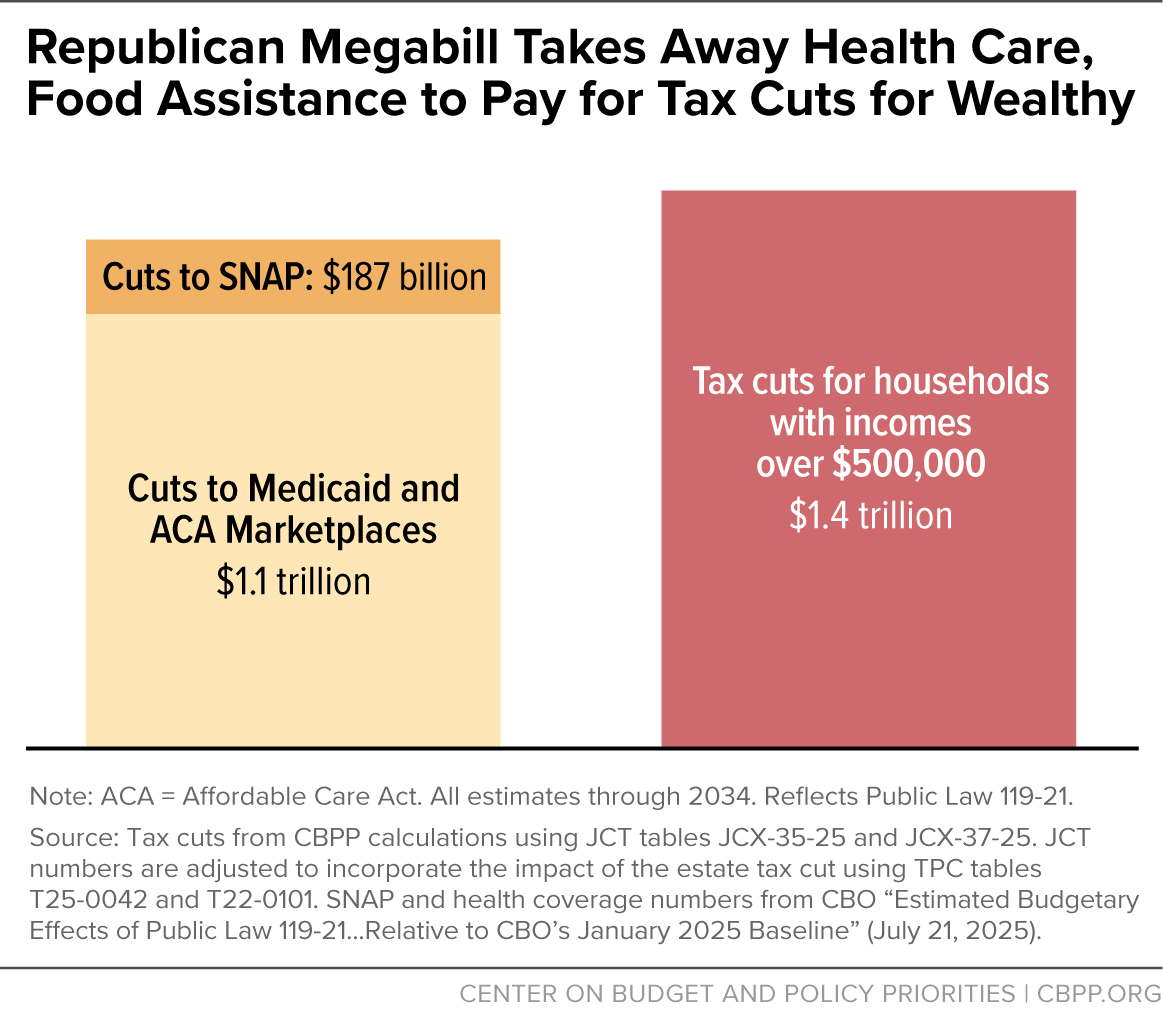
The law’s harm will only deepen as its more than $1 trillion in cuts for Medicaid and the Affordable Care Act (ACA) marketplaces fully take effect and states fully implement SNAP eligibility restrictions and take drastic measures ahead of the federal government’s significant shift of SNAP costs to states. As a result, tens of millions of people will be less able to meet the growing cost of their basic needs — whether it’s affording groceries, seeing a doctor, keeping the power on, or paying the rent.
While people from all races and ethnicities need assistance at various points during their lifetimes, the law’s cuts will expand the still-deep inequities long experienced by those who face the most economic discrimination and poverty, including Black, Latino, and Indigenous people and families with people who are immigrants.
We’ve published many analyses and graphics illustrating the law’s harm. Here are a few of the pieces detailing both the early impacts and those that are still forthcoming:
Taking Away Food Assistance
The Republican reconciliation law poses great harm to families, including higher food costs, poverty, and hunger. It makes deep cuts to federal funding for food assistance through SNAP, making a major structural change to the program by shifting significant new costs to states for the first time. It dramatically expands SNAP’s already harsh and ineffective provision taking away people’s benefits for not meeting a work requirement. And it ended eligibility for many people with a lawful immigration status.
Between the law’s July 2025 enactment and March 2026 (the last month with data on all states):
- SNAP participation is down by more than 4 million people, or 10 percent, in USDA data. (It’s down more than 4.7 million people, or 11 percent, over the past year.)
- SNAP participation has dropped in every state, including by 5 percent or more in 42 states, and by 10 percent or more in 21 states.
- In the 13 states with publicly available data, the number of children receiving SNAP has fallen by about 808,000.
States’ First-Ever Bill for SNAP Benefits Could Cost Billions
Based on new Department of Agriculture data, our estimates show that states may soon face a collective bill of roughly $9 billion, threatening benefits for millions of SNAP households, 79 percent of which include a child, a senior, or a person with a disability, who count on SNAP to help them meet their basic needs. Without immediate congressional action to delay this cost shift for all states, the unfolding emergency will only worsen as more people lose the SNAP benefits they need to afford groceries.
Congress Must Address SNAP Cost Shift Before Even More Low-Income Families Lose Food Assistance
Policymakers must urgently address this unfolding hunger crisis. At minimum, Congress should delay the law’s unprecedented cost shift to state budgets, which is already hurting struggling families and driving far deeper SNAP cuts than anticipated as states scramble to respond to this massive unfunded mandate.
Taking Away Health Coverage and Raising Costs
Over the last several decades, the U.S. made important, if insufficient, progress in expanding health coverage and affordable care. These improvements have been driven by expansions in coverage through Medicaid, the Children’s Health Insurance Program (CHIP), and the ACA marketplaces, culminating in a record low share of people who lacked health insurance in 2023. Unfortunately, rather than building on that progress, President Trump and the congressional Republican majority’s megabill provides large tax cuts for wealthy households while taking health coverage away from millions of people, taking us in the wrong direction.
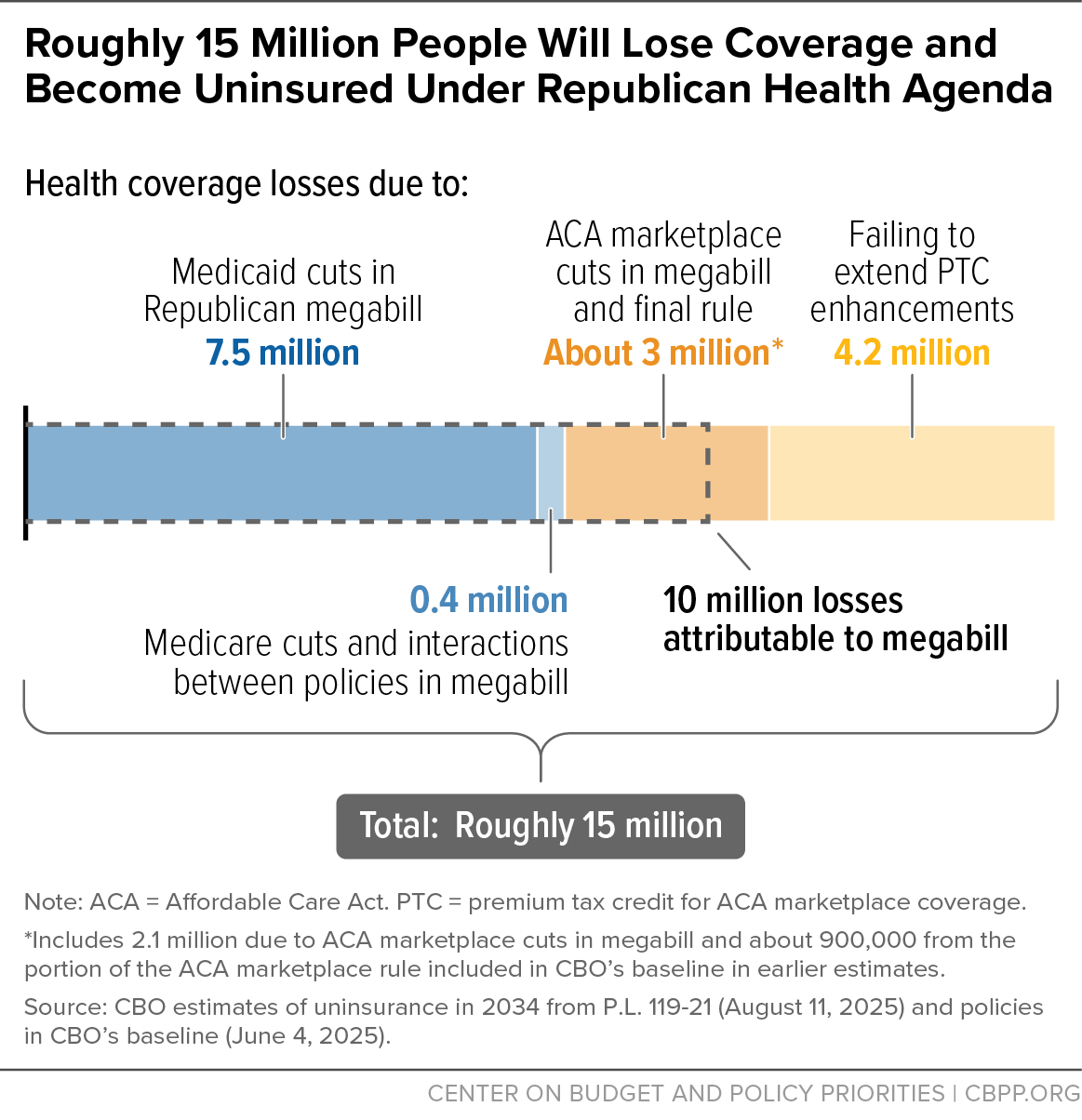
The harmful Republican megabill will take health coverage away from millions of people and dramatically raise health care costs for millions more.
The law cuts $1.1 trillion from Medicaid and ACA marketplaces, according to Congressional Budget Office (CBO) estimates. Major cuts include a provision that takes away Medicaid from people who are eligible for the ACA Medicaid expansion but can’t show that they meet a work requirement, other red tape that will block people from enrolling in health coverage they are eligible for, and provisions that take away health coverage, across all major programs, from most categories of immigrants living lawfully in the U.S.
Administration’s Last-Minute Restrictions Likely to Worsen Impact of Medicaid Work Requirement
The Trump Administration’s final rule implementing the new Medicaid work requirement makes major, last-minute policy shifts that will likely increase the number of people who are denied or lose health coverage due to the requirement, while stymieing states’ ability to implement it on time and in ways that ensure eligible people can enroll.
The work requirement as established by the 2025 reconciliation law will take away coverage from childless adults and some parents who can’t prove that they are participating in countable “community engagement” activities at least 80 hours per month (or have income equal to 80 hours times the federal minimum wage) or are exempt; up to 7 million people could lose coverage by 2028 due to the requirement, according to the Urban Institute. And it imposes a tight implementation timeline on states, which have been rushing to carry out complex changes by the January 2027 deadline.
Higher Marketplace Premiums Take a Toll on Enrollment and on Marketplace Enrollees
Congressional Republicans failed to extend premium tax credit enhancements at the end of 2025, and now the harm of higher marketplace premium costs is beginning to show up. Enrollment has plummeted, and many families are making tough tradeoffs to afford health care along with other basic needs.
Harming People Who Are Immigrants and Their Families
The harmful Republican megabill imposes massive cuts in food assistance, health coverage, and other supports for people with low incomes and singles out immigrants with lawful status and their families for particularly harsh restrictions on assistance. These measures partially pay for the bill’s trillions of dollars in tax cuts heavily weighted to the wealthy, as well as its more than $170 billion super fueling funding for the Administration’s overbroad detention and removal apparatus that is separating families and violating the legal and constitutional rights of many immigrants and others who get swept up by this dragnet.
Raising Energy Costs
The megabill cuts more than $300 billion from energy investments, which will raise energy costs for households and businesses at a time when energy demand is projected to grow. One study estimates that households will face a 13 percent increase ($280 per year) in their energy bills by 2035 as a result of these cuts.
Pushing Pain to States
Sound State Revenue Choices Essential to Counteract Harmful Policies and Build Forward
State and local policymakers nationwide are facing a one-two punch. For one, last summer’s harmful Republican megabill paired enormous tax breaks for wealthy households and corporations with historically deep cuts that will take away people’s vital health care and food assistance, all while foisting considerable new costs and responsibilities onto states and localities. The resulting damage to people and communities is expected to be significant. And it comes at a time when many states are also facing intensifying budget pressures from the second threat: their own recent policy choices, like widespread income tax cuts, costly private school voucher programs, and a growing trend of property tax cuts and caps.
This combination of significant new costs and existing fiscal strain could worsen over coming years as state and federal policies continue to phase in. States are required by law to balance their budgets, so unless they respond with policies that protect and raise revenue, states and localities will have little choice but to enact steep cuts not just to health care and food assistance, but also to a broad set of public services including education, housing, child care, and infrastructure.
Showering Wealthy Households and Profitable Corporations With More Tax Cuts
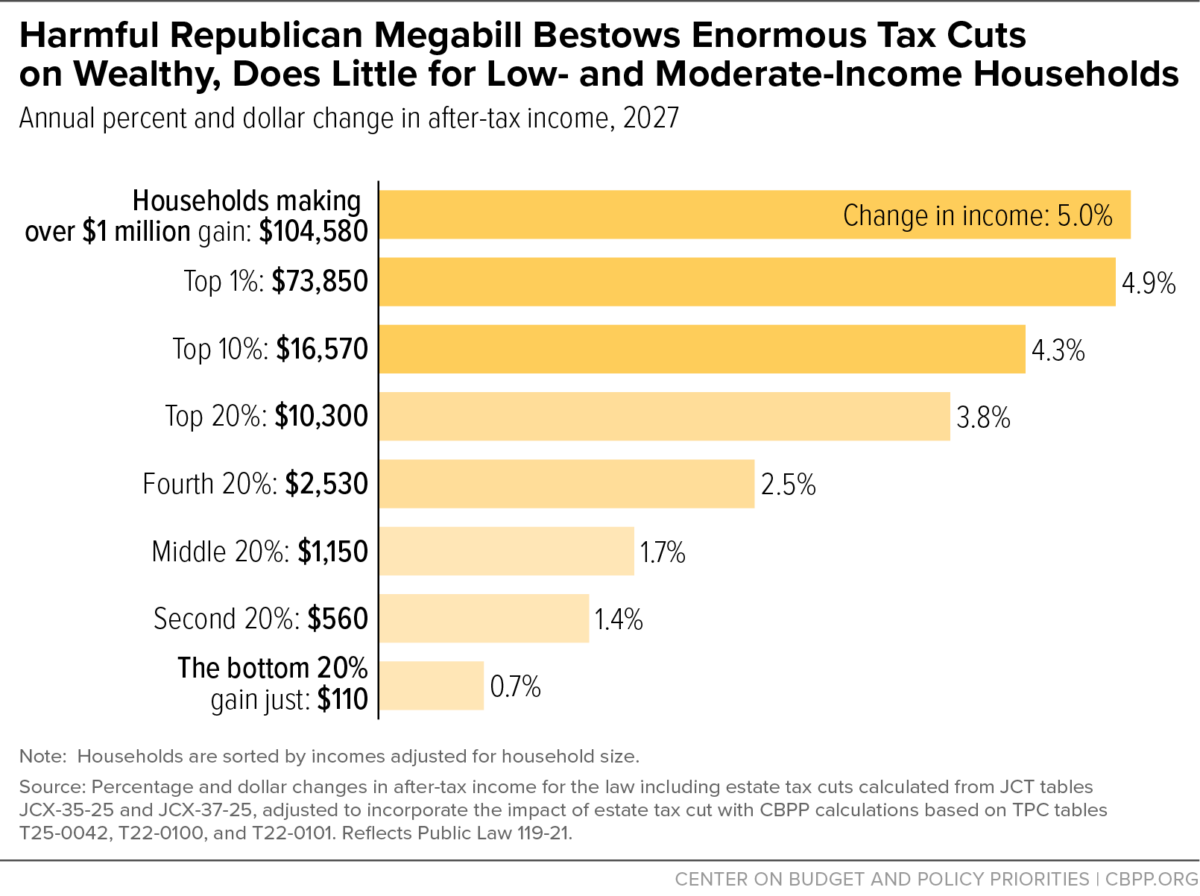
The tax provisions of the Republican megabill double down on the failures of the 2017 tax law, which was skewed in favor of the richest people in the country, was expensive and eroded the nation’s revenue base, and didn’t produce the promised economic gains for working people. Instead of changing course and prioritizing people with low and moderate incomes as Republicans’ campaign rhetoric about supporting hard-pressed working families suggested, the new law again gives enormous, permanent tax cuts to wealthy households while failing to deliver for individuals and families with low and middle incomes, many of whom will be hurt by the law’s cuts to health care and food assistance.
The combined impact of the megabill and the Trump Administration’s sweeping and regressive tariffs will leave households with incomes in the bottom 70 percent worse off. The end result will be increased income inequality and economic hardship.
Policymakers can and should change course to stop this law from making it even harder for families to afford the basics.
For more of our analyses, see our resources page.
Media that fights fascism
Truthout is funded almost entirely by readers — that’s why we can speak truth to power and cut against the mainstream narrative. But independent journalists at Truthout face mounting political repression under Trump.
We rely on your support to survive McCarthyist censorship. Please make a tax-deductible one-time or monthly donation.











+ There are no comments
Add yours