






Part of the Series
Struggle and Solidarity: Writing Toward Palestinian Liberation
Truthout is an indispensable resource for activists, movement leaders and workers everywhere. Please make this work possible with a quick donation.
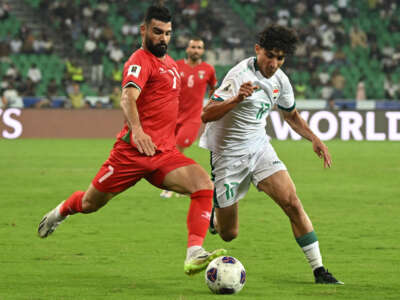
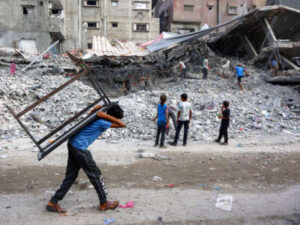
As the 2026 FIFA World Cup kicks off across North America, millions of soccer fans around the world are gathering in stadiums, homes, and cafés to watch the tournament. In Gaza, however, where war and its aftermath continue to shape daily life, the World Cup feels distant for many residents. Some are unable to watch matches due to electricity and internet outages, while others have lost the ability to play the game they once loved because of war-related injuries.
Among them is 19-year-old Mohammed Khaled Afana from Jabalia in northern Gaza. Before the war, he was a soccer (“football”) player for Khadamat Jabalia Club and spent much of his time training and following local and international matches.
On July 20, 2025, Afana suffered a life-changing injury while attempting to obtain flour from an aid distribution point in the Netzarim area. According to his account, he was shot by a quadcopter drone, leaving him with partial paralysis and severe spinal cord damage. The injury abruptly ended his soccer career and transformed every aspect of his life.
“My greatest dream was to become a professional football player,” Afana said. “My entire life revolved around football. It was more than just a game to me. Football was my life.”
Before his injury, Afana spent long hours training with his club and dreamed of one day representing Palestine in international competitions. He still remembers hearing the cheers of supporters during local matches.
“When I heard the fans chanting from the stands, it gave me energy and motivation to perform my best on the field,” he said.
Before the outbreak of war in October 2023, soccer was one of Gaza’s most popular activities. Local league matches regularly attracted large crowds, and residents eagerly anticipated major international tournaments, especially the FIFA World Cup.
Mohammed Siam, media officer for the Palestinian Football Association in Gaza, said approximately 3,300 players were officially registered with the association before the war.
He added that more than 500 soccer matches were held annually during each sporting season across Gaza’s major stadiums, drawing hundreds of spectators who filled the stands to support their favorite clubs and players.
“The stadiums were packed with fans,” Siam said. “Football provided an important space for recreation, competition, and community life in Gaza.”
During previous World Cups, cafés throughout Gaza became gathering places where soccer fans watched matches together and discussed the results late into the night.
Afana remembers those days vividly.
“I used to watch World Cup matches in cafés with my friends and made sure I didn’t miss a single game,” he said. “I supported Argentina. When they won, I felt incredibly happy. When they lost, I was deeply disappointed.”
The impact of the war has extended beyond injured players. It has also affected ordinary fans who once looked forward to the tournament every four years.
Majd Al-Muqayyad, a Gaza resident and soccer enthusiast, said he used to spend much of the World Cup watching matches with friends or in local cafés.
“We used to wait for the World Cup with great excitement,” he said. “The matches brought us together for hours. Today, everything has changed.”
He explained that following the tournament has become increasingly difficult amid Gaza’s current conditions.
“I spend most of my day trying to secure basic necessities for my family,” he said. “Searching for food, water, and cooking supplies takes so much time and energy that watching football is no longer a priority.”
He added that frequent electricity and internet outages often make it impossible to watch matches or even follow the results in real time.
According to Siam, the war has fundamentally changed the priorities of both players and fans.
“Before the war, players focused on training, matches, and improving their performance … Today, many of them are focused on finding food, water, and meeting their families’ basic needs.”
“Before the war, players focused on training, matches, and improving their performance,” he said. “Today, many of them are focused on finding food, water, and meeting their families’ basic needs.”
He noted that many soccer players now live in tents or displacement shelters under difficult humanitarian conditions.
“Many players who once spent hours on football fields now spend their days searching for water, aid, or necessities for their children,” Siam said. “For them, survival has become more important than sport.”
Meanwhile, Afana, who once dreamed of wearing the jersey of a major international club, now follows World Cup news only occasionally whenever he can access the internet. Electricity shortages and unstable communications prevent him from watching matches regularly.
“After my injury, I could no longer go to cafés or gather with friends to watch football,” he said. “There is also no reliable electricity or internet where I am currently displaced.”
The injury has not only changed Afana’s relationship with soccer but has also transformed his dreams.
“Instead of dreaming about playing for major clubs and representing Palestine, my dream now is simply to stand on my feet again,” he said.
Mohammed Afana’s father, Khaled Afana, recalls how his son dedicated most of his time to soccer before the injury.
“He dreamed of becoming a well-known player and representing Palestine,” Khaled Afana said. “I always encouraged him and supported his passion for the sport.”
According to his father, Mohammed Afana also played a vital role in helping the family survive during the war. He helped collect water, secure food, gather firewood, and light fires for cooking.
“Mohammed is my only son, and I depended on him for many things,” Khaled Afana said. “Since his injury, the burden has fallen entirely on me. I am now responsible for everything, including helping him eat and move around.”
During his interview with me, Khaled Afana struggled to hold back tears as he spoke about his son’s future. He appealed to international organizations and health authorities to help facilitate his son’s travel abroad for medical treatment.
“I appeal to international institutions and health organizations to help him receive treatment outside Gaza so that he may have a chance to walk again,” he said.
While thousands of soccer fans are traveling to the United States, Canada, and Mexico to attend World Cup matches in person, Mohammed Afana spends his days lying on a mattress in his place of displacement, following tournament news whenever circumstances allow.
As soccer supporters around the world celebrate goals, victories, and unforgettable moments, many people in Gaza remain disconnected from the tournament — not only because of power and internet outages, but because securing food, water, and shelter has become a daily struggle.
For Afana, the World Cup is no longer an opportunity to watch football stars or dream about his future in the sport. Instead, it serves as a reminder of the life he once had and of a new dream that has replaced all others: standing on his feet once again.
An important fundraising appeal: 5 Days to raise $38,000
Truthout is one of only a few platforms for justice-oriented, grassroots journalism. Today, as political censorship from the right intensifies, we have no choice but to ask for your help.
We are fundraising right now to cover our basic operating expenses. If you can support Truthout with a one-time or monthly donation, you will make a significant impact on our work. Anything you can do makes a difference — we appreciate your support.





+ There are no comments
Add yours