







Truthout is an indispensable resource for activists, movement leaders and workers everywhere. Please make this work possible with a quick donation.
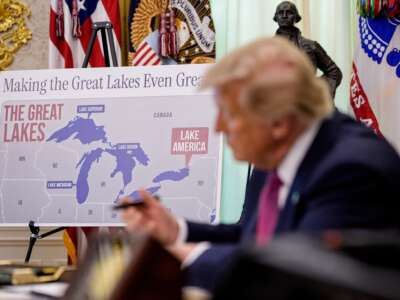
As trade war escalates between the U.S. and Canada, Donald Trump spent the Labor Day weekend sharing generative AI images of him as a hockey player beating up Canadian Prime Minister Mark Carney. Carney took a more serious tone, releasing a 15-minute video (20 minutes in French) on Tuesday morning speaking directly to Canadians. In it, he said that by standing up to Trump’s belligerence, he is protecting Canadians and our interests.
Carney’s video followed new tariffs, which took effect early Tuesday morning. The United States put 50 percent tariffs on a variety of goods, and Canada responded with tariffs of its own that range from 15 percent to 50 percent and will be levied on nearly $20 billion in goods.
In the struggle against Trump’s tariffs, Carney has formed a special relationship with Quebec’s premier, Christine Fréchette. The alliance makes sense: Quebec will be badly hit by these new tariffs but also poses an ironclad defence against Donald Trump.
On August 17, Carney and Fréchette announced a new memorandum of understanding that will oversee a massive green energy investment at the Churchill Falls hydroelectric dam. The memorandum of understanding fixes a historic imbalance between Quebec and the province of Newfoundland and Labrador dating back to the 1960s, in which the rates set for Quebec to buy hydroelectricity were low, allowing the province to sell it at a much higher price. Newfoundlanders and Labradorians felt that they were ripped off in that deal.
Carney is said to have played an important role in developing the new agreement this summer, and his level of involvement was considered unusual for a prime minister. Despite being announced in August, the agreement won’t be finalized until after October 5 — the date of Quebec’s provincial election.
The following week, Mark Carney told journalists that Canada and the United States were very close to reaching a deal on the tariffs until, he explained in extremely broken French, the Americans changed their minds and threatened the French language and Quebec culture. “Because of that, it’s the end of this step of our negotiations,” he said.
In the struggle against Trump’s tariffs, Carney has formed a special relationship with Quebec’s premier, Christine Fréchette.
On August 24, the day after trade talks broke down, Carney again stood alongside Fréchette to announce that Canada’s federal government would purchase six new ice breakers from the Davie shipyard in Lévis for $11.3 billion — the largest shipbuilding contract in Quebec’s history. While the Liberals had promised since 2019 to buy new ice breakers, it wasn’t a coincidence that such an important announcement was made now in Quebec.
The sovereigntist province might be seen as an unlikely defense against a hostile country that has mused about taking over Canada, but the combination of strong language protections and local cultural institutions makes Quebec into Canada’s most effective bulwark against Trump. For Carney, choosing to defend Quebec in relation to Canada-U.S. trade negotiations is a silver-bullet strategy enabling him to refuse Donald Trump’s unacceptable demands while not losing favor with Canadians.
Equivocating on the French language is a nonstarter in Canada. Language and culture have been at the heart of the struggle for Quebec’s rights and sovereignty since the 1950s. Today, while 22 percent of Canadians nationally speak French, 84 percent of Quebecers speak French (with the province of New Brunswick, Canada’s only officially bilingual province, at 30 per cent). Outside of Montreal, with the exception of some First Nations communities, regions along the North Shore, and border regions neighboring Ontario and Vermont, fewer than 10 percent of Quebecers can hold a conversation in English.
Equivocating on the French language is a nonstarter in Canada. Language and culture have been at the heart of the struggle for Quebec’s rights and sovereignty since the 1950s.
What’s more, Quebec’s industrial base will be hit hard by Trump’s tariffs, second only to Ontario. The Montreal Gazette reports that Quebec’s effective tariff rate — the amount that is paid when all inputs are considered — will go from 6.8 percent to 11 percent.
Polls have consistently shown that Quebecers have the lowest opinion of Trump. This could be, in part, due to the language barrier — U.S. propaganda doesn’t work as easily in Quebec as it does elsewhere.
While Carney needs Quebec, Fréchette, who is running in Quebec’s election to remain premier, needs Canada. Her party, the Coalition Avenir Québec, went from being dead in the water, with zero seats projected to win, to polling neck and neck with the Parti Québécois to win the province’s government, all in a span of half a year. The Coalition Avenir Québec’s former leader François Legault ran governments as a CEO would run a business, and was highly criticized for pursuing business-friendly policies and business-style reforms to Quebec’s fragile health care system. Fréchette took over in March, and has been seen as a capable manager, while distancing herself from Legault’s legacy.
The sovereigntist Parti Québécois has not figured out how to position itself around Fréchette’s Canadian cooperation, and it’s obvious from the outside that the Coalition Avenir Québec is placing its electoral hopes on standing up to Trump by standing up for Canada. Over the long weekend, Fréchette announced that she would suspend her election campaign to reconvene her cabinet to talk about responding to Trump’s tariffs, a move that her political opponents panned as being a charade. Even Quebec’s caricaturists have noticed Fréchette’s political strategy.
Carney’s Team Canada approach includes powerful rhetoric cribbed directly from Quebec’s sovereigntist movement.
While the jury is out on whether or not Fréchette’s gamble will pay off — her party’s polling numbers shot up at the same time as the announcements with Carney over major investments but have stayed stable since — Carney’s Quebec-defender act has seemingly worked to maintain his popularity in Canada. While Avi Lewis, the leader of the left-leaning New Democratic Party, has tried to point out that Carney has protected business interests above Canadians’ needs during trade negotiations, his arguments have not chipped away at Carney’s popularity. On August 31, the Liberals swept three by-elections, including one held in the northeastern Quebec electoral district of Chicoutimi-Le Fjord.
After Carney blamed the failed trade talks on Trump’s opposition to French language protections, Trump took to Truth Social to insist that the French language was never an issue. He claimed that Carney invented this line to curry favor with French speakers.
While it’s hard to take Trump at his word, his staff likely clued into Carney’s strategy and wanted to try to hack it off at the knees. Fortunately for Carney, Trump’s claim triggered very little backlash.
As Canada and the United States enter into a new tariff regime, Carney’s Team Canada approach includes not only Quebec but also powerful rhetoric cribbed directly from Quebec’s sovereigntist movement. Canada, strong in the face of adversity, must be maîtres chez nous (masters in our own homes), he told Canadians in his English post-tariff video. Maîtres chez nous is a phrase that the vast majority of Canadians won’t recognize or even understand, but it is the principle rallying cry of Quebec’s independence movement.
Please support movement journalism
Independent media is a pillar of democracy and a powerful force for justice. We rely on reader support. Please make a tax-deductible one-time or monthly donation to Truthout if you can.






+ There are no comments
Add yours