







Did you know that Truthout is a nonprofit and independently funded by readers like you? If you value what we do, please support our work with a donation.
When Sara Ramirez started as an interpreter for Monterey, California-based LanguageLine Solutions, in October 2020, she saw it as “a regular company.” She worked part-time as a Spanish-language interpreter from her home in El Paso, Texas, translating by phone for clients that included the Federal Emergency Management Agency, banks and hospitals. If she encountered a problem, she emailed her supervisor. If she still had questions, they talked on the phone.
Things began to change quickly after LanguageLine introduced a new AI workforce management program in 2025, Ramirez said. Before, she had her break midway through her five-hour shift. Now it moved around, seemingly at random. Entire shifts were eliminated from her schedule with little notice. The workload also increased, giving her as few as 15 seconds between calls during busy hours, when previously she had a few minutes.
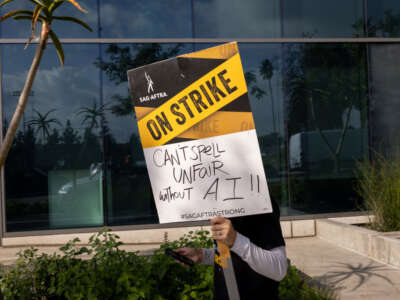
The AI program, called NiCE and made by an Israeli-American company with the same name, promises employers it will create “a more agile, efficient, and human workforce.” For many of the workers themselves, however, the experience has been negative. “NiCE is supposed to optimize the perfect workload,” said Karolina Yermak, a Russian interpreter at LanguageLine. “But you get the workload of two instead of one, without enough time to even take a sip of water between calls.”
Interpreters are often listed among the workers at the highest risk of replacement by AI. But interviews with a half dozen LanguageLine employees reveal a different phenomenon: AI is not so much eliminating as eroding the quality of their work. In a recent survey of 161 workers conducted by the Communication Workers of America, who are seeking to unionize the interpreters, a majority of LanguageLine workers reported high levels of burnout, insufficient time between calls and frequent back and neck pain.
“No matter how hard you try to stay sharp, you lose it, because there is only so much you can take,” said Yermak about the pace of work needed to meet AI metrics set by LanguageLine. “By the end of the day, your brain is so fried that you make mistakes. The intensity leads to massive burnout.”
A LanguageLine spokesperson who declined to be named said in an email that the rollout of AI software to forecast volume and create schedules had landed during a difficult stretch for the industry, and they have since adjusted and operations are “back to normal.” The spokesperson attributed workers’ complaints about erratic schedules primarily to federal budget cuts that have strained the resources of their clients, as well as an immigration crackdown that has left many immigrants afraid to access services.
“We acknowledge and regret the disruptions our interpreters have experienced and we deeply appreciate their patience and commitment,” the spokesperson wrote in a statement.
LanguageLine Solutions grew out of a project launched in 1982 by a San Jose police officer struggling to communicate with the city’s Vietnamese refugee population and a former U.S. Marine who had served as an interpreter in Vietnam. Today, that volunteer initiative has become the largest interpretive services company in the world, with particularly rapid growth during the last decade. Since LanguageLine was purchased in 2016 by France-based Teleperformance, the number of interpreters at the company has grown from 8,000 to 24,000, including nearly 3,000 U.S.-based employees whom Communication Workers of America is seeking to organize.
In 2025, the company reported $1.1 billion in revenue and a client list that includes hospitals, government agencies, schools, immigration courts and private companies. Many of the situations in which interpreters work are highly charged, demanding nuance, judgment and precision. One call could be for an immigrant seeking asylum, another for a patient receiving a sensitive medical diagnosis, a third for a frantic individual calling 911.
Even before its deployment of AI management software in 2025, LanguageLine faced scrutiny for its treatment of employees. In 2015, an investigation by the U.S. Department of Labor found that the company owed interpreters $1.47 million after failing to properly pay overtime and prevailing wage rates. And last year, the company settled a class action lawsuit for $3.725 million brought by interpreters who alleged that the company failed to pay minimum and overtime wages. (The settlement did not include an admission of wrongdoing by LanguageLine.)
Low wages remain a concern for interpreters. The LanguageLine spokesperson told Capital & Main that the average hourly wage of a full-time interpreter in the U.S. exceeded $20 an hour, but four LanguageLine workers with the highest possible level of certification told Capital & Main they earn less than $20 an hour.
It’s the working conditions, however, that have driven many interpreters to join the union drive. The introduction of NiCE, the AI-powered workforce software, has led to forced time off with little notice, workers said. “Sometimes they cut my hours, sometimes a full day,” said Aizo Nokes, a Spanish-language interpreter in Florida. “Reduced hours means a reduced paycheck and reduced security,” she added.
Interpreters have also found their breaks between shifts moving around, seemingly at random. “They say it’s AI powered, and you can see that,” said Yermak. “It cuts up your shifts into strange, pointless segments that aren’t convenient for any live human being.” Instead of evenly spaced breaks, she said, she could have a lunch break and then another break just 45 minutes later.
Many interpreters also reported that the introduction of the AI management system had increased the number of calls they typically receive in a shift. Before, they usually had several minutes between calls, but the minimum time between calls had now been shortened to 15 seconds.
“It’s like they flipped a switch for me,” said Agnieszka Lamirowska, a Polish interpreter who had been with the company for a decade before being fired in August due to what she said the company identified as “performance issues.” She said her call volume has more than doubled in the past year, up to 50 calls a day, and she received a deluge of alerts when she wasn’t meeting her goals. (LanguageLine said that from January to June of 2026, the median time between calls for U.S. interpreters was 2 minutes and 15 seconds and the average time was 5 minutes and 43 seconds.)
The implementation of NiCE, according to workers, had also led to more intense surveillance of their calls with clients based on metrics they did not fully understand. Interpreters said they could be penalized for situations they couldn’t control, such as having a call dropped due to faulty company equipment or having a client hang up before they could say their closing remarks. “You wake up in the morning and you don’t want to log in, because your stomach hurts,” said Nonése Kissane, a Haitian Creole interpreter in Florida. “The stress is too much.”
Interpreters at LanguageLine expressed some optimism that AI would not replace them entirely. One factor in their favor: Customers want to talk to people. “At the beginning of calls, I’ve had people ask me, ‘Are you a robot? Are you a recording?’” said Ramirez. Customers are relieved to learn she’s human.
Madhurima Ganguly, a Bengali video interpreter in Michigan who mostly takes hospital calls, described the relief her bewildered clients express when she greets the patient in their native language. “You have to understand that I’m the person they connect with,” she said. “I am their sister.” Ganguly absorbs their anguish, too. She recounted interpreting for parents of a child in the neonatal intensive care unit who were learning their baby might not survive. “It’s heavy, very heavy,” she said, close to tears. “The nuances, the emotions, the empathy that we humans have for one another … that will be there for eternity. No amount of AI can ever do that.”
A second factor may also protect the jobs of LanguageLine interpreters: the potential legal risk to the company and their clients of an overreliance on AI. LanguageLine interpreters work in situations — like immigration court, emergency rooms or 911 dispatch calls — where even small errors can have outsized consequences. Full-fledged AI hallucinations could have disastrous consequences, interpreters said.
The centrality of humans to interpretation is a point on which LanguageLine’s senior management agrees with workers. In January, Simon Yoxon-Grant, the CEO of LanguageLine, wrote in a company blog post that, even in the age of AI, humans “bring judgment, cultural nuance, and the ability to navigate what cannot be reduced to patterns.” AI did not “diminish the human role” in interpretation, he wrote, but rather “elevated it by handling the mechanical so people could focus on the meaningful.”
Last year, the company announced on its website that, as AI interpretation had improved, it was introducing a pilot program that routed less complicated calls to AI interpreters, thereby “freeing up human interpreters for more demanding work.”
According to Lauren McFerran, former chair of the National Labor Relations Board and currently the executive director of the AFL-CIO Tech Institute, which analyzes the impact of new technologies on workers, this illustrates a broader pattern: What management perceives as increased efficiency, workers experience as intensification. As less emotionally and cognitively taxing calls are handled by AI, the more difficult work is left to humans.
“This is often a selling point,” said McFerran. “We’re going to delegate the easier tasks to this technology. It may be very efficient and productive from the employer’s perspective, but the workers’ lived experience with only doing the very hardest parts of their job in an intensely monitored fashion is a very different side of that story.”
At LanguageLine, the new AI pilot service provides interpretation in more than 10 languages to handle “high volume, low risk” situations, though the company spokesperson said that the pilot was small and that it was not designed to replace interpreter jobs. Multiple interpreters reported that they had already seen a decrease in some simpler calls, like setting up appointments or telling patients a refill was ready.
In April, the LanguageLine interpreters’ union drive received the backing of numerous New York City officials, including Comptroller Mark Levine, at a press conference held at City Hall. Workers have also formed an employee health and safety committee, and in July a delegation traveled to the company’s Monterey headquarters, asking for a meeting with management. To date, the company has not agreed to meet collectively with the workers.
One motive for the unionization drive is the workers’ desire to shape their working conditions, including how and where AI is used. “No one asked us about NiCE,” said Kissane. “They told us what they were doing and we had to figure it out.”
For interpreters like Kissane, workers, not AI or managers, are the ones who know what conditions they need to do their work. “Let us take breaks when we need a break,” she said. “We know when our back hurts. We know when we need a walk. We know when a call is so deep that we can’t take another one.”
Please support movement journalism
Independent media is a pillar of democracy and a powerful force for justice. We rely on reader support. Please make a tax-deductible one-time or monthly donation to Truthout if you can.











+ There are no comments
Add yours