





Aid, Armed Conflicts, Crime & Justice, Energy, Food and Agriculture, Headlines, Health, Human Rights, Middle East & North Africa, Migration & Refugees, TerraViva United Nations
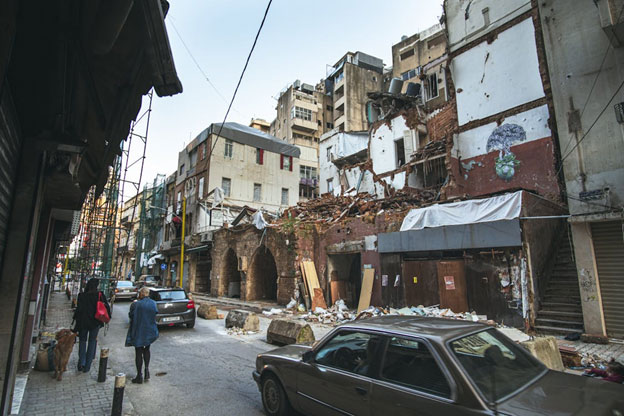
A street in Beirut, Lebanon, where civilian infrastructure has sustained significant damage. Credit: Pexels/Jo Kassis
– Last week on May 28, the Israeli Defence Forces (IDF) issued an evacuation order to Lebanese civilians ordering them to move north of the Zahrani River, approximately 25 miles from the Israeli border, and roughly 20 percent of the Lebanese territory. These new escalations bring the displaced population to more than 1.3 million people, including more than 300,000 of those people being children. 1.3 million people represents approximately 1/4th of the nation’s population of 5.3 million.
On Friday May 29th, the UN Office for the Coordination of Humanitarian Affairs (OCHA) said the following regarding the current situation of displacement: “Just in the past 48 hours, renewed displacement orders by the Israeli Defence Forces have affected hundreds of thousands of people south of the Zahrani River, including in the cities of Tyre and Nabatieh. Collective shelters in Tyre and Saida in the South Governorate are reportedly full and can’t take in more people.”
On Friday May 22nd, the UN Interim Force in Lebanon (UNIFIL) observed a continuation of Israeli military aggression along with Hezbollah attacks on Israeli force mission areas. In the following week, on Monday May 25th, the largest number of airspace violations at 91 occurrences, along with 399 firing incidents by the IDF were recorded. Additionally, on May 27th, 670 trajectories of projectiles were reported, making this the highest since the cessation of hostilities on April 17th. The IDF has also been attributed to separate incidents of firings on Saturday May 23rd and Sunday May 24th, at approximately 160 per day, with about 16 launches of projectiles by Hezbollah; along with large-scale engineering works, logistical traffic, and armored vehicle convoys through this escalation by the IDF.
Between May 21 and May 24, the World Health Organization (WHO) recorded 8 health workers killed and 45 injured, with 25 medical staff just on May 23rd being injured at the Hiram Hospital in the South governorate following airstrikes.
“We reiterate that attacks on health workers and health facilities are unacceptable. All parties to conflicts must immediately stop them and ensure protection for healthcare,” said Deputy Spokesperson for the Secretary-General, Farhan Haq.
As of March 2026, a flash appeal has been submitted by the UN Refugee Agency (UNHCR), acting as a funding instrument to garner USD 308.3 million to provide life-saving assistance and protection targeting up to 1 million people. Within this appeal, USD 61 million is planned to be allocated to Multi-purpose Cash Assistance (MPCA), $56 million to Food Security & Agriculture, $42.5 million to Shelter, and $40 million and $37 million to WASH and Health, along with other allocations to much needed life-saving sectors. Prior to these latest advancements, an estimated 3 million people were already requiring assistance, with 961,000 people facing acute food insecurity.
Although conditions are worsening, all ports remain operational and accessible, according to the latest report from Logistics Cluster. Airspace is open as well, however humanitarian and commercial access remains limited. Also, according to the same report from Logistics Cluster, many roads and bridges in southern Lebanon remain not passable or closed, limiting crucial movements of goods into the most affected areas of hostilities.
OCHA told Inter Press Service that these constraints have been “complicating planning and limiting sustained operations, even as partners continue to reach people where access permits.”
As of May 2026, fuel prices are higher in Lebanon than any other state in the region, besides Pakistan. Since February 28th 2026, the following increases have been recorded:
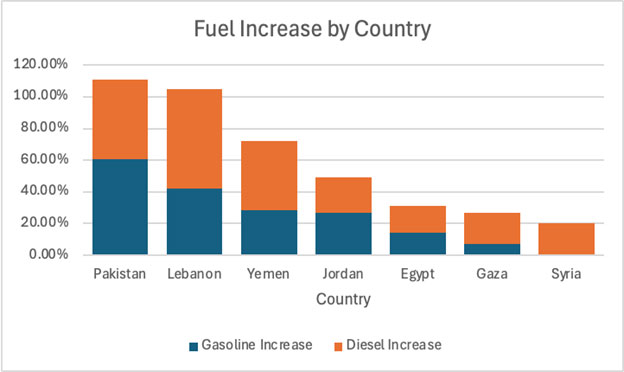
The estimated fuel increase by country since February 28th, 2026. Credit: Maximilian Malawista
OCHA added that “Rising costs are adding further pressure on an already fragile humanitarian response. Fuel prices have surged significantly, driving up transport and production costs, while the cost of basic food items has also increased.” OCHA warned that these trends are “undermining people’s ability to afford essentials”, and are “further complicating the delivery of humanitarian assistance.”
IPS UN Bureau Report









+ There are no comments
Add yours