




Did you know that Truthout is a nonprofit and independently funded by readers like you? If you value what we do, please support our work with a donation.
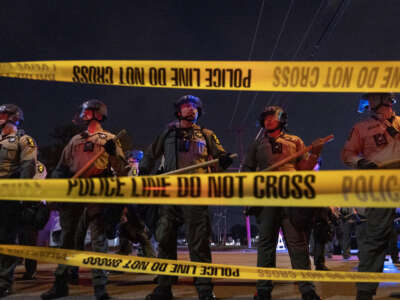
Jury deliberations in the case of a group of San Francisco protesters dubbed the “Golden Gate Defendants” resulted in multiple misdemeanor convictions on July 2, 2026. The case stems from an organized action that took place April 15, 2024, in protest of the U.S.-enabled Israeli genocide in Gaza. Twenty-six people were initially arrested for blocking traffic on San Francisco’s Golden Gate Bridge and jailed for more than 48 hours. After a majority of the 1,144 combined charges were dropped, seven people went to trial.
In spite of being found guilty of multiple misdemeanors, the Golden Gate Defendants view the outcome as a victory. Tori Porell, senior staff attorney at Palestine Legal, who has been supporting the defendants, said San Francisco District Attorney Brooke Jenkins “failed to secure convictions on the most serious charges” of felony conspiracy. Jury members were deadlocked on the felony charges that could have resulted in 15-year prison sentences.
Still, defendants and their allies have spent two years enmeshed in the stress of a long-drawn-out trial. Now, those charged and convicted await a sentencing hearing in August.
Defendants and their allies have spent two years enmeshed in the stress of a long-drawn-out trial.
The decision to bring such a wide array of charges in relation to a protest action was unusual. Porell called it “a classic case of over-prosecution, meant to stifle dissent and scare people away from speaking out against the United States and Israeli-backed genocide of Palestinians.” During the trial, DA Jenkins even attempted to prevent Golden Gate Defendants and their supporters from wearing keffiyehs — a symbol of solidarity with Palestinians. “The judge, fortunately, knows the First Amendment and did not proceed with that request,” Porell said.
Sara Cantor, one of the defendants, was quoted in a press release as saying that the goal of the protest was “to show that the status quo cannot continue while our government funds genocide.”
Porell explained that Cantor and her fellow activists are using their serious predicament to continue raising awareness of the genocide. “These defendants have bravely showed up and centered Palestine throughout this trial, showing that even under this aggressive prosecution, they won’t be silenced, and they won’t be scared away from speaking up against a genocide.”
Although the actions of April 15, 2024, ought to have been considered protected speech under the First Amendment, DA Jenkins justified the harsh charges her office brought against the activists. She cited “the danger … to people who are on the bridge, who might be suffering medical emergencies, who might have significant things that they’re trying to get to.” Jenkins went on to suggest that in the event of an earthquake, people trapped on a bridge would have their lives endangered by such an act of civil disobedience.
What the DA did not say is that law enforcement had the ability to let traffic through but chose to let the bridge remain completely blocked. “The protesters had a plan to allow a lane of traffic for emergency vehicles to pass,” but it was the police “who did not open that channel,” Porell said. “The police also blocked the bridge traffic in the opposite direction, which the protesters did not do.”
“These defendants have bravely showed up and centered Palestine throughout this trial, showing that even under this aggressive prosecution, they won’t be silenced.”
Moreover, there were several comparable protests blocking traffic on San Francisco’s Golden Gate Bridge in the past, including an AIDS-related protest in 1989, and, more recently, a Black Lives Matter protest in 2020. “Those protesters were not treated anywhere near as harshly as these protesters who were speaking up for Palestine were treated,” said Porell. The only conclusion that can be drawn, according to Porell, is that the Golden Gate Defendants “were targeted because of the content of their speech and what they were speaking up about.”
Actions in support of Palestinians have long been anathema in the United States, a phenomenon Porell and others describe as “the Palestine exception to free speech.” She viewed the case of the Golden Gate Defendants as “just one of many examples we’ve seen in the last several years of attempts to chill speech around Palestine.”
“The protesters had a plan to allow a lane of traffic for emergency vehicles to pass,” but it was the police “who did not open that channel.”
At the same time as activists blocked the Golden Gate Bridge to protest the Gaza genocide in Spring 2024, students across the country were occupying college campuses, decrying the horrors of the genocide and demanding their administrations divest from Israel. Countless numbers of students were harshly penalized for their activism, including being suspended, expelled, or having their degrees revoked.
A year later, the advent of the second Trump administration saw a greater escalation in the attacks on free speech when outspoken Columbia University student activist Mahmoud Khalil became the highest-profile victim of both the “Palestine exception” and Donald Trump’s war on immigrants. Federal immigration authorities revoked Khalil’s student visa and arrested him in Spring 2025.
Immigrants in the U.S. are facing a similar sort of dehumanization to Palestinians, and those who defend one or both groups might pay an extraordinarily high cost for their activism today. The charges in the Golden Gate Defendants’ case came soon after decades-long sentences were announced in the federal case against eight people arrested in connection the protest of an immigration jail in North Texas. The prosecution of the Prairieland Defendants, as they are called, was the first to be brought under Trump’s executive order proclaiming “Antifa” as a terrorist organization.
DA Jenkins, according to Porell, “is taking a page out of the Trump administration’s playbook by overcharging and over-prosecuting a classic act of civil disobedience. This is exactly what we’re seeing the Trump administration doing on an even more horrendous scale with the Prairieland prosecution.”
Lydia Koza, whose wife Autumn Hill is a Prairieland Defendant sentenced to 50 years in prison, said, “This is a shocking escalation, and at the same time, the trajectory as to how we got here is very sadly predictable.” Koza likened the harsh sentences of the Prairieland Defendants to what Black activists and their allies dealt with during the civil rights movement.
“It’s just abominable to me that the U.S. government wants to take this amazing, marvelous, sweet young woman’s life away from her entirely, that they want to put her in a box for the rest of her life,” said Koza of her wife, Autumn.
Just as racial justice activists in the 1950s risked their lives to defend civil rights and human rights, their modern-day counterparts have continued showing up, uncowed in the face of draconian government responses.
“Despite all of this repression that we’ve seen increase over the last few years, people are not silent,” said Porell. “People are continuing to speak up. More and more and more people every day are speaking up about Palestine and raising awareness about our government’s complicity in an ongoing genocide.”
An important fundraising appeal: 8 Days to raise $47,000
Truthout is one of only a few platforms for justice-oriented, grassroots journalism. Today, as political censorship from the right intensifies, we have no choice but to ask for your help.
We are fundraising right now to cover our basic operating expenses. If you can support Truthout with a one-time or monthly donation, you will make a significant impact on our work. Anything you can do makes a difference — we appreciate your support.




+ There are no comments
Add yours