







Honest, paywall-free news is rare. Please support our boldly independent journalism with a donation of any size.
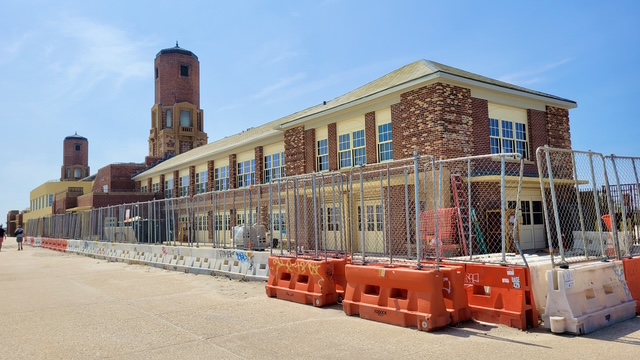
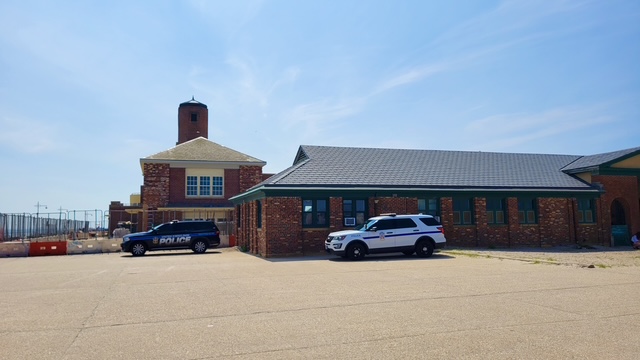
On July 4, a small group gathered at Jacob Riis Beach in Queens, New York, with handmade signs and zines. They were protesting the conversion of a public bathhouse — a 1930s architectural gem — into a private beach club, set to open on August 15.
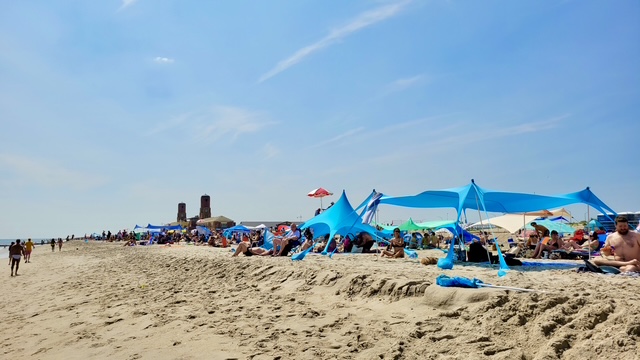
The response was warm, and beachgoers cheered as the group passed. As the protesters approached the historic bathhouse, the mood shifted. The crowd skewed more toward families, and reactions ranged from curious to confused. The contrast in energy between the two sections illustrates something about who this beach still belongs to, and where that sense of belonging begins to thin.
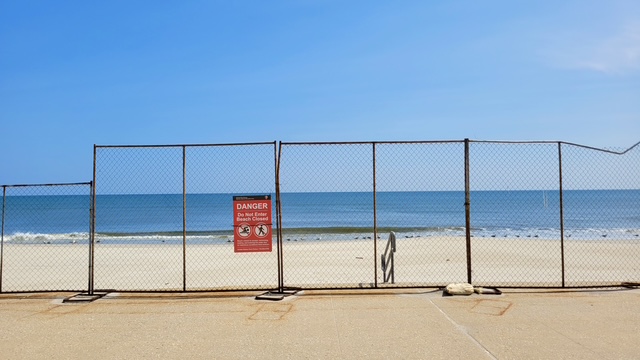
That dividing line became even more clear later that evening, when I watched a U.S. Park Police officer approach a group of 20 to 30 predominantly Black queer and trans beachgoers who had gathered peacefully under a canopy tent since late morning, sharing food, coolers, and each other’s company without incident. The officer said they exceeded a permitted gathering size and called for backup; two more officers arrived. The group complied, packing up their tables and canopy.
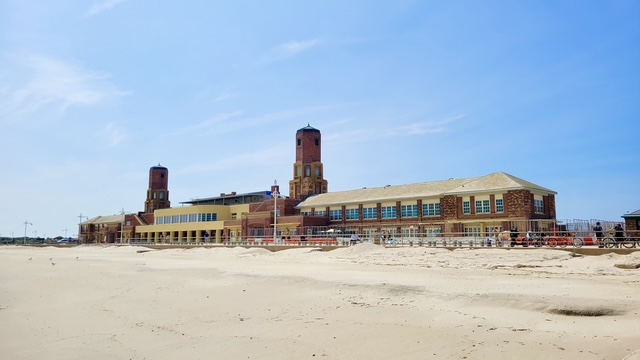
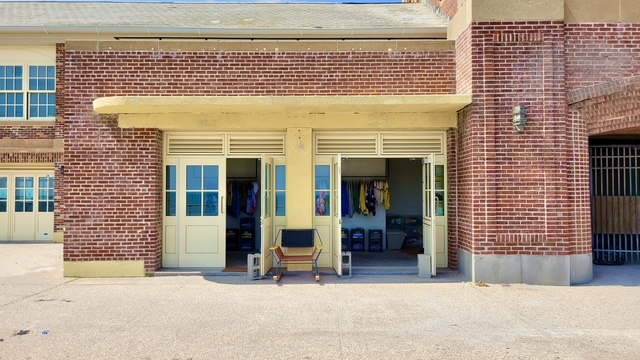
Jacob Riis Beach has served for decades as one of the most famous cost-free public spaces in New York City, known especially as a gathering place for the LGBTQIA+ community since the 1940s. In June, I documented for Truthout the 60-year lease financing the bathhouse’s transformation, including a $15 million historic tax credit investment tied to the building’s status on the National Register of Historic Places. Roughly 60 percent of the restored building will remain open to the public; the rest will operate as a private, membership-based club. Ahead of its August 15 opening, marketing for the club largely ignored the significance of Jacob Riis Beach to New York’s LGBTQIA+ community.
Now, as the community prepares for the August 15 opening of the Rockaway Ocean Club, they continue to push for real accountability, and for a genuine seat at the table in shaping what comes next.
Profiting Off the People’s Beach
The reopening of the beach club has brought a new wave of attention to the entities set to profit off its privatization. Among the figures tied to the bathhouse’s reopening is developer Jonah Bamberger, who has a known history as one of the city’s worst landlords, a history that Truthout has documented. In July, when New York news outlet Hell Gate asked about Bamberger’s role, Ursula Damani, a founding partner of the Rockaway Ocean Club, called him a “silent investor” with “zero involvement.”
Despite Damani’s comments, Bamberger has narrated the project’s origin story on multiple real estate podcasts. Bamberger’s company, Aulder Capital, once described itself on its own website as having been “awarded a 60-year concession,” contradicting Damani’s account.
Bamberger’s record, including a $2,124,845 civil penalty imposed in August 2025 for 148 open housing violations, remains undisputed. Public records show the 60-year NPS lease is held by Bathhouse Lodge LLC; Aulder Capital’s name does not appear. A FOIA request filed with the National Park Service to identify who’s actually behind these entities remains pending.
Reached for comment, Aulder Capital spokesperson David Myers said the archived website language reflected marketing rather than the firm’s actual role, and clarified that Bamberger’s interest is held through a separate entity, “passive, with no involvement in the operation or management” of the club. He did not address why Bamberger’s own public statements tied the project directly to Aulder Capital.
As early as November 2024, a tenant in one of Bamberger’s Brooklyn buildings emailed officials with concerns about the project’s tax credits. She received no response. Amid this pattern of official silence, the people actually organizing around the beach’s future have kept building their own vision for it.
The People Fighting for the Beach
Ceyenne Doroshow’s relationship to Jacob Riis Beach began, like so much of her life’s work, with survival. She’s been coming to this beach for decades, watching friends grow old, get sick, and in some cases, die. She remembers a version of this beach with no bathhouse restoration underway at all, just the community itself, holding the space together with nothing but its own presence.
“I found home in people on that beach before I even met the Village,” Doroshow told Truthout. “I found safety. I found the adoption of family when my family rejected me.”
Born and raised in Brooklyn, Doroshow founded GLITS (Gays and Lesbians Living in a Transgender Society) after her own experiences with homelessness and incarceration as a Black trans woman, building it into one of the city’s most consequential organizations serving Black transgender New Yorkers. GQ has called her the “godmother” of the Black Trans Lives Matter movement. Where she sees government programs designed around temporary fixes, she has built GLITS around permanence, an intentional bet that stability, not just shelter, is what actually breaks cycles of crisis.
“Here we are watching gentrification drop in our laps, right in our place called home.”
Her vision for the Neponsit Hospital site, adjacent to the beach club and still gated and largely empty since its 2023 demolition, stands in direct contrast to the beach club now opening next door — a contrast Doroshow attributes to the fact that Damani and her team never reached out to Doroshow or, as far as she knows, to anyone in the community before moving forward. She imagines a health and wellness resource center offering therapy, physical and occupational health services, and real bathrooms and outdoor showers that “you don’t have to walk a mile to.” She pictures an art gallery, an observation deck doubling as an event space, and a parks maintenance crew staffed by and for the community it serves. “That’s year-round jobs,” she said, “not just in the summer.”
Against a competing push by the local community board to build a children’s playground on the Neponsit Hospital site, Doroshow doesn’t mince words. She said, “A playground, a dog park, a park, period, would all amount to erasure on that specific piece of ground. How many playgrounds do they have in the Rockaways already? Another one right there, on that spot, is erasure in the finest of erasing ways.”
She describes the broader pattern of development around the beach, the bathhouse, the waterfront, the parking lot, the baseball diamonds, as something that took her years just to map. “It’s hidden in such a way that it took me years of work to untangle it,” she said.
Doroshow said she personally asked people connected to the bathhouse project a few years ago whether a small number of units or memberships could be set aside for low-income community members. She was told it would be “a consideration.” She never heard back. “Here we are watching gentrification drop in our laps, right in our place called home,” she said. “You should be ashamed of what you’re creating, for the $30 lobster rolls. This is the blood and sweat of the community.”
Stephen Miranda, a stylist who’s been coming to Riis since 2021, still remembers his first trip to the beach, guided there by a friend who walked him through the exact train and bus connections beforehand. It immediately became a practice he’s kept ever since. “I just take the train, take the bus, get there, do my thing, leave,” he said. “It’s kind of like a queer ritual that I really treasure. Doesn’t matter who I go with. I can always just depend on feeling good being there.” He remembers the old Neponsit Beach Hospital serving as a privacy buffer before its 2023 demolition, and says its removal “painted a clear picture” of what was coming. On the phrase “family-friendly,” his response was immediate: “It just brings up an agenda to push out the queer community and control behavior.”
“Riis has been a precious place for queer people since the 1940s at least, and we should have a seat at the table where decisions about this beach’s present and future are made.”
Mars Plater, an assistant professor of history at University of Connecticut-Stamford who studies the unruly parks of 19th-century New York City, put the stakes in blunt terms: “Riis has been a precious place for queer people since the 1940s at least, and we should have a seat at the table where decisions about this beach’s present and future are made,” Plater said, arguing that the bathhouse’s original purpose as a New Deal-era public investment makes its privatization “extremely disheartening.” Plater also said U.S. Park Police have been scanning license plates and towing cars over unrelated violations since last summer, “stranding beachgoers on the peninsula,” and running counter to the National Park Service’s own stated mission. The tactics at Riis are a far cry from the lethal force federal immigration agents have used elsewhere this year. But the pattern, Plater said, reflects the same underlying dynamic: a federal agency treating an already-marginalized community’s presence as inherently suspect.
Pushing for a Different Kind of Leadership
The community that has made a home out of Jacob Riis Beach is trying to find ways to use every lever of power available to preserve the People’s Beach. Much of that has come back to the woman at the center of the Rockaway Ocean Club.
Ursula Damani’s relationship to the beach began nine years ago. Brought into the project in 2017, she and her partners won the bid for taking over the bathhouse and signed the 60-year lease in October 2022. In an interview four weeks before the club’s opening date, Damani was candid and forthcoming.
She explained the “family-friendly” framing of the marketing around the bathhouse project as a matter of literal inclusivity. When the phrase’s coded history was explained to her, she took it seriously. “I get it now,” she said. “That’s not what I mean.”
That history runs deep: in July 1974, The New York Times reported a wave of arrests at the beach under the headline “11 Men Arrested at Riis Park as U.S. Begins a Crackdown.” A National Park Service ranger explained the goal was to “make the beach as pleasant for families as possible,” according to research by Mars Plater. More than 50 years later, the same language resurfaced in Damani’s own explanation.
Damani also suggested that she would be open to more community input as the bathhouse is set to open. She raised the idea of a photography exhibit honoring the beach’s queer history, and said she’d be glad to host benefit events for groups like GLITS. Asked about Doroshow’s low-income membership request, Damani said it “hasn’t come across my desk.” On Park Police, she said she’s never had contact with them and pushed back on any suggestion the club’s presence justifies increased policing. “That’s not fair, and it’s got to stop,” she said. Damani also asked to be connected with Doroshow directly, eventually leading to the first meeting between the two (a meeting I sat in on at Doroshow’s request).
The bathhouse and its surrounding beach area sit on federal land under a lease the National Park Service has already granted; no city official can undo it. But the future of the adjacent Neponsit Hospital site remains a decision within the hands of the city.
In May, Mayor Zohran Mamdani reopened the Orchard Beach Pavilion in the Bronx, restored entirely through city and state funding — no private lease involved. Where a federal lease handed Riis to a private LLC, city ownership at Orchard Beach kept decision-making accountable to the people who use the beach. That accountability is still undecided at Neponsit, and it’s still Mamdani’s to decide. Victoria Cruz put it plainly in 2022: “This is the people’s beach. And we are the people.”
An important fundraising appeal: 5 Days to raise $35,000
Truthout is one of only a few platforms for justice-oriented, grassroots journalism. Today, as political censorship from the right intensifies, we have no choice but to ask for your help.
We are fundraising right now to cover our basic operating expenses. If you can support Truthout with a one-time or monthly donation, you will make a significant impact on our work. Anything you can do makes a difference — we appreciate your support.









+ There are no comments
Add yours