







Honest, paywall-free news is rare. Please support our boldly independent journalism with a donation of any size.
Sabrina Rucker wasn’t just focused on protecting her immigrant neighbors and coordinating with activists in grassroots response networks during “Operation Metro Surge,” the aggressive federal immigration crackdown that rocked Minnesota this past winter.
Rucker, co-founder and CEO of a local publishing company, StoryForge, conceived the idea to document the crackdown after she tried — to no avail — to get a cousin to understand its intensity in the suburbs, especially in her affluent Apple Valley home, about 20 miles south of Minneapolis. Then it hit her: If her cousin couldn’t grasp what was happening, others probably couldn’t either. So in February, during the peak of the surge, Rucker started the Metro Surge Anthology, a project that documents stories from impacted individuals and families in immigrant and non-immigrant communities.
“Personal stories have the power to reach people in a way that big, flashy news stories don’t,” she told Truthout. “My hope is that compiling a bunch of real people and their experiences in one place will be more compelling to sharing what the reality of Operation Metro Surge was like to a broader audience who really didn’t understand. Having an accurate picture of what it was like is really important.”
Today, she’s hardly alone. State officials, nonprofit groups, and independent oral historians are also recording experiences from Operation Metro Surge and the related but little-known Operation Post-Admission Refugee Reverification and Integrity Strengthening (PARRIS), which targeted about 5,600 refugees in Minnesota. While their motives vary, these projects share one goal: to capture both the brutality of the crackdown and the grassroots resistance that emerged in response.
Llana Barber, a history professor and director of the Immigration History Research Center at the University of Minnesota, has collaborated with some of those documenting the experiences. She says these initiatives aren’t just crucial archival records for future researchers; they also inform ongoing political and grassroots work nationwide.
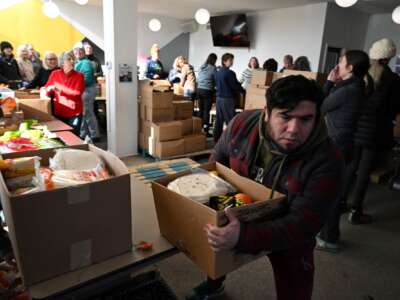
“The immense outpouring of community care and mutual responsibility that happened during the surge — to me, it’s really important to document that for what it was and not let it get misread or misrepresented as something nefarious,” she told Truthout. “It was such an inspiring community response: the way that people developed all of these elaborate networks to take care of their neighbors, make sure that their rent was paid, that they had food to eat, that their kids were safe going to school, and that schools were open — all of the ways in which communities came together to protect one another was one of the most powerful things I’ve ever seen in my life. And making sure that the truth of that gets recorded and that the power of that gets recorded is why these documenting projects are so important.”
The Documentation Initiatives
The Minnesota state government is leading the largest effort to collect stories about the crackdown. In the spring, Gov. Tim Walz signed an executive order establishing the Governor’s Council on Recording the Truth of Operation Metro Surge and Operation PARRIS on Minnesotans, or the Minnesota Truth Council, to create a comprehensive public record. This includes gathering oral histories, testimonies, and documents from affected residents and state agents. The council will then produce a final report with recommendations to prevent similar federal abuse and violations in the future.
“Minnesotans know what happened in their communities, but too many stories have yet to be heard, documented, and shared,” Walz stated in a press release. “For months, families lived in fear, children were separated from their parents, and our neighbors were subjected to racial profiling and unlawful detentions. At the same time, people showed up for one another with compassion, courage, and resilience. This council will make sure we document Minnesota’s history.”
“Being able to document what our truth is — our individual or collective truth — is really an important part of both knowing what happened and being able to prevent its recurrence … and of healing as a community.”
To implement the Minnesota Truth Council, the state has partnered with The Advocates for Human Rights, a Minneapolis-based nonprofit that has collaborated with international organizations on truth and reconciliation projects, including efforts with members of the Cambodian and Liberian diasporas to document human rights abuses in their respective countries.
The Advocates for Human Rights Executive Director Michele Garnett McKenzie told Truthout that truth-telling projects have historically given victims space to have their experiences heard and acknowledged. “Memory is fragile, fleeting, and very personal,” she said. “Being able to document what our truth is — our individual or collective truth — is really an important part of both knowing what happened and being able to prevent its recurrence … and of healing as a community.”
The group has trained individual volunteers and organizations in story collection to help more Minnesotans participate. McKenzie said the approach is particularly important because each individual or group can engage communities they already know. At a time when the Trump administration is targeting political critics and protesters, many are reluctant to share their experiences for fear of retaliation. As a result, McKenzie said, “we developed a way for people to share their stories collectively, individually, and anonymously” — an approach echoed by other organizations also documenting these experiences.
Green Card Voices, a Minneapolis-based nonprofit that has collected and shared stories of immigrants and refugees for over a decade, is also documenting stories from Operation Metro Surge. Through a two-year project, “We Had Whistles: Minnesotans Under Operation Metro Surge,” the organization plans to collect 40 stories from immigrant and non-immigrant Minnesotans, including educators, students, business owners, faith leaders, mental health professionals, and attorneys. (Disclosure: the author of this article is one of four oral historians working on the project.)
“This project is deeply personal to me because the terror surrounding Operation Metro Surge was so real and widespread,” Green Card Voices Co-Executive Director Tea Rozman told Truthout. “The only other time I remember feeling anything similar was at age 15 in my hometown of Ljubljana, at the beginning of the war that would eventually break Yugoslavia apart. It carried the same terrifying sense that an entire community was under threat, and that danger could come at any moment from the very institutions and people entrusted with providing protection. Ordinary life no longer felt safe.”
Rozman now wants to document the fears and hopes thousands of people experienced during the 10-week federal occupation in Minnesota. Her team of oral historians, drawn from the same communities that were targeted, conducts interviews in Somali, Spanish, and English — helping remove language barriers that might otherwise prevent people from participating.
Rucker, the StoryForge CEO, is also pursuing creative ways to include more people in the Metro Surge Anthology project. She and her team have been meeting with participants at local cafés and libraries to record their experiences. They also created a page where participants can submit diaries and essays about their experiences. Those for whom writing isn’t a preferred mode of communication can submit their stories via text or voicemail.
Preserving the Stories
For most of the documentation projects, collecting stories from Operation Metro Surge is just one step. The next is preserving those experiences and making them accessible to the public.
“Immigrant communities are not simply subjects of policy or enforcement; they are witnesses, historians, and authors of their own lives.”
Rucker, who studied history at the University of Minnesota, knows the power of documenting history and the importance of making diverse voices from impacted populations available to the public. “When I realized that we’re living through history, it was really important to me to collect an accurate picture of what was being experienced and to gather as many primary sources as possible, particularly in the middle of it all,” she said. “I felt that the best way for people to get a source that felt they could trust was to actually interview the people that were being affected; the people this was actually happening to, and not the political figures who were trying to create a narrative for their own benefit.”
So far, more than 70 immigrants, protesters, attorneys, and volunteers in the grassroots response networks have shared their stories with the Metro Surge Anthology project. Once the collection stage is complete, Rucker said she plans to compile the stories into a 300-page anthology that offers a comprehensive portrait of life for Minnesota immigrants and non-immigrants under Operation Metro Surge.
Green Card Voices also plans to make the stories accessible to the public. The collection will be curated into an anthology, displayed as an exhibit, and archived for future researchers. “We hope this latest collection of stories … will deepen public understanding, contribute to accountability, and preserve essential lessons for future generations,” Rozman said. “Immigrant communities are not simply subjects of policy or enforcement; they are witnesses, historians, and authors of their own lives.”
Barber, the director at the Immigration History Research Center, said all the ongoing efforts to document Operation Metro Surge are especially important because institutional archives have, for the most part, preserved only the accounts of the powerful, wealthy, and influential, while overlooking or intentionally erasing the voices of the poor, women, and people of color.
“Archives are often shaped by power; history is always written by the powerful because archives document the perspectives of the powerful,” she said. “So, these projects — what immigrants experienced, what organizers experienced, what people on the ground experienced — are a way to build an archive that will give us a much more textured, much more accurate understanding of what happened during the surge.”
25 Years of Truthout: An important fundraising appeal
This September, Truthout is celebrating 25 years of publication. For over two decades, we have been a trusted source for fiercely independent journalism thanks to readers like you.
As we look to the next 25 years, we have launched a special fundraising campaign. Looking to a sustainable future for our publication, we have a fundraising goal of $84,000 in the next 7 days.
We are asking for your support at this juncture because we face greater threats than ever before in our organizational history. Trump and his MAGA allies are determined to control the information ecosystem, and movement-based organizations are subject to dangerous censorship and scrutiny.
If you can support Truthout with a one-time or monthly donation, you will make a significant impact on our work and our legacy. Anything you can do makes a difference!








+ There are no comments
Add yours