






Truthout is a vital news source and a living history of political struggle. If you think our work is valuable, support us with a donation of any size.
Over 3,000 Palestinians have been displaced from their homes in the occupied West Bank city of Hebron (Al-Khalil) since Friday, as Israeli Prime Minister Benjamin Netanyahu carries out collective punishment in a bid to shore up support ahead of Israel’s elections on Tuesday.
On Friday, after two Palestinian gunmen opened fire on an Israeli military checkpoint in Hebron, killing two Israeli soldiers, Netanyahu stated that he would “prepare for a full lockdown across all of Judea and Samaria,” using the Israeli term to encompass the West Bank.
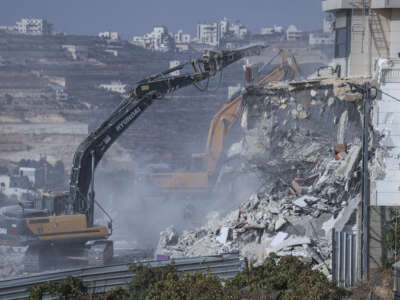
The Israeli military quickly locked down the city of Hebron — the largest city in the West Bank and its economic capital — and destroyed the Farsh al-Hawa neighborhood, where the checkpoint was located. Israel’s Finance Minister Bezalel Smotrich said he ordered the destruction in the neighborhood, and filmed himself in front of a building being demolished. The army went on to convert some Palestinian homes into military posts for its operation, and forced families in the Ein Deir Baha neighborhood to leave their homes at night on foot.
Israeli soldiers also besieged the Fawwar refugee camp in Hebron, blocking the camp’s entrance on Saturday to prevent any Palestinians from entering or leaving.
Nearly half of those displaced are babies and children under the age of 18, along with elderly people and pregnant women.
According to Haaretz, Israeli military Chief of Staff Eyal Zamir moved to end the military raid of Hebron on Saturday, stating that its objectives had been met. But Netanyahu and Defense Minister Israel Katz insisted that the military operation continue, expanding the displacement of residents and preventing those who had been displaced from returning home.
“These actions by the Israeli occupation are driven by the elections,” Hebron’s mayor, Yousef al-Jabari, told Democracy Now! on Monday. “We are days, or even hours, away from the Israeli elections. Netanyahu and the radical ministers in his government are trying to win as many votes as possible from the settlers. The Israeli response is disproportionate, and there is no justification for these actions.”
Al-Jabari also said that Israel’s actions constituted collective punishment — a statement echoed by the UN.
On Tuesday, Israelis will head to the polls in the first Israeli election since before October 7, 2023 — and one that polls show is an extremely tight race between Netanyahu and Gadi Eisenkot. Though Netanyahu is the longest-standing Israeli prime minister, his candidacy has been shaken by his corruption trial and his failures on and after October 7.
Netanyahu’s disproportionate response is likely fueled by his desire to demonstrate his ability to wage violence against Palestinians ahead of the election, and to shore up additional votes.
Netanyahu has also reportedly been considering renewed attacks against Iran, likely for the same reason. On Sunday, he published a video warning Iran “and its allies” against interfering with Israel’s elections, saying: “You will suffer blows far stronger than you can imagine.”
Tamir Sorek, professor of Middle East History at Pennsylvania State University, told Truthout that Netanyahu’s actions are consistent with Israel’s long-standing settler-colonial violence and dispossession of Palestinians.
“But at the same time, in these particular circumstances, Netanyahu needs to put what is called the ‘security situation’ at the heart of public discussion,” he said.
Netanyahu “knows that if there are discussions about corruption, for example, or about the economic situation, he is vulnerable,” Sorek went on. But if he can create the feeling of “a security emergency … then he has a better chance to succeed in the elections.”
“So for him, escalating the dynamics everywhere — in the West Bank, in the Gaza Strip, in Iran — for him, it is an electoral advantage,” Sorek said.
The escalations are not likely to end on Tuesday, either — particularly given the fact that Israel’s political parties will need to form alliances to create a ruling coalition, which could take weeks.
“We are likely to see him pushing toward more escalations,” Sorek said. This is for two reasons, he explained: The first is to show the Israeli public that there is an emergency, and to insist that the opposition is not collaborating and that government handover should not happen under these circumstances.
The second reason is to push against the Israeli opposition forming an alliance with Palestinian political parties.
“Although the leaders of the opposition parties declared that they are not going to collaborate with the Arab parties, what we see in public opinion polls is that the vast majority of the voters of the opposition do support [forming a coalition with Palestinian political parties],” he said.
Netanyahu has “an interest in breaking up this opposition,” which is more easily done “if there is an emergency situation, if the Palestinians are perceived again as the major existential threat for Israelis.”
An urgent fundraising appeal: We still need to raise $9,000
Truthout is one of only a few platforms for justice-oriented, grassroots journalism. Today, we face an existential threat.
Due to Google’s launch of AI search, we’ve seen a drastic plunge in our site traffic and, as a result, our revenue. We lost 15 percent of our readership overnight. This was a readership we painstakingly built over decades, and it vanished because Google chose corporate greed over a healthy democracy.
We are fundraising right now to meet our basic operating expenses. If you can support Truthout with a one-time or monthly donation, you will make a significant impact on our work. Anything you can do makes a difference — we appreciate your support.






+ There are no comments
Add yours