






Did you know that Truthout is a nonprofit and independently funded by readers like you? If you value what we do, please support our work with a donation.
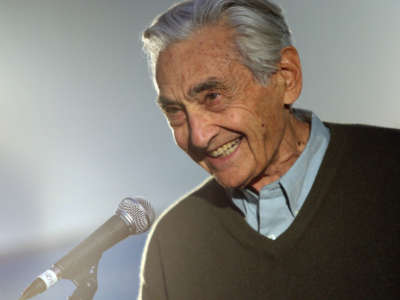
We speak to Dave Zirin, author and sports editor at The Nation, about his new book, The People’s Historian: The Outsized Life of Howard Zinn, chronicling the life and activism of the legendary historian Howard Zinn, author of A People’s History of the United States. For Zinn, says Zirin, “being an academic was always secondary to being in the streets and making history, not just studying history.”
TRANSCRIPT
This is a rush transcript. Copy may not be in its final form.
AMY GOODMAN: This is Democracy Now!, democracynow.org.
We turn now to the new book The People’s Historian: The Outsized Life of Howard Zinn, written by our next guest, Dave Zirin. The book explores the remarkable life of the late historian, teacher and activist Howard Zinn. He’s best known for writing A People’s History of the United States. First published in 1980, the book has sold more than 4 million copies.
Howard Zinn died in 2010 at the age of 87, but his work is still seen as threatening to many, and by others, by empowering so many. During his first term, President Trump directly attacked Zinn’s work.
PRESIDENT DONALD TRUMP: The left-wing rioting and mayhem are the direct result of decades of left-wing indoctrination in our schools. It’s gone on far too long. Our children are instructed from propaganda tracts, like those of Howard Zinn, that try to make students ashamed of their own history.
AMY GOODMAN: Over the years, professor Howard Zinn appeared on Democracy Now! many times. In 2009, he “talked”: about the importance of teaching students the true history of the country.
HOWARD ZINN: It’s true that people have asked that question again and again. You know, should we tell kids that Columbus, whom they have been told was a great hero, that Columbus mutilated Indians and kidnapped them and killed them in pursuit of gold? Should we tell people that Theodore Roosevelt, who is held up as one of our great presidents, was really a warmonger who loved military exploits and who congratulated an American general who committed a massacre in the Philippines? Should we tell young people that?
And I think the answer is: We should be honest with young people; we should not deceive them. We should be honest about the history of our country. And we should be not only taking down the traditional heroes, like Andrew Jackson and Theodore Roosevelt, but we should be giving young people an alternate set of heroes.
AMY GOODMAN: So, that is the late great historian Howard Zinn.
Dave Zirin joins us now.
Dave, you wrote The People’s Historian: The Outsized Life of Howard Zinn. Everyone knows you as a sportswriter. Why you switch gears for now, if in fact you did? And tell us Howard Zinn’s life story and his impact.
DAVE ZIRIN: Well, I could tell you that in the 1930s, as a teenage union organizer, Howard Zinn played for his union basketball team and used his tall frame as a way to recruit people to the union, but that still doesn’t make this a sports story. That’s as close as we’re going to get.
Howard Zinn’s life was remarkable. It was 70 years-plus of activism, 64 of those years alongside his incredible partner Roslyn Shechter Zinn. And it’s in those 70 years that we have so many lessons for us today and for our struggles. I mean, we’re talking about somebody who in the 1930s, like I said, was a teenage union organizer during the Depression. In the 1940s, he was a bombardier in World War II who hated fascism so much, he signed up to be a bombardier even though he’d never been on a plane. I mean, I get claustrophobic in the middle seat, and he’s there as a bombardier. You know, in the late 1940s, he lived through the Red Scare as a firebrand, 20-something organizer fighting for veterans’ rights in Brooklyn, which is an incredible story which he never told unto himself, which I was able to get documentary information on.
In the 1950s, teaching at Spelman College, a HBCU for women in Atlanta, he taught an incredible generation of women, people like Alice Walker, the author, Marian Wright Edelman, Beverly Guy-Sheftall, women who were the first to graduate from Harvard Law School, and Howard Zinn was their beloved professor. They voted him the professor of the year on campus in their yearbook, which is an incredible little exhibit of the Howard Zinn of that time, 1961. And then he’s forced out of the school because he dared stand up not just for his students’ right to protest Jim Crow in Atlanta, but also their fight against the patriarchy and sexism on their campus. He wrote an article for The Nation magazine, which got wide coverage, the virality of 1950s, that was called “A Finishing School for Pickets,” about the women at Spelman.
Then he goes on from that and becomes one of the adult organizers of one of the vanguard organizations of the civil rights movement, the Student Nonviolent Coordinating Committee. Like, the fact that he was asked to be an adult adviser of people like Stokely Carmichael, soon to be known as Kwame Ture; Bob Moses; Diane Nash; Dorothy Ladner. I mean, they were looking to both Howard Zinn and his partner at the time, Ella Baker, to be the — his work partner — to oversee and help with SNCC. And then he worked alongside folks like James Baldwin and Dick Gregory, like in the heart of Jim Crow. And it wasn’t all roses and flowers, either. I mean, they had comrades die in those streets and in those swamps fighting against Jim Crow.
And then he goes on from that to become a leading figure in the movement against the war in Vietnam, including traveling to North Vietnam, traveling to Hanoi on behalf of the peace movement during the Tet Offensive, during the Tet Offensive, to free POWs.
And he continues being active into the 1980s, into the 1990s and in the 2000s, as you well know, because he loved appearing on Democracy Now! to talk about this, the wars in the Middle East, the endless wars of George W. Bush. He spoke out against something we’re dealing with so strongly today: the growing surveillance state, that we were seeing under the PATRIOT Act and George W. Bush.
So, the lessons of Howard Zinn’s life over 70 years are so important to us. And I would argue the most critical lesson is that he lived through the ups and downs. It wasn’t all pie in the sky. There were tremendous difficulties along the way, particularly during the Red Scare of the late 1940s and early ’50s. And yet he persevered. And he persevered because he wasn’t just an activist. This is what’s so interesting about him to me, is that he was also a trained historian. And we don’t always see trained historians on the frontlines of activism. And frankly, that’s why so many, like, I would call them, centrist or liberal historians are so resentful of him and his work, because he was such a frontline fighter. And for him, being an academic was always secondary to being in the streets and making history, not just studying history.
AMY GOODMAN: I want to go back to a 1997 film, that Oscar-winning film Good Will Hunting, which had this famous scene featuring Robin Williams and Matt Damon.
WILL HUNTING: [played by Matt Damon] You want to read a real history book, read Howard Zinn’s People’s History of the United States. That book will [bleep] knock you on your ass.
SEAN MAGUIRE: [played by Robin Williams] Better than Chomsky’s Manufacturing Consent? You think that’s a good book?
AMY GOODMAN: There it is. And you have a lot from Matt Damon in this book.
DAVE ZIRIN: I was able to interview Matt Damon for the book. He was incredibly generous with his time in talking about Howard Zinn, because, you know, he grew up next door to Howard Zinn and Roslyn Zinn and the Zinn family in Newton, Massachusetts. They practically shared a wall of their duplex, to the point of which Matt Damon talks about his brother hearing Howard Zinn type out A People’s History of the United States on one of those old typewriters.
And Matt Damon told a lot of stories about growing up at Zinn’s knee, barbecues, things of the like. But the story I loved the most was that Howard Zinn was giving their family early drafts of A People’s History of the United States. And at 10 years old, Matt Damon’s mother, Nancy Carlsson-Paige, who’s an incredible education activist, by the way, Nancy Carlsson-Paige read her 10-year-old son the opening chapter of A People’s History of the United States, which is, of course, all about the plunder of Christopher Columbus, the depravity in terms of how he treated Indigenous people in this country. So, 10-year-old Mattie Damon goes to school and does an oral report in class about Christopher Columbus and all of his crimes. And they actually — they called his parents, because they were so concerned that he was coming into school talking about this. And as Damon said to me, he said, “Donald Trump might say that was the beginning of my indoctrination.”
AMY GOODMAN: I want to go back to Howard Zinn on Democracy Now! like 20 years ago.
AMY GOODMAN: Howard Zinn, you called your autobiography You Can’t Be Neutral on a Moving Train. Why?
HOWARD ZINN: Well, it came from — I stole it from myself. That is, I used to say that to my classes at the beginning of every class. I wanted to be honest with them about the fact that they were not entering a class where the teacher would be neutral. It was not going to be a class where the teacher spent a half a year or year with the students, and they would have no idea where the teacher stood on the important issues. This is not going to be a neutral class, I said. I don’t believe in neutrality. I believe neutrality is impossible, because the world is already moving in certain directions. Wars are going on. Children are starving. And to be neutral, to pretend to neutrality, to not take a stand in a situation like that, is to collaborate with whatever is going on, to allow it to happen. I did not want to be a collaborator with what was happening. I wanted to enter into history. I wanted to play a role. I wanted my students to play a role. I wanted us to intercede. I wanted my history to intercede and to take a stand on behalf of peace, on behalf of a racial equality or sexual equality. And so I wanted my students to know that right from the beginning, know you can’t be neutral on a moving train.
AMY GOODMAN: “You can’t be neutral on a moving train.”
DAVE ZIRIN: Incredible.
AMY GOODMAN: And, Dave, how did you come to know Howard Zinn?
DAVE ZIRIN: I came to Howard Zinn because he got my sports writing from a mutual friend, a collaborator of Howard Zinn named Anthony Arnove. And Howard read it, and he asked me if I would write a book for his People’s History series called A People’s History of Sports in the United States. And we got to know each other.
And he asked me if I would travel with him at the end of his life and interview him on stage. I got to tell you, the easiest — as you well know, the easiest interview in the world. You would just say, “Howard Zinn, civil rights movement, your thoughts?” Half an hour later and three different times of people applauding and interrupting him. I would just sit there. I could have had coffee and popcorn, and I would have been as happy as anybody in the crowd. Just a terrific interview.
And I got a — a couple of times, I said to him, when he would tell his stories, “What we need is A People’s History of Howard Zinn, because I think this is very much — of Howard Zinn being of that generation of the 1930s, the Depression generation. You’re always looking at the movements. You’re always looking at the struggle.” So, he would pull his name from the stories and tell them more generally. And I said to him, “We need your stories.” I never thought I’d write it, but now I have.
AMY GOODMAN: And talk about him being a bombardier in World War II —
DAVE ZIRIN: Very powerful for him.
AMY GOODMAN: — and what he then did afterwards —
DAVE ZIRIN: Absolutely.
AMY GOODMAN: — going to the sites he had bombed.
DAVE ZIRIN: Well, he spoke about when he was a bombardier, about being, quote-unquote, “war crazy,” because they psych you up. They push you to bomb these areas. And then he realized what was happening, and he became a person of peace for the rest of his life.
AMY GOODMAN: Let’s go to Howard Zinn talking about this on Democracy Now!
HOWARD ZINN: And we don’t know how many people we killed or how many people were terribly burned as a result of what we did. But I did it, like most soldiers do, unthinkingly, mechanically, thinking we’re on the right side, they’re on the wrong side, and therefore we can do whatever we want, and it’s OK. And only afterward, only really after the war, did I — when I was reading about Hiroshima from John Hersey and reading the stories of the survivors of Hiroshima and what they went through, only then did I begin to think about the human effects of bombing. Only then did I begin to think about what it meant to human beings on the ground when bombs were dropped on them, because as a bombardier, I was flying at 30,000 feet, six miles high, couldn’t hear screams, couldn’t see blood. And this is modern warfare.
AMY GOODMAN: That was the great historian Howard Zinn, who went to fight fascism, was a bombardier. He bombed occupied France.
DAVE ZIRIN: Yes, and a place called Royan. And he returned there in 1966 to really learn for himself about the damage that he did. He was one of the first bombardiers to drop what they called jellied gasoline, which came to be known as napalm, which burns off the skin, used infamously during the war on Vietnam.
And the thing about Howard and war, which so interesting, is he then spent decades, not with — with no publicity, writing to the Pentagon after 1966, trying to get the truth of what happened in those bombing raids. Did they know they were bombing civilians? Did they know the effects of napalm? And he had a folder. He had a folder in his archives that I found that was all about his correspondence with the Pentagon. And they sent him back letters all the time, too, about what they would and wouldn’t show him. And he had written on that folder, just very, very big — he just wrote, “Never again.”
AMY GOODMAN: As we wrap up, what were you most surprised by in researching your book, The People’s Historian?
DAVE ZIRIN: I was most surprised about his ability to endure the downs, that his life wasn’t just about up, up and struggle, because we hear things. Certainly, people my age hear civil rights movement, antiwar movement, and you think of these things as these mass struggles that are just up, up and away. There were tons of ups and downs along the way. There was a lot of demoralization along the way. But he was able to weather that through his knowledge of history. And I think that’s what our movements so desperately need today, because we need to be able to endure 2026, because, as Howard Zinn said, “You know what? The history is full of surprises, and sometimes we can do the surprising.”
AMY GOODMAN: Well, we want to thank you so much for being with us, Dave Zirin, author of the new book The People’s Historian: The Outsized Life of Howard Zinn. He’s sports editor at The Nation and author of many other books, including A People’s History of Sports in the United States, that he did at the request of Howard Zinn. We’re going to bring you a post-show at democracynow.org. Dave is a sportswriter, and we want to find out the politics of what just happened, the attempted privatization of FIFA. Go to democracynow.org for that. Thank you so much for this book.
DAVE ZIRIN: Thank you, Amy.
AMY GOODMAN: Dave Zirin. Democracy Now! is produced with Mike Burke, Deena Guzder, Anjali Kamat, Messiah Rhodes. I’ll be in Edinburgh next Tuesday and London next Wednesday. Check our website at democracynow.org.
Important Message: Please Read
For 25 years, Truthout has survived by publishing impactful investigative journalism and analysis; distributing full editions 365 days a year; and building a community of readers who support us with small, hard-earned donations.
Eighty percent of our $3 million yearly budget comes from small donors alone. Of those, 8,000 readers support us with monthly donations. Back in 2018, when Facebook decided to suppress the circulation of posts made by organizations, thereby cutting readers off from seeing many articles shared by the news organizations they had intentionally decided to follow, Truthout’s total traffic declined by 40 percent, as nearly all of our traffic from that platform disappeared.
Now, Google has recently rolled out its AI search bar, providing AI summaries instead of directing readers to our site. Google Search is our single largest source of traffic; it’s the route by which nearly one third of our readers find us. Much like in 2018, a shocking 40 percent of our Google traffic has disappeared overnight.
It will not be easy for Truthout to shoulder this blow. Nor will it be easy for our peers and collaborators — news sites that depend on traffic and aren’t bankrolled by large corporations.
If you can support Truthout with a donation today, you can help us resist the AI onslaught. Please give today.








+ There are no comments
Add yours