




Did you know that Truthout is a nonprofit and independently funded by readers like you? If you value what we do, please support our work with a donation.
The University of Michigan’s proposed computing facility in Ypsilanti Township is the next step in high-powered computing and nuclear weapons research for Los Alamos National Laboratory. Nonproliferation experts say the research could also contribute to the development of new weapons.
The $1.2 billion research center would be almost 300,000 square feet, with the lion’s share going to Los Alamos. A much smaller portion – about 50,000 square feet – would go to the university for nonclassified research. First announced in 2024, the project has drawn opposition from residents and the township as commercial data centers pop up across Michigan.
The university argues that while the facility resembles a commercial data center, its purpose is quite different. The project would use high-powered computing to perform scientific experiments and support research across a variety of disciplines – including nuclear weapons research for the U.S.’s Stockpile Stewardship Program.
That has drawn further criticism and concern from residents, officials, and members of the university community – who argue that research goes beyond maintaining the U.S.’s existing stockpile.
The Precedent
None of this work is new to Los Alamos, which has been running these experiments for decades. Started in the mid-1990s, the program uses physical experiments and computer simulations to explore how nuclear weapons behave and perform – without live detonations.
Those computer simulations capture data for processes that happen in slivers of a second. That could be the simulated detonation of a nuclear weapon, or something more mundane like materials science, how the nuclear fuel decays, fluid dynamics, and more.
The U.S. uses data gleaned from this research to maintain its stockpile of about 3,700 nuclear weapons.
Los Alamos and other national labs have steadily increased their computing power as their research needs and computing technology evolve.
It’s not unusual for Los Alamos to collaborate with the University of Michigan, said Dylan Spaulding, senior scientist at the Global Security Program at the Union of Concerned Scientists.
“There is a long history of collaboration between universities and the Department of Energy or the National Nuclear Security Administration, as well as Department of Defense,” he said.
Steve Ceccio, the project lead for the proposed facility, said the decades-long collaboration has benefited both institutions and high-powered computing research.
“They are at the bleeding edge of this. And so our researchers, their people, we work together to sort of push the envelope,” he said. “That’s why Michigan and Los Alamos’s partnership is so important to us, because it really is helping us advance the field.”
What’s unusual is the amount of classified research the facility could be doing, Spaulding said.
“What appears to separate this collaboration may be the level of classification attached to this new data center,” he said. Handling classified information “suggests that it may be sort of taking a more aggressive approach towards weapons-related science than fundamental science that you would find in the open literature.”
The facility would be doing nonclassified research as well, Ceccio said, noting that researchers from a wide variety of disciplines could propose using the university’s side for their needs. Los Alamos has used its computing systems to model wildfire behavior and study changes in Arctic sea ice, according to the university.
But it’s unclear how much of the facility’s resources would be devoted to national security research, and how much would go to fundamental research. The university and Los Alamos referred most specific questions about the facility to each other. While Michigan Advance gave Los Alamos several weeks to arrange an interview, no one from the organization was available to comment.
The primary purpose of the Ypsilanti facility would be to continue the classified work Los Alamos has already been doing, including research on nuclear weapons, Ceccio said.
“They would be using that facility to advance their basic mission for national security,” he said.
Nathan Kim, a doctoral student in the university’s School of Information, said the proposed computing facility dwarfs previous projects.
“It’s just not comparable, I think, because of that scale,” he said.
Kim is an organizer with the Graduate Employees Organization, the union representing graduate students who work at the university. He’s trying to bring more student workers into the movement to oppose the facility.
“We refuse to have our livelihoods and our labor be part of this project that will be used to fuel the U.S.’s military power over other countries,” he said.
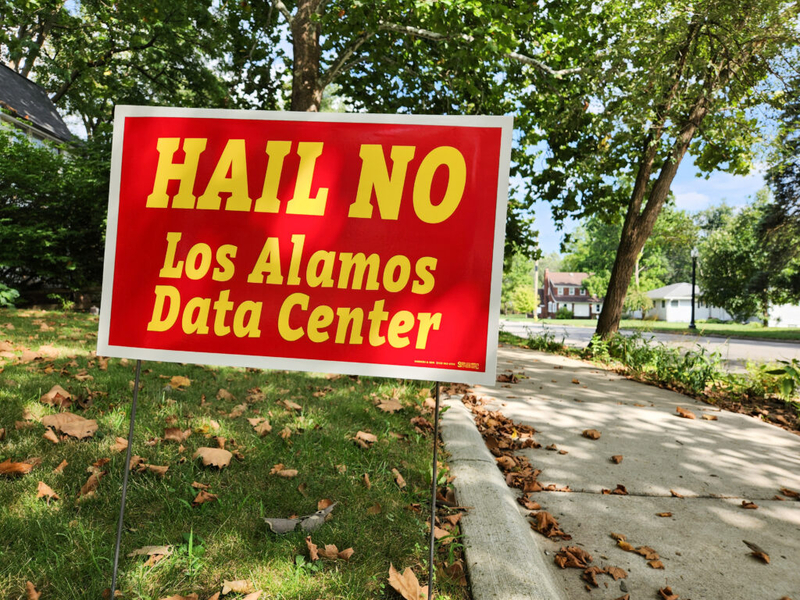
So far, he and other organizers have circulated a petition opposing the project and held a community meeting in July. The grassroots organization “Stop the Data Center” focuses on direct action that has earned some of its members a warning for trespassing. Township officials have ramped up opposition to the project as well, providing yard signs for residents and produced a series of videos criticizing the university.
But Kim said the union’s efforts are not connected to the township, its residents, or Stop the Data Center. They’re focused on learning more about the facility and who at the university makes decisions about the project.
“We’re looking to stop it completely,” he said. “It should not be built anywhere.”
What’s Changed?
Spaulding is concerned about how the stockpile stewardship program has changed over the past 30 years. He said the U.S. is no longer interested in only maintaining the stockpile – and that stewardship has evolved into modernization and design, including supporting the production of new weapons. Stewart Prager, a professor of astrophysical sciences at Princeton University, has similar concerns.
“When the stockpile stewardship program was initiated, it was explicitly stated in documents in those days that this will not be used to develop any new capabilities. Period,” he said.
The U.S. began a moratorium on nuclear weapons testing in 1992; the stockpile stewardship program followed in 1993. In 1996, the United Nations introduced the Comprehensive Nuclear Test Ban Treaty, which prohibited live tests of nuclear weapons. The treaty has never been enforceable, because some nuclear-capable countries – including the United States – never ratified it.
Prager’s research focuses on fusion energy, but he also contributes to Princeton’s Program on Science and Global Security. He said research capabilities have improved so much that the U.S. can use the stockpile stewardship data to improve weapons. That includes developing new ones – a departure from the program’s original intentions, he said.
Since the Obama administration, the U.S. government has made moves to modernize its nuclear stockpile to support the Department of Defense’s long-held nuclear deterrence strategy. The U.S. has committed close to $2 trillion to overhauling its stockpile and delivery systems. Spaulding said these policies are distinct from previous maintenance activity.
“There is a sort of paradigm shift happening right now in that the stockpile stewardship program has not previously introduced new designs to the nuclear arsenal,” he said. “And that is what we are now seeing happen with the actual introduction of one of the new warheads.”
Recently, calls for modernization have gained even more traction, Spaulding said.
“The U.S. is increasingly transparent about its desire to build new weapons and new capabilities rather than continue to maintain the ones we have,” he said.
President Donald Trump has said the U.S. should resume live testing and called on the U.S.’s allies to increase investment in their own nuclear programs. Before Trump’s second term, the Department of Defense said it was prioritizing nuclear modernization now that the U.S. has two nuclear-capable rivals (Russia and China). That’s a clear acceleration, Spaulding said.
“These programs are being funded at levels that are completely unprecedented,” he said.
The U.S.’s activities have reached a point where the country may be violating the test ban treaty, Prager argues.
“This does not maintain the status quo. This is proliferative,” he said. “And as one element that fuels a nuclear arms race.”
The university has assured critics that the facility won’t be manufacturing nuclear weapons. Kim argued in an op-ed in The Michigan Daily (the university’s student newspaper) that the university is still supporting the development of new weapons, even if it is not physically assembling the weapons.
Prager and Spaulding argue that there is a clear distinction between maintaining existing weapons and designing new ones. Ceccio, the university project lead, said they’re both part of the same project.
“It’s all a continuum of activities,” he said. “The bottom line being to enhance our national security.”
A Lack of Transparency
The university has pointed out that the facility will be doing more than nuclear weapons research. Los Alamos already uses its computation program to study topics like wildfires and fusion energy. And the university’s section would be used only for nonclassified, open science research, Ceccio said.
But the university and Los Alamos have provided few details about how much of the facility’s time and energy will go to nuclear weapons research.
It’s unclear how powerful this facility will be compared to previous supercomputers. The university is measuring the facility’s size in megawatts, similar to a commercial data center. But the supercomputers Los Alamos and other national laboratories currently use measure their computational power in FLOPS, a measurement of how many calculations a computer can run in one second.
A university spokesperson said the facility’s computing power would be determined during the design phase. Ceccio didn’t have specifics, but said the facility would definitely be an improvement on the supercomputers Los Alamos already uses.
“This would be the next generation of that,” he said. “So it’s not just bigger but potentially better.”
But without this metric, it’s hard to tell how the new facility could change Los Alamos’s work. More computing power means more potential to use large language models and other AI tools in Los Alamos’s weapons research. And the Advanced Simulation and Computing program includes AI applications for national security as part of its 2030 Vision.
Residents have expressed other concerns about the project, including its resource use, noise pollution, and the lack of transparency and collaboration with local officials. The township claimed in its March memorandum opposing the project that the facility would make Ypsilanti Township a target for foreign adversaries. Prager and Spaulding said that’s not likely, and a university spokesperson said neither the university nor Los Alamos had classified the facility using the language in the township’s memorandum.
The university is hosting the next informational town hall about the project on Sept. 9 at the Ann Arbor Marriott Ypsilanti at Eagle Crest. Registration for the in-person event is already full, but it will be available over Zoom as well. Ceccio said they’re expecting opposition, but want to hear what opponents have to say.
“We want to really listen and try to allay concerns and answer questions,” he said.
Spaulding and Prager said that as physicists familiar with the stockpile stewardship program, they had some questions.
“How devoted is this to weapons research, as opposed to these dual use areas of research in physics and engineering that traditionally have been the subjects of DOE and DOD collaborations and universities?” Spaulding said.
Prager said residents should be concerned about the facility’s effect beyond Ypsilanti Township.
“The real challenge is whether a Michigan resident, in evaluating the computer center, thinks it’s in their interest to take into account what this does to the likelihood of fueling a nuclear arms race.”
Press freedom is under attack
As Trump cracks down on political speech, independent media is increasingly necessary.
Truthout produces reporting you won’t see in the mainstream: journalism from the frontlines of global conflict, interviews with grassroots movement leaders, high-quality legal analysis and more.
Our work is possible thanks to reader support. Help Truthout catalyze change and social justice — make a tax-deductible monthly or one-time donation today.



+ There are no comments
Add yours