







Civil Society, Headlines, Human Rights, Press Freedom, TerraViva United Nations
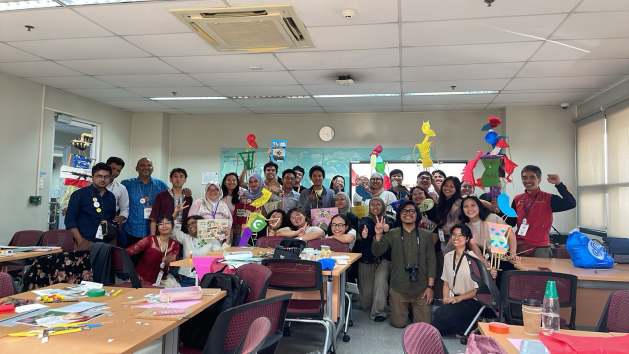
Collective care should not be reduced to practices that merely keep us strong enough to survive hostile conditions. Collective care should also make us question, resist, and transform the very systems of power that generate harm. Credit: Humanis
– “To respect strength, never power” is one of my favorite quotes from the acclaimed writer and activist, Arundhati Roy. For years, this quote has stayed with me. It encourages a way of life grounded in compassion rather than dominance.
It was particularly on my mind as I returned from the June 2026 Digital Rights Asia-Pacific Assembly (DRAPAC26) in Manila, an annual forum organized by EngageMedia. Co-hosted by local partners, the Foundation for Media Alternatives (FMA) and DAKILA, it brought together more than 800 digital rights practitioners, researchers, funders, journalists, technologists, and activists from across the Asia-Pacific region.
But my participation in DRAPAC started long before I arrived in Manila. Throughout the first half of 2026, through the Connect, Defend, Act! program, I had been engaging with civil society actors at workshops held across different regions.
Moving in harmony with one another
During a session on collective care at one of them, we asked if abstract principles like human rights, solidarity, resilience, and collective care could be translated into concrete care practices. If so, what would that look like?
One group responded with a local expression: “Na Pada Ajong Ta.” It means to move in harmony with one another, walking side by side and sharing a common rhythm.
I was instantly struck by the phrase.
We are constantly being told to “unite” by both figures of authority and agents of change. But what they want is us to move in the same direction, at the same pace, and with the same voice. Yet perhaps what we need is something closer to “Na Pada Ajong Ta,” walking side by side without marching in lockstep.
Resilience is important, but so is interrogating power
The DRAPAC Assembly took me back to these questions about power, accountability, humanity, and collective care, especially in the discussions on how we frame activists and human rights defenders.
An important discussion revolved around the growing glorification of the “resilience” of activists and human rights defenders. Stories of sacrifice, adaptation, and perseverance are often presented as inspiring accounts of brave individuals fighting for justice in increasingly challenging environments.
Yet I found myself wondering: What happens when resilience becomes an unquestioned virtue? What if our admiration for people’s endurance blinds us to the systems that oppress them? Or traps us in a worldview that celebrates those strong enough to endure, while those who struggle or fall behind are quietly left to fend for themselves?
So, interrogating power in conversations about resilience also means challenging a narrow understanding of collective care. It should not be reduced to practices that merely keep us strong enough to survive hostile conditions. Collective care should also make us question, resist, and transform the very systems of power that generate harm.
AI (just like any other technology) is never neutral
Throughout DRAPAC, countless sessions explored different dimensions of Artificial Intelligence (AI). For me, the most interesting ones treated AI as a political development.
One recurring insight was that AI outputs are shaped by far more than users’ prompts. They are also influenced by invisible system prompts, training datasets, institutional priorities, commercial interests, and political decisions embedded within the technology itself.
In other words, AI reflects the values, assumptions, and most importantly, the power relations built into it.
One of the most well-known principles in computer programming is the phrase “Garbage In, Garbage Out” (GIGO). At its simplest, the principle suggests that the quality of an output depends on the quality of the input.
But after the discussions at DRAPAC, I have come to see GIGO as more than a technical principle. It is also a political one. “Garbage In, Garbage Out” is ultimately a question of power. AI outputs are shaped not only by data, but also by the social, political, and economic structures that determine whose knowledge is collected, whose views and experiences are prioritized, and whose realities are ignored.
The power of the attention economy
Writer and scholar Alfie Bown’s 2022 book, Dream Lovers: The Gamification of Relationships, explores how human desires are increasingly shaped to suit certain economic and political agendas, creating a profound dependency on algorithm-driven technology.
At DRAPAC’s “Algorithm Anonymous” session, we also explored how digital platforms are actually systems of control designed to both capture attention and influence habits, desires, and emotional attachments.
We started off by acknowledging that our choices, behaviors, and things we pay attention to online are often shaped by algorithms. And we examined the deceptive design tricks used by websites and apps that get users to do things they hadn’t planned to, like buying something, sharing more data, or signing up for services.
Then we reflected on how social media, fitness applications, and health platforms create validation loops that encourage continuous engagement, often treating privacy and user agency as an afterthought.
The many forms power takes
As I left DRAPAC, I couldn’t help but think that Arundhati Roy’s reminder to “respect strength, never power,” is perhaps not enough. Because strength, much like power, also has layers that need to be scrutinized and questioned. And while doing so, we also need to re-examine our own roles and individual social and political identities.
We must be clear on where we stand in relation to the systems and structures around us. That doesn’t mean to stop questioning power, but to remain curious about the many forms it takes, including those we may have internalized without realizing it.











+ There are no comments
Add yours