








Author
Ahmed Barakat
Author

Share


More than 100 amendments have been filed to the Digital Asset Market Clarity Act ahead of the Senate Banking Committee’s scheduled markup on May 14, 2026, a volume that signals the bill has entered genuine horse-trading territory, not procedural formality.
Triple-digit amendments at this stage mean the legislative text is live, contested, and being reshaped in real time by competing institutional interests.
The markup, set for 10:30 a.m. in Dirksen Room 538, follows the House’s bipartisan 294-134 passage of the bill on July 17, 2025.
The White House has flagged a July 4, 2026 target for presidential signature, a deadline that gives the Senate roughly seven weeks to resolve disputes that have already derailed two prior markup sessions.
Discover: The best pre-launch token sales
What 100-Plus Amendments Actually Signal About the Clarity ACT Bill’s Fault Lines
The amendment volume is not noise. It maps, with unusual precision, exactly where the bill’s drafters left negotiating room, and where they didn’t.
The most contested provisions cluster around four areas: stablecoin yield treatment, DeFi protocol liability, digital asset mixer classifications, and software developer safe harbors under the Blockchain Regulatory Certainty Act provisions embedded in the Senate’s expanded nine-title structure.
Democrats, including Senators Elizabeth Warren, Chris Van Hollen, Angela Alsobrooks, and Raphael Warnock, have pushed ethics amendments that would bar public officials and their families from profiting on stablecoins or crypto while in office, alongside restrictions preventing big tech firms from issuing stablecoins.
Van Hollen’s “anti-corruption” and “anti-touting” disclosure amendments are framed as consumer protection measures.
Republicans, including Senators Cynthia Lummis, Bill Hagerty, and Thom Tillis, view that framing as a deliberate bill-killer, ethics language broad enough to suppress Democratic floor votes without being negotiable on substance.
The stablecoin yield debate is technically specific: amendments contest whether the bill’s language banning interest payments on stablecoins should include the word “solely,” a single-word distinction that determines whether yield-bearing stablecoin products are structurally compliant or categorically prohibited.
That is not a drafting detail, it is a market-structure decision worth billions in product revenue for issuers already operating in that space.
The CLARITY Act’s jurisdictional architecture, CFTC exclusive authority over spot and cash markets for “digital commodities” on decentralized blockchains, SEC retaining primary oversight over investment contracts and fundraising, remains the bill’s structural core.
Most amendments, analysts note, are negotiating tactics unlikely to survive the markup vote. The real question is which ones are concessions in disguise. That distinction determines the bill’s final shape more than the raw amendment count does.
What Passes the Markup, and What Stalls the Full Senate Floor Vote
If the Banking Committee clears the bill on May 14 with ethics language Democrats can accept, likely a narrowed version targeting Trump-family conflicts rather than a categorical ban, the Senate Agriculture Committee follows with its own markup, and the floor vote timeline toward July 4 holds.
If Warren’s coalition treats the ethics provision as a floor requirement and Republicans refuse to incorporate it, the bill exits committee on party lines and faces a 60-vote cloture threshold it cannot currently clear.
The banking lobby’s opposition to DeFi safe harbor provisions adds a second pressure vector. Banks have argued that developer liability protections create regulatory arbitrage, allowing DeFi protocols to operate without the compliance infrastructure that chartered institutions must maintain.
If that argument gains traction with moderate Democrats, the Blockchain Regulatory Certainty Act provisions get stripped or diluted, which fractures the crypto industry coalition that has been the bill’s most consistent Senate floor lobbying force.
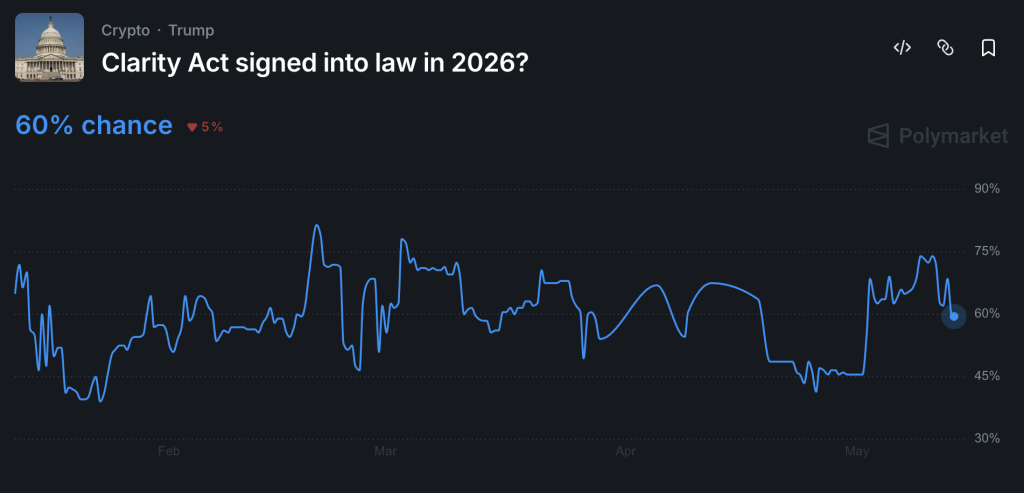
Bipartisan momentum is real, 78 House Democrats voted for the bill, and the CLARITY Act’s stablecoin reserve framework drew support from members who previously opposed crypto legislation. But House votes don’t transfer to Senate arithmetic. The 60-vote math is the decisive variable, and it runs through the ethics amendment.
The May 14 committee vote is the first hard signal on whether this Congress delivers a crypto market structure framework before the legislative calendar tightens. Everything after that depends on what the markup produces,x and which amendments survive it.