



Truthout is a vital news source and a living history of political struggle. If you think our work is valuable, support us with a donation of any size.
South Korea is often regarded as an example of a young and vibrant democracy. Merely two years ago, mass protests thwarted a self-coup attempted by the sitting far right President Yoon Suk-yeol. But due to an array of social factors, the support of wealthy donors like retail tycoon Chung Yong-jin (the chairman of the conglomerate that owns Starbucks Korea), and growing links to the U.S. right, an anti-democratic and reactionary movement is steadily picking up steam.
Seoul was a major overseas stop for far right influencer Charlie Kirk ahead of his September 2025 assassination. Kirk was the keynote speaker in 2025 at the annual rally of Build Up Korea, a far right group founded in 2023 by Mina Kim, a young conservative Christian educated in the U.S. who appears to be determined to create a reactionary youth movement in the image of Kirk’s Turning Point USA.
Kim also serves as president of EveryLife Korea, the national franchise of an anti-abortion diaper brand with a self-described “‘Make More Babies’ mission” in which Donald Trump Jr. holds a stake through a financial vehicle. In the U.S., the brand remains marginal, depending exclusively on mail order sales. In South Korea, however, its products are sold in Korea’s largest mass retailer (led by Chung) with about $20 billion in annual sales.
In a September 2025 interview with Charlie Kirk, Kim jokingly asked if he would sue her for imitating Turning Point USA’s tactics and politics. Participants were kept caffeinated throughout the two-day event by a seemingly endless stream of coffee donated by Starbucks Korea, which is owned by Shinsegae, the country’s largest retail conglomerate headed by Chung.
Starbucks Korea’s Role in Stoking the Rise of the Far Right
In addition to providing free coffee throughout the far right Build Up Korea conference, Starbucks Korea has also stoked anti-democratic forces in sweeping symbolic ways.
Starbucks Korea struck a nerve on May 18 when it launched a tumbler named “Tank” and branded the promotion “Tank Day.” It was a symbolic, and painful, affront to South Korea’s democratic legacy. May 18 marks the anniversary of the beginning of the Gwangju Uprising, the 10-day civilian resistance to the military coup of 1980, which was crushed by special warfare troops using tanks and armored vehicles to overrun the southwestern city of Gwangju.
The “Tank Day” fiasco enraged much of the South Korean public, triggering consumer boycotts targeting Starbucks, for which Chung holds the exclusive franchise rights in the country.
In an attempt to contain the fallout from the controversy, more than 2,000 Starbucks stores across South Korea closed early on June 21 to conduct historical awareness trainings for the company’s 24,000 or so baristas. The franchise reported that due to the early closure, it incurred 2.1 billion South Korean won ($1.4 million in U.S. dollars) in lost sales. But the closure was deemed necessary to manage the backlash Starbucks Korea was facing and contain fallout from the controversy that had been building around Chung.
In addition to providing free coffee throughout the far right Build Up Korea conference, Starbucks Korea has also stoked anti-democratic forces in sweeping symbolic ways.
Chung, a retail tycoon and longtime friend of Donald Trump Jr., is open about his far right views and has often made provocative remarks on X. These statements had largely been dismissed as the provocative musings of a powerful tycoon, buffered by the PR influence of his conglomerate.
The scandal also elicited media scrutiny from outlets worldwide, including The New York Times and The Financial Times. While most coverage focused on the conglomerate’s convoluted corporate governance, which allowed even a marketing promotion to be tailored to the chairman’s political taste in spite of public sentiment, it largely overlooked another dimension of the story: Chung has been helping bankroll a rising far right movement. He effectively put Mina Kim on his payroll by letting her selling her diaper brand through his vast retail network.
Meme-ing the Far Right Agenda
The Starbucks fiasco is already having rippling effects. On June 29, during a popular livestreamed baseball match, players on a Seoul team mocked their opponents from Gwangju, chanting “Let’s go to Starbucks” and “Tank Day” from the dugout while performing a choreographed gesture. Far right propaganda has leaned into entertainment value, with Build Up Korea and other right-wing variants flooding social media with short-form videos, memes, and catchy songs to attract teenagers and young adults.
The movement has drawn both ideological inspiration and tactical cues from the MAGA movement in the United States.
In early June, these emerging layers of the far right converged at Olympics Park in Seoul to protest what they claimed was election fraud. The government should bear some responsibility for the flare-up — ballots ran out at a polling station in the park a few hours before voting closed in a local election. As of this writing, hundreds of young far right elements are still squatting in the park, now blanketed with banners and posters promoting their conspiracy theory and slogans.
The movement has drawn both ideological inspiration and tactical cues from the MAGA movement in the United States.Protesters rallied almost daily in central Seoul, repeating slogans such as “Stop the Steal” and “CCP Out” (referring to the Chinese Communist Party), often in English. The demonstrations increasingly took the form of a typical MAGA rally, with heavy emphasis on social media
Over the past two years, the ties between MAGA and its Korean clones have deepened. At last year’s Conservative Political Action Conference (CPAC), conservative commentator Gordon Chang, a mendacious China hawk who has extended his acid-tongued rants to paint South Korea’s liberalism as pro-China and pro-North Korea, defended Yoon’s coup in his remarks. At this year’s gathering, Hwang Kyo-ahn, a conservative Christian and former South Korean prime minister — a role roughly equivalent to the U.S.’s vice presidency — alleged that the recent South Korean elections were rigged through a tripartite collusion of the South Korean left, North Korea, and China.
A Failed Coup Galvanizes the Far Right
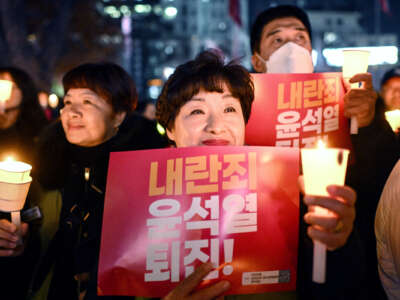
In much of the global imagination, South Korea has come to be seen as a democracy with a unique cultural cache — having transformed from a grim authoritarian industrial park into an emerging soft power conquering global cultural platforms with K-pop and K-dramas. This relatively new public image has often obscured the smoldering political tensions between the far right, liberals, and the left. That steadily growing cacophony finally broke containment on December 3, 2024, when then-president Yoon Suk-yeol abruptly declare martial law to stage a self-coup on the pretext of protecting the government from “communist and Chinese interference,” echoing far right conspiracy theories that CCP-hired hackers and North Korean operatives manipulated South Korean elections.
In response, South Korean citizens spontaneously took to the streets, supporting the legislature to override martial law. Because its people knew how they should respond to the president’s subversion of their hard-won democracy, South Korea appeared to emerge from the crisis with a new opportunity to renew its democracy. On the surface, the sequence of post-coup developments confirmed that belief — Yoon was impeached and swiftly tried for insurrection and Lee Jae-myung, of the liberal Democratic Party of Korea (DPK), was elected president in a snap election. Once again, these reassuring changes obscured a more troubling reality — the failed coup has revitalized, rather than demoralized, the far right.
Yoon’s ill-fated power grab provided far right forces with the momentum these once-fringe groups needed by drawing on their anti-China conspiracy theories and faith-based anti-communism. Yoon then further inflamed these fanatics by resisting arrest inside the presidential residence for more than a month. And he had success. In January 2025, Yoon’s supporters raided and torched a courthouse in Seoul, injuring 40 police officers, after the court extended the detention warrant for Yoon. Lee, the liberal DPK candidate, failed to win more than 50 percent of the vote in the snap election that should have given him a landslide win.
Meanwhile, the U.S. right stepped in to support Yoon. One of the first figures — Korean or foreign — to publicly approach the president during his attempted coup was Matt Schlapp, president of the American Conservative Union. At a CPAC forum attended by Steve Bannon in 2025, Schlapp claimed that Yoon believed Chinese technology firm Huawei was influencing South Korea’s elections, alleging that election servers were compromised by Chinese malware.
Fertile Ground for the Far Right
Shaped by Cold War politics and evangelical Christianity, South Korea is fertile ground for the far right. The country is home to five of the world’s 20 largest Christian congregations — including the largest Presbyterian megachurch and likely the largest Methodist megachurch as well — many of which were preaching prosperity theology long before it spread widely in the U.S. About 33 percent of the population identifies as Christian.
College-educated young men unable to secure work commensurate with their credentials have gravitated toward online subcultures of misogyny.
In the 1970s and 1980s, a succession of U.S.-backed military dictatorships permitted few large outdoor gatherings. Christian rallies were among the exceptions. A watershed moment came in 1973, when U.S. evangelist Billy Graham held his largest-ever crusade in Seoul under the auspices of President Park Chung-hee — a Buddhist who saw conservative Christian congregations as a counterweight to the rising labor ministry movement. The rally was broadcast nationwide and rebroadcast repeatedly. Megachurch expansion followed, as Billy Kim, Graham’s Korean interpreter and a Baptist pastor, later recalled.
Today, these congregations face a familiar problem: declining attendance in an aging, shrinking society. Their response has often been to rebrand — mobilizing homophobia, Islamophobia, Cold War anti-communism, and hostility to organized labor as adhesive forces for diminishing memberships.
Youth discontent provides a parallel current for the far right. South Korea’s youth unemployment rate sits around 7 percent — well under the Organization of Economic Co-operation and Development (OECD) average. The issue is not joblessness per se, but credential inflation without commensurate returns.
Roughly 77 percent of South Korean women aged 25-34 in 2023 had completed postsecondary education, and 63 percent of their male counterparts had as well, according to a recent OECD report. Yet 13 percent of South Korean men with postsecondary degrees in this age group were economically inactive at that time — neither employed nor seeking work. The standard explanation points to exam preparation. While the rate of economic inactivity among South Korean women aged 25-34 with a postsecondary education is even higher at 21 percent, pressure on them to seek employment has perhaps been less acute due to entrenched biases against working women, and those who do seek work experience a demographic imbalance that favors women in the labor market. Many inactive young men are studying for civil service and other competitive positions, where women have recently outperformed them.
The political implications are stark. College-educated young men unable to secure work commensurate with their credentials have gravitated toward online subcultures of misogyny and conspiracy theories — a Korean analogue to the U.S. incel phenomenon. In the post-coup period, many became foot soldiers of the far right. Women facing parallel frustrations have also joined in significant numbers.
At the risk of oversimplification, the traditional far right of older conservative Christians has joined with younger organizations such as Kim’s Build Up Korea to constitute a new force in alliance with the U.S. MAGA movement. When Kirk died, Kim’s group erected an impromptu altar for him in central Seoul. Build Up Korea and Free University, its campus affiliate, have since organized debates in Kirk’s signature style and anti-China protests, while mobilizing as the youth infantry of the movement to restore Yoon to power.
The older traditional forces have found a new face in Busan-based Presbyterian evangelist Son Hyun-bo, who launched Save Korea, a political movement, in the aftermath of the failed coup. The group has gained traction through its austere, disciplined rallies, drawing support from megachurches and conservative lawmakers. At one such rally, 37 lawmakers from the People Power Party (PPP) appeared, publicly endorsing Son’s claims of election fraud and his defense of Yoon.
In early September 2025, Son was detained for violating electoral regulations by holding rallies for conservative candidates without party affiliation. By then, however, he appeared to have gained the ear of U.S. Vice President J.D. Vance, who serves as a leading voice for Christian nationalism within the Trump administration. During a January meeting with his South Korean counterpart, Vance raised concerns about Son’s detention.
In January, a court released Son, waiving his six-month prison sentence. Upon his release, he claimed that his two adult sons had been invited to the White House on two separate occasions while he was in detention awaiting trial. Son also said that Alliance Defending Freedom, a conservative legal fund in the U.S., donated $15,000 to his legal defense.
MAGA Internationalism
South Korea’s MAGA-inspired far right realignment is not unique. From Europe to South America, MAGA has emerged not only as a source of inspiration but also as a provider of tactics, offering a flexible playbook that has proven effective in mobilizing younger generations.
At first glance, it may seem counterintuitive that a movement rooted in nativism and Christian nationalism would seek global influence. Yet another core pillar of MAGA is evangelical Christianity, which has long pursued transnational reach.
While cracks have surfaced within MAGA over the geographic scope and ambitions of the movement — especially in the wake of Trump’s assault on Iran — these divisions should not be overstated. So long as MAGA’s ideas continue to find receptive audiences abroad, amplified by the international ambitions of evangelical networks, the global reactionary movement will continue to grow. South Korea is a case in point.
An important fundraising appeal: 5 Days to raise $37,000
Truthout is one of only a few platforms for justice-oriented, grassroots journalism. Today, as political censorship from the right intensifies, we have no choice but to ask for your help.
We are fundraising right now to cover our basic operating expenses. If you can support Truthout with a one-time or monthly donation, you will make a significant impact on our work. Anything you can do makes a difference — we appreciate your support.

+ There are no comments
Add yours