






Active Citizens, Aid, Armed Conflicts, Civil Society, Climate Action, Crime & Justice, Environment, Featured, Freedom of Expression, Global, Headlines, Human Rights, TerraViva United Nations
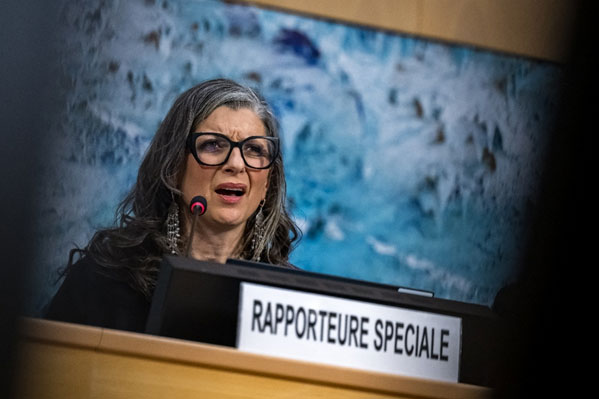
UN Special Rapporteur on the Occupied Palestinian Territories Francesca Albanese presents her latest report before delegates at the Human Rights Council in Geneva, Switzerland on 23 March 2026. Credit: Fabrice Coffrini/AFP
– For a few days in May, Francesca Albanese could live more easily. On 13 May, a US federal judge ruled that sanctions the Trump administration imposed on her violated her right to free expression. The government was forced to remove the UN Special Rapporteur on the Occupied Palestinian Territories from its sanctions list. But the reprieve lasted barely a week. On 27 May, after an appeals court suspended the ruling, the US Treasury restored sanctions.
The sanctions have been punishing. Due to the dominant role US institutions play in international financial transactions, Albanese can no longer use credit and debit cards. Her apartment in Washington DC has been seized, while Georgetown University ended her affiliation as a scholar. Her offence is to call out Israel’s genocide in Gaza and the occupation policies that preceded it.
An Italian citizen with a legal background, Albanese was appointed in 2022 and began her final term in 2025. She’s consistently been critical of Israel’s occupation of Palestinian territories. In 2024, she presented her Anatomy of a Genocide report to the Human Rights Council. The report found reasonable grounds to conclude that Israel was committing genocidal acts in Gaza, and called for an arms embargo. Her 2025 report, From Economy of Occupation to Economy of Genocide, set out the complicity of major companies in Israel’s human rights atrocities.
Albanese’s demands for justice have brought a fierce backlash from Israel and its allies. Israel called for her to be removed from her post and banned her from visiting Israel and Palestine. The Trump administration followed suit in calling for her sacking. When it imposed sanctions on Albanese last July, it was the first time these had been applied against a UN independent human rights expert.
Sanctions politicised
Albanese isn’t the only target. Democratic states have long applied sanctions against dictators, terrorists and human rights abusers, but the Trump administration is increasingly using them as a weapon against people who defend human rights.
This month, Israel received widespread international condemnation for its actions against the Global Sumud Flotilla, a civil society-led initiative to defy Israel’s chokehold on aid for Gaza and bring vital humanitarian supplies by sea. Israel intercepted the boats in international waters, abducted those on board and subjected them to sickening abuse. When Israel’s far-right national security minister Itamar Ben-Gvir posted a video of himself taunting the abducted activists, democratic states including Canada, Italy and the UK deplored his behaviour, and France and Poland banned him from their countries.
But the US government has done the opposite, imposing sanctions on four activists involved in organising the flotilla. The politicisation of sanctions is evident, given that one of Donald Trump’s first acts on returning to the presidency was to lift sanctions on violent Israeli West Bank settlers.
The International Criminal Court (ICC) is also a target. Last year the Trump administration sanctioned nine ICC officials. The measures came after the ICC issued arrest warrants on crimes against humanity and war crimes charges against Israeli Prime Minister Benjamin Netanyahu and ex-Defence Minister Yoav Gallant, and in retaliation for the court’s investigation into potential US war crimes in Afghanistan.
Trump sanctioned two ICC officials in his first term and has repeatedly attacked the ICC, with reports last year that his administration was threatening further sanctions to try to force revisions of the court’s founding treaty, the Rome Statute, to explicitly prevent it having jurisdiction over non-member states such as the USA. Early in his second presidency, he issued an executive order threatening sanctions against anyone who participates in the ICC’s investigations. This sweeping order enabled the sanctions against Albanese.
Trump has also weaponised sanctions to block climate action. Last year the International Maritime Organization was about to finalise a deal to limit the shipping industry’s greenhouse gas emissions. At the last minute, adoption of the new rules was postponed when Trump threatened sanctions against states that supported the emissions curbs.
Chilling effect
Beyond their immediate effects, sanctions help repressive states smear human rights advocates as criminals and terrorists. For Albanese, sanctions form part of a broader campaign to restrict her right to speak out. She has received death threats, which have also been levelled against her daughter.
A broader chilling effect on civil society is visible. Concern about being penalised for sanctions violations caused two US-based human rights groups to pull out of the ICC’s annual meeting last year. For the Trump administration, sanctions are part of a wider onslaught on the rights of people and institutions to demand justice for Israel’s many human rights violations. They’ve come alongside violence against US protests in solidarity with Palestine, deportations of activists and threats to throw young people out of university and defund education institutions.
The misuse of sanctions also forms part of a broader assault on the institutions and rules of global governance. At the same time that the Trump administration is twisting international norms about how sanctions are used and who they’re applied to, it’s also choosing which organisations to participate in and which rules to follow depending on what it sees as the US national interest, and lashing out at international bodies and processes that bring human rights scrutiny.
A single ruling, now suspended, was never going to be enough against the Trump administration’s increasing use of sanctions as a tool to try to silence people. The democratic states that condemned Israel’s abuses against the flotilla activists must show the same resolve when the world’s most powerful state turns sanctions against people whose only offence is to insist that human rights apply everywhere, including in Gaza.
Andrew Firmin is CIVICUS Editor-in-Chief, co-director and writer for CIVICUS Lens and co-author of the State of Civil Society Report.
For interviews or more information, please contact [email protected]





+ There are no comments
Add yours