





Africa, Climate Change, Crime & Justice, Economy & Trade, Education, Environment, Food and Agriculture, Headlines, Health, Human Rights, Humanitarian Emergencies, Migration & Refugees, TerraViva United Nations
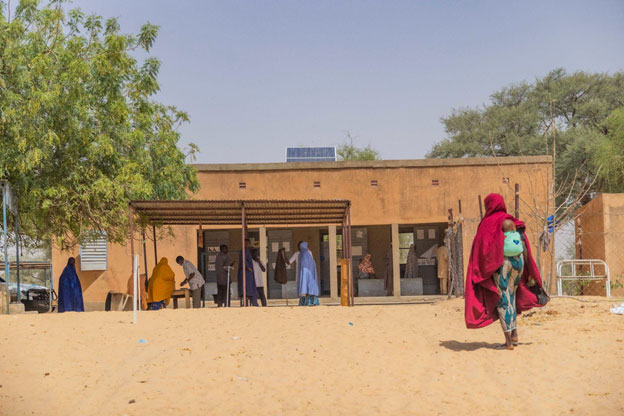
Niger, Mayahi, Village of Koren Habdjia. At the village health centre supported by UNICEF, mothers come for consultations with their children. This health centre provides care for childhood illnesses, maternal health, and pregnant women. It treats children for malnutrition and also provides delivery services. Credit: UNICEF/Islamane Abdou
– Over the past few years, the humanitarian crisis in Africa’s Sahel region has expanded considerably, largely driven by a surge of violence—particularly in the Central Sahel. Although the crisis has been described by the United Nations (UN) as having “largely faded from the headlines” since its wake in 2012, millions of people across the region are in dire need of humanitarian assistance as civilian displacement, climate shocks, and widespread hunger rapidly spill across borders.
“The people of the Sahel are not on the sidelines of a global crisis; they are at the very heart of one of the world’s most severe and neglected emergencies,” said Charles Bernimolin, the regional head of the Office for the Coordination of Humanitarian Affairs (OCHA) for West and Central Africa. “Every funding gap has a human cost. When we cut a program, a child loses a meal, women and girls’ protection, and a family loses hope. We cannot allow a financing collapse to become a death sentence for millions of people.”
On June 3, OCHA published the 2026 Humanitarian Needs and Response Overview (HNRO) for the Sahel, detailing a pronounced and escalating humanitarian crisis across Chad, Mali, Niger, Burkina Faso, Northeast Nigeria, and the Far North of Cameroon. OCHA estimates that approximately 24.3 million people across the region are in dire need of humanitarian assistance. According to the United Nations Children’s Fund (UNICEF), this includes 7.5 million children in central Sahel alone.
According to figures from the United Nations Regional Information Centre for Western Europe (UNRIC), the majority of terrorism-related murders in the world take place in the Sahel. Additionally, over the course of 2025, OCHA has recorded a sharp rise in civilian exploitation, significant disruptions to local economies, and the uprooting of entire communities across some areas.
The scale of needs is most pronounced in the central Sahel region, which hosts nearly three million internally displaced persons, roughly two million in Burkina Faso, 548,000 in Niger, and 415,000 in Mali. An additional one million refugees have been recorded across numerous neighbouring countries. According to figures from UNICEF, over 3.6 million people have been forcibly displaced as a direct result of violence this year.
In late April, the Office of the United Nations High Commissioner for Human Rights (OHCHR) recorded a series of large-scale attacks that targeted multiple municipalities across Mali—including the capital, Bamako—resulting in significant civilian casualties and exacerbated displacement. Subsequent attacks between the Mali police and armed groups were reported in the following days
OHCHR also reported numerous allegations of serious human rights violations following the attacks, such as extrajudicial killings and abductions. In May, Mountaga Tall, a Malian politician and lawyer, was abducted from his home, while his wife was assaulted. The whereabouts of Tall, his wife, and several other abduction victims remain unknown.
Additionally, the UN Committee on the Elimination of Racial Discrimination (CERD) issued findings on May 6 that showed a significant rise in human rights violations against the Fulani ethnic group in Burkina Faso. The Fulani were found to be subjected to extrajudicial killings, abduction, torture, enforced disappearances, arbitrary detention, and property destruction by state and non-state actors.
OCHA reports that armed groups have begun expanding their influence across the central Sahel and Lake Chad Basin regions, stripping entire communities of protection services and any form of governance. Approximately 12,900 schools are estimated to have been closed as a result of escalating instability, leaving over 2.3 million children without education and leaving them increasingly vulnerable to recruitment and exploitation.
Children have been particularly hard-hit by this crisis, with UNICEF recording over 1,500 serious human rights violations against children. Schools continue to be targets for attacks, as a school in Mopti, Mali, was impacted by the presence of explosive devices and armed activity in May, affecting approximately 300 million. In the same period, UNICEF also recorded an attack on a community health facility in Gao, which disrupted access to medical care for roughly 2,700 children.
Recurring climate shocks across the region continue to exacerbate the crisis, with the Sahel warming considerably faster than the global average. Figures from OCHA show that roughly 590,000 people in the Sahel were impacted by violent floods in 2025 alone, with prolonged droughts and widespread desertification devastating local agriculture
and millions of livelihoods.
Prolonged climate shocks and protracted armed conflict have led to the Sahel region forming one of the world’s most severe hunger crises. OCHA projects that from June to August, approximately 15.4 million people could face crisis-level food insecurity or worse, including 1.5 million who could fall into emergency levels.
UNRIC reports that reduced food rations in Mali have resulted in a 64 percent increase in famine across numerous areas, leaving 1.5 million Malians severely food insecure. Additionally, rising fertiliser costs in the Sahel further exacerbate low agricultural yields, while rising fuel prices drive increasing food and aid costs.
Despite the vast and growing scale of needs, humanitarian funding for the Sahel has plummeted in recent years. Support from the international community for the region has reached its lowest level in a decade, with only 29 per cent of funding goals met in 2025, prompting aid organisations to scale back responses and prioritise the most vulnerable populations.
“Across the Sahel, humanitarian actors are implementing a Humanitarian Reset: refocusing on the most urgent needs, simplifying the response, and making sure limited resources have the greatest possible impact,” said Bernimolin.
“This means making difficult choices, improving efficiency, and bringing decision-making closer to affected communities. It also includes acting earlier through anticipatory action, expanding cash assistance, and strengthening support to national and local organizations, who play a key role in reaching people, especially in hard-to-reach areas,” he added.
IPS UN Bureau Report







+ There are no comments
Add yours