







Honest, paywall-free news is rare. Please support our boldly independent journalism with a donation of any size.
In a “60 Minutes” interview that aired on Sunday evening, President Donald Trump admitted that Republicans’ massive defeats in the midterm elections resulted from widespread frustration with the war on Iran, as well as his immigration policies.
Reiterating that he “was not on the ballot” — as if to suggest that support would have been higher for him personally — Trump said that Americans “didn’t like the war” and “the fact that gasoline went up,” claiming he “had it down at a low” prior to launching the war. In Trump’s assessment, public opposition to his war on Iran is reducible to gasoline prices.
Trump also stated that Republicans’ massive losses during the midterm elections were due to “a great dislike, incredibly, for Israel” — characterizing growing opposition to the U.S.’s relationship with the genocidal state as mere “dislike.”
Trump then said that his immigration policies may have also affected the midterms, and that he may have been “too tough.”
“I think I got an A+ for closing up the border,” he said. “I get very high marks for getting the bad ones out. But I get hurt because we also took people that had good jobs, that created one violation, or breaking of the law, and that was that they came into the country illegally. And there’s a large group of people [that] think they should be allowed to stay.”
“So you think your deportation policy went too far?” asked CBS News’s Ross Douthat.
“I think it might be too tough,” Trump replied.
In the interview, Trump acknowledged a central contradiction in his administration: that he is caught between the priorities of his far right base, who “would like everybody taken out” [of the country], and the general population, which rejects his brutal policies.
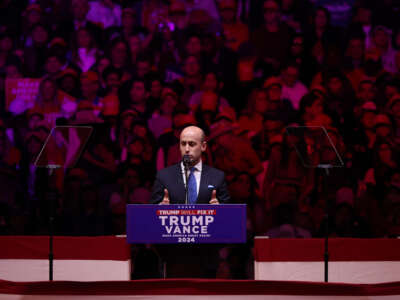
Shortly after his “60 Minutes” interview on Friday, Trump announced that he was promoting political advisor Stephen Miller to White House chief of staff — suggesting that he does not, in fact, plan to soften his approach to immigration enforcement. Miller is known as the hardline, white nationalist architect of Trump’s mass deportation policies, including his policy of family separation.
Over the past year of his administration, Trump has been forced to temper the most overt aspects of his immigration crackdown, after Immigration and Customs Enforcement’s (ICE) brutal “Operation Metro Surge” in the Twin Cities brought about widespread resistance, particularly after immigration agents killed Minneapolis residents Renee Good and Alex Pretti. As a result of widespread opposition, mass protests, and even a general strike in the Twin Cities, Trump replaced Department of Homeland Security (DHS) Secretary Kristi Noem with Markwayne Mullin, who promised that DHS operations would be less visible and stay out of the headlines.
While subsequent ICE operations have not been as brazen as that of Operation Metro Surge, the agency’s strategy has not fundamentally changed. In New York City in July and August, ICE’s “Operation Rotten Apple” resulted in the arrests of some 2,200 people — more than the amount detained by ICE during Operation Metro Surge earlier in the year. The New York City operation, however, managed to evade the same level of pushback, as ICE agents remained less visible, arriving in unmarked cars and detaining and disappearing people quickly, before resistance could emerge.
Trump also stated in the “60 Minutes” interview that he would work with Democrats on immigration. Indeed, his categorization of immigrants as either hard workers or “rough,” “drug dealers” and “killers” echoes rhetoric that has been key to both Republicans’ and Democrats’ approach to immigration since the 1980s — and to bipartisan “comprehensive immigration reform” policies that have increasingly ceded ground to the right.
While voters rejected Trump’s policies in the midterm elections, it is little surprise that Trump has offered to work with Democrats on immigration, as they do not represent an actual alternative to the criminalization, deportation, and precarity offered to undocumented immigrants and asylum seekers.
Meanwhile, the president’s promotion of Miller suggests that even as Trump’s own popularity falls, his aggressive deportation tactics are likely to continue.
An important fundraising appeal: 10 Days to raise $50,000
Donations are down for Truthout at a time when media is under immense pressure. Google’s AI search has driven our traffic down by 15 percent, Trump is arresting journalists, and many independent media organizations face heartbreaking cutbacks and closures.
At the same time, movement media is vital in the fight against Trump’s authoritarian reign. Our mandate to tell the truth, share strategies for resistance, and speak against fascism is ever more urgent in this deluge of political censorship and misinformation. Yet, we are struggling to meet our publishing costs when our work is so urgently needed.
We are fundraising right now for those basic operating expenses — we need $50,000 in the next 10 days. If you can support Truthout with a one-time or monthly donation, you will make a significant impact on our work. Anything you can do makes a difference.





+ There are no comments
Add yours