







Aid, Armed Conflicts, Crime & Justice, Economy & Trade, Food and Agriculture, Headlines, Health, Human Rights, Humanitarian Emergencies, Labour, Middle East & North Africa, Migration & Refugees, TerraViva United Nations
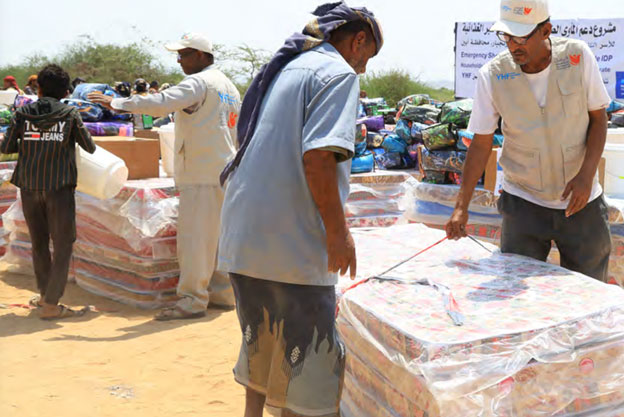
Distribution of emergency shelter supplies in Abyan, Yemen funded by the Yemen Humanitarian Fund (YHF). Credit: UN OCHA/Altawasul
– In Yemen, increasing funding constraints on humanitarian operations have put millions of civilians in dire need of life-saving assistance amid overlapping crises. Acute food insecurity is a persistent issue, as recent reports from the Integrated Food Security Phase Classification (IPC) give a stark warning of conditions without urgent intervention.
According to the IPC Acute Food Insecurity Snapshot, one in two people within Government of Yemen (GoY) controlled areas are experiencing high levels of food insecurity, with percentages only expecting to rise or maintain as the conflict goes on. 3.6 million people are experiencing IPC phase 3 (crisis level), and 1.4 million people are experiencing even worse conditions at IPC Phase 4 (emergency). Such measures indicate “extreme coping strategies” where families are forced to sell their house, land, their last female animal, and beg due to the limited supply of food.
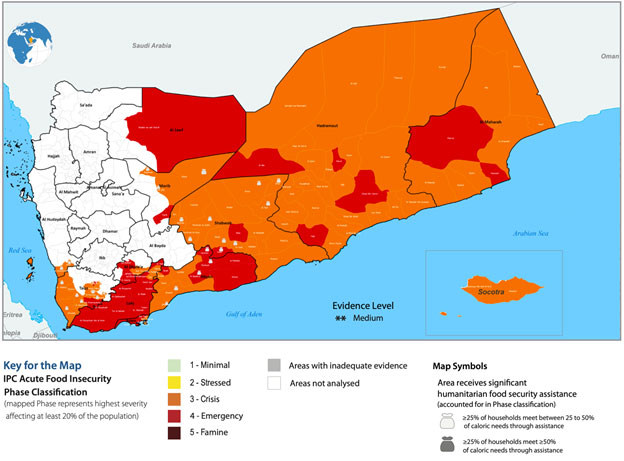
Food Insecurity Projection in Yemen | June – September 2026. Credit: IPC
As the crisis looms, the Food and Agriculture Organization (FAO), the World Food Programme (WFP), and the United Nations Children’s Fund (UNICEF) have “jointly called on the international community to urgently scale up funding for humanitarian food assistance, nutrition services, health, agriculture and resilience programming.” according to the spokesperson for the Secretary General, Stéphane Dujarric.
The IPC projects that food supply conditions will only worsen through October and December 2026, with 1.8 million people being in phase 4, 3.6 million being in phase 3, and 3.2 million being in phase 2.
The ongoing conflict is driving heightened amounts of food insecurity due to intensifying macroeconomic pressures, making the local currency, the Yemeni Riyal, highly volatile due to “depleted reserves of halted oil exports”. Insecurity is also impacted by irregular salaries, limited labor opportunities, and a smaller and smaller household purchasing power each day.
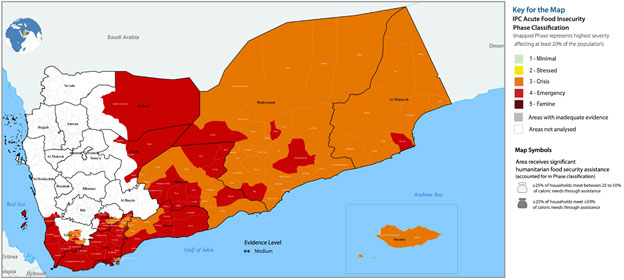
Food Insecurity Projection in Yemen | October – December 2026. Credit: IPC
In April, the Houthis, which controls the northwest of Yemen and the capital of Sana’a, threatened to close the Bab al-Mandeb Strait, which connects the Red Sea to the Gulf of Aden. In the event of this strait being closed, the entire red sea and the Suez Canal would virtually be unpassable other than a few exports / imports between Saudi Arabia’s western province, Egypt, Sudan, and Eritrea, which would likely still receive pressure at its ports. This would further increase food insecurity in Yemen, as humanitarian assistance is the only lifeline keeping Yemenis under famine levels. Without humanitarian assistance the situation would become increasingly lethal, making this call for action vital for the safety and vitality of Yemeni lives.
According to OCHA, at least USD 2.2 billion will be needed for assistance of twelve million people of the 22.3 million in need. Approximately 14.71 percent of such funding has been covered, leaving a funding gap of USD 1.8 billion. This is likely to become larger as the conflict becomes more costly, increasing food insecurity as the projections suggest.
IPS UN Bureau Report









+ There are no comments
Add yours