






Africa, Headlines, Health, TerraViva United Nations
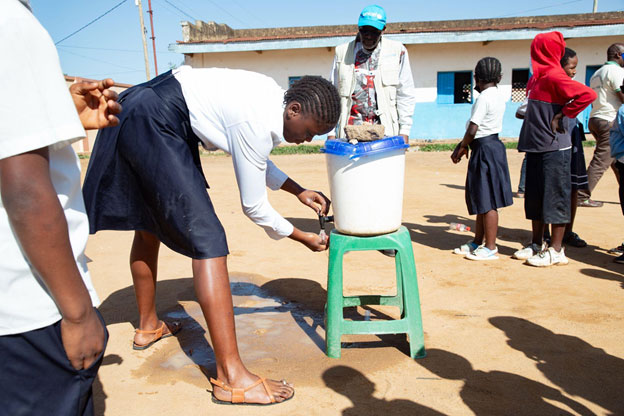
The world often asks whether we can afford to invest in preparedness before a crisis occurs. The more relevant question is whether we can afford not to. Credit: UNICEF/Carmel Ndomba Mbikayi
– When the world learned that Ebola was spreading across parts of the Democratic Republic of the Congo and Uganda, one fact stood out above all others: there was no approved vaccine for the virus responsible.
Not because scientists only recently discovered it.
Not because the technology does not exist.
But because the world never made the investment.
No Vaccine Exists Because the World Failed to Invest
The current outbreak is caused by the Bundibugyo ebolavirus, one of several species that cause Ebola disease. The virus was first identified in Uganda in 2007. Nearly two decades later, as hundreds of suspected infections and dozens of deaths are reported across Central and East Africa, health workers are confronting the same deadly disease without a licensed vaccine or treatment approved to prevent or treat it respectively.
This is not simply a scientific failure. It is a health equity failure.
The outbreak is unlikely to become another COVID-19. Ebola spreads through direct contact with bodily fluids, making it far less transmissible than airborne viruses. Yet the lesson it offers is no less important. It reveals whose health risks attract sustained investment and whose are allowed to remain neglected.
For years, global health leaders have warned that epidemic preparedness cannot focus only on threats that endanger wealthy countries. Pathogens do not become priorities because of their biological risks alone. They become priorities because of political attention, financial incentives and public visibility.
The result is a troubling pattern: communities facing the greatest risks often have access to the fewest tools.
Bundibugyo virus has caused only a handful of outbreaks since its discovery. Unlike the more common Zaire strain of Ebola, which drove major epidemics in West Africa and eastern Congo, Bundibugyo attracted relatively little research funding and commercial attention. While effective vaccines and treatments were developed for the Zaire strain, investment in countermeasures for Bundibugyo remained limited.
Now the consequences are visible.
The Outbreak Exposes a Global Health Equity Gap
Doctors and nurses in eastern Congo and Uganda are relying primarily on supportive care, isolation measures, contact tracing and community engagement to stop transmission. Scientists are racing to develop vaccines and treatments, but those efforts are occurring during an outbreak rather than before one.
The contrast is striking. We are witnessing extraordinary scientific mobilization precisely because the crisis has already begun.
The Cycle of Panic and Neglect Continues
Last week, Gavi, the Vaccine Alliance, announced up to US$50 million through its First Response Fund to accelerate vaccine development and support outbreak response. CEPI has committed tens of millions more to advance vaccine candidates being developed by Moderna, the University of Oxford and IAVI. The European Union has mobilized humanitarian funding and emergency supplies. The World Health Organization has activated its highest emergency response mechanisms and is coordinating clinical trials of potential treatments.
These investments are essential and deserve recognition.
But they also raise a difficult question: why did it take an outbreak to generate this level of urgency?
Scientists have understood the threat posed by Bundibugyo virus since 2007. Promising vaccine approaches have existed for years. Researchers have identified monoclonal antibodies that demonstrated protection in animal studies. Yet many of these efforts struggled to secure sustained funding once the immediate threat faded.
This is a recurring problem in global health. Funding surges during emergencies and recedes once headlines disappear. Research programs are launched and then abandoned. Preparedness becomes a priority only after vulnerabilities have already been exposed.
The result is a cycle of panic and neglect.
This is where the health equity dimension becomes impossible to ignore.
Health equity is often discussed as a moral imperative. It is that. But it is also a practical necessity.
Countries that rapidly detect outbreaks, share biological samples and alert the world to emerging threats are providing a global public good. The benefits extend far beyond national borders. Those countries should be able to expect that the products of scientific innovation—vaccines, diagnostics and treatments—will also be available to them in a timely and equitable manner.
Instead, we too often ask vulnerable countries to contribute to global security while denying them equal access to its benefits.
Preparedness Requires More Than Vaccines
The outbreak also highlights another reality that deserves greater attention: strong health systems remain the world’s best defense against emerging epidemics.
As Norway’s International Development Minister Åsmund Aukrust recently observed, “No country can face these challenges alone.” Experience from decades of global health cooperation shows that rapid detection, trained health workers, effective laboratories, community trust and resilient primary healthcare systems remain our most powerful tools against infectious disease threats.
Vaccines matter enormously. But vaccines alone are not preparedness.
The countries currently confronting Ebola understand this better than most. Uganda and the Democratic Republic of the Congo have some of the world’s most experienced Ebola responders. Their scientists, surveillance officers, laboratory teams, community leaders and frontline health workers have repeatedly demonstrated remarkable expertise and courage under difficult circumstances.
The international response succeeds when it strengthens local leadership rather than substitutes for it.
The broader lesson extends far beyond Ebola.
The next global health security emergency will begin where health systems are weakest, where surveillance gaps are largest and where scientific neglect has been allowed to persist.
The world often asks whether we can afford to invest in preparedness before a crisis occurs.
The more relevant question is whether we can afford not to.
On that test, the Bundibugyo Ebola outbreak should make all of us uncomfortable.
Mario Jimenez is a health economist working to increase access to immunization in low-income countries. He is a Senior Atlantic Fellow for Health Equity.
Ifeanyi Nsofor is a public health physician and co-founder of the Africa Behavioral Science Network. He is a Senior Atlantic Fellow for Health Equity. In 2015, Ifeanyi co-led the African Union’s Intervention to End Ebola and Strengthen Health Systems in Guinea, Liberia and Sierra Leone (ASEOWA).







+ There are no comments
Add yours