







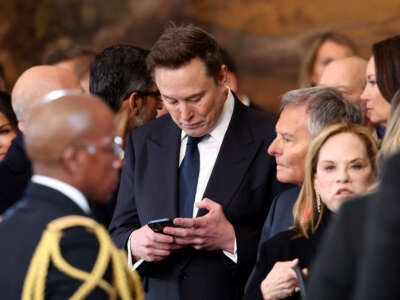
Musk gave three voters million-dollar checks, encouraging them to vote in the 2025 state Supreme Court election.
Truthout is a vital news source and a living history of political struggle. If you think our work is valuable, support us with a donation of any size.
The Wisconsin Elections Commission (WEC), a bipartisan panel that manages the elections process in the Badger State, has referred two felony-level complaints against Elon Musk to a local prosecutor’s office after he handed out checks to voters, encouraging them to vote in the 2025 state Supreme Court race.
The world’s first trillionaire (whose net worth recently slipped into multi-billionaire status) poured millions of his own dollars into that election, backing conservative, Trump-aligned Brad Schimel over the liberal candidate Susan Crawford. Musk also provided funding for a group that created deceptive ads during the campaign, spreading misinformation about Crawford in radio and TV ads.
Crawford wound up winning the election, defeating Schimel by nearly 10 percentage points in the most expensive court race the country has ever seen.
Despite his substantial spending in the race, it was Musk’s decision to reward would-be voters with million-dollar checks that resulted in the WEC investigating his involvement in the race.
Last week, the WEC, which is composed equally of Democratic and Republican members, voted 5-1 in favor of referring Musk to the Brown County District Attorney’s office, relating to his million-dollar checks to voters in Green Bay. District Attorney David Lasee, a Republican, will have 40 days to decide whether to seek charges against Musk.
Three Wisconsin voters (two of whom reside in Brown County) received checks for $1 million, which Musk said he was handing out as prizes to encourage people to vote in the state’s spring election. Musk also offered basic $100 checks to all voters who signed a petition to oppose “activist judges.”
Even though Musk never said the checks were contingent on who recipients voted for, state law forbids providing monetary incentives for people to vote or not vote. Per those statutes, “Any person who…offers, gives, lends or promises to give or lend, or endeavors to procure, anything of value, or any office or employment or any privilege or immunity to, or for, any elector, or to or for any other person, in order to induce any elector to vote or refrain from voting” is guilty of a Class I felony.
If convicted, Musk could be fined up to $10,000 and/or serve a prison sentence of up to 3.5 years.
Following Crawford’s win and the loss of his preferred candidate, Musk vowed to donate “a lot less” to political causes in the future.
Crawford’s victory secured control of the state Supreme Court in favor of the liberal bloc. A subsequent state Supreme Court race was also won by a liberal candidate, creating the current 5-2 majority for liberals on the bench.
In the past few years, the court has ruled in favor of reproductive rights in the state (including access to abortion) and found state legislative maps to be unconstitutional gerrymanders, ordering fairer maps to be drawn.
An important fundraising appeal: 8 Days to raise $47,000
Truthout is one of only a few platforms for justice-oriented, grassroots journalism. Today, as political censorship from the right intensifies, we have no choice but to ask for your help.
We are fundraising right now to cover our basic operating expenses. If you can support Truthout with a one-time or monthly donation, you will make a significant impact on our work. Anything you can do makes a difference — we appreciate your support.






+ There are no comments
Add yours