







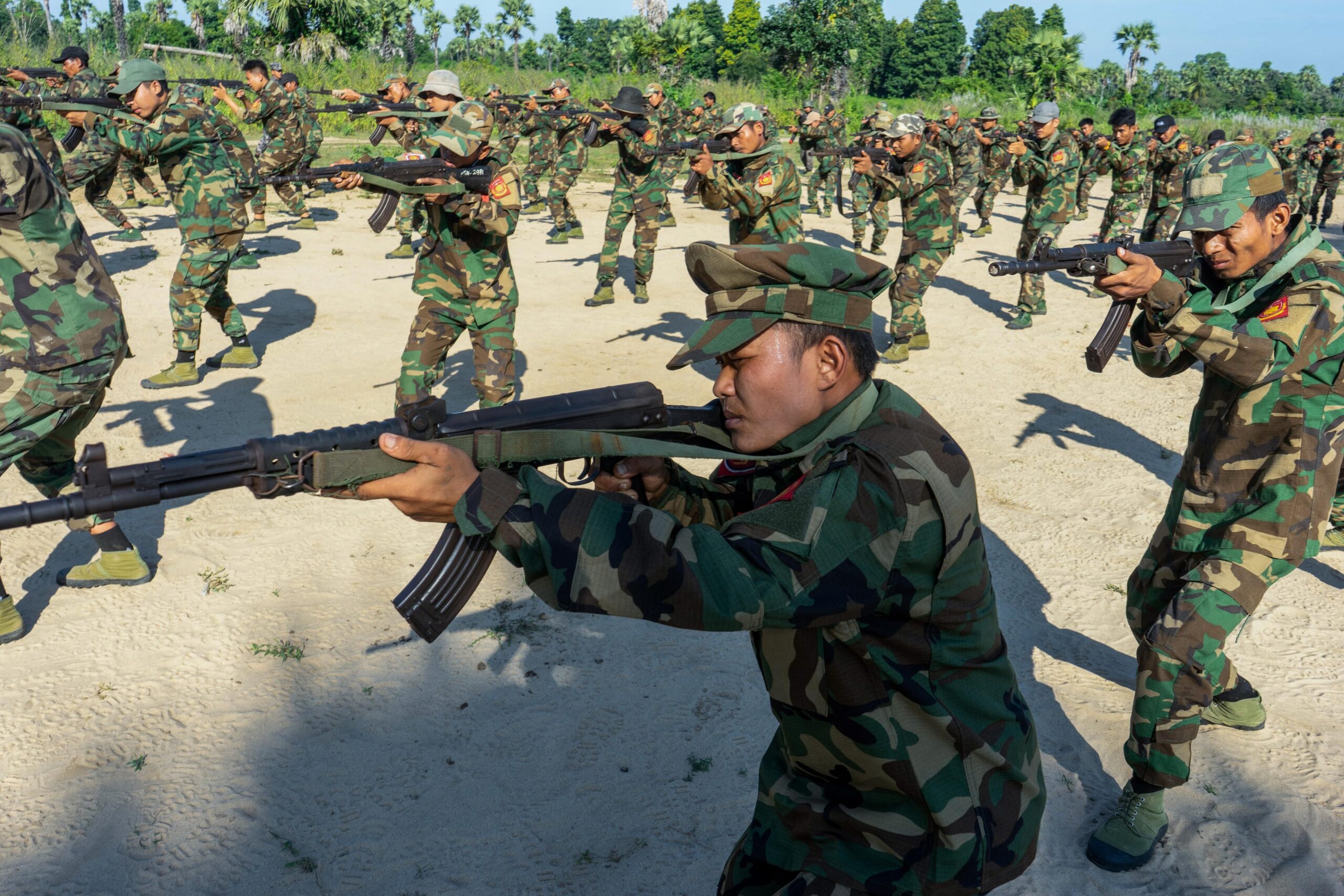
The Burmese people continue to suffer as the brutal civil war in Myanmar heads toward its sixth year.
The conflict was recently brought home to America with China’s arrest of Min Zin, an American citizen who heads the Institute for Strategy and Policy (ISP)–Myanmar, located in Thailand. Beijing accused him of spying.
China has increasingly close relations with the government in Naypyidaw, highlighted by the June visit to Beijing of Min Aung Hlaing, the commanding general who recently anointed himself Myanmar’s president. China helps Hlaing’s regime survive despite widespread popular opposition.
For decades the borderlands of Myanmar have been aflame, as ethnic minorities fought for the autonomy promised them when the country gained independence after World War II. The Tatmadaw, or military, seized power in 1962 and has ruled the country in varying iterations ever since. In 2021, Hlaing, disappointed by the hybrid civilian-led government’s refusal to make him president, staged a coup, ending Burma’s brief experiment in limited democratic governance.
In response to widespread protests, the regime “instituted curfews and other limitations on gatherings to curb the demonstrations. Doubling down, the military launched violent campaigns across the country, targeting resistance villages, and silencing and torturing dissenters, displacing thousands in the process,” according to the Council on Foreign Relations.
The junta detained tens of thousands of its citizens as the nation quickly returned to civil war, this time across almost the entire country. Most of Burma now lies beyond the Tatmadaw’s control; the regime is secure only in major cities.
The result is a humanitarian horror. Reports the New York Times: “Far from the spotlight fixed on Iran, Ukraine, Lebanon and other global conflicts, Myanmar, a Southeast Asian nation of about 50 million people, has quietly collapsed.” Tens of thousands have died. Hundreds of thousands have fled the country. Millions have been uprooted. Reports the European Commission: “Mass displacement continues at an alarming rate, with some 3.6 million people displaced as of December 2025, about 90% of whom have been displaced since February 2021.”
The conflict is religious as well. Nearly a decade ago, the military, backed by the civilian authorities, launched a brutal campaign against the largely Muslim Rohingya. As the United Nations’ refugee agency explained, “armed attacks, massive scale violence, and serious human rights violations forced thousands of Rohingya to flee their homes in Myanmar’s Rakhine State. Many walked for days through jungles and undertook dangerous sea journeys across the Bay of Bengal to reach safety in Bangladesh,” where roughly a million remain.
Many of the ethnic insurgents — especially the Kachin, Chin, and Karen, as well as smaller shares of the Lahu, Lisu, and Naga — are Christian. Against them the Tatmadaw has promoted Buddhism. Reported the Baltimore Council on Foreign Affairs: “Stated-owned newspapers and television channels report daily about Senior General Min Aung Hlaing and his inner circle making donations to monks, or building monasteries and images of the Buddha.” The regime has demonized religious minorities. According to Georgetown University’s Berkley Center: “the military planted and perpetuated the ideology that to be nationalist is to be Buddhist. … The military successfully used the polarizing ‘us vs. them’ rhetoric in portraying non-Buddhists as threats to the state and in capitalizing Buddhists as protectors of the Burmese race and effective guardians of Buddhism.”
I made my first trip to Karen-held territory more than a quarter century ago and have returned several times since. The region bordering Thailand was long ravaged by conflict, with many Burmese pushed across the border into refugee camps. A tenuous peace was established through a 2012 ceasefire, only to end after the latest coup.
Washington has sanctioned the Tatmadaw and its junta, but Southeast Asia worries little about the nature of ruling regimes. Most important, neither India nor China, competing for influence in Myanmar, is squeamish about working with murderous regimes. Both hosted Hlaing in June, with enhanced economic and security cooperation on the agenda. Analyst Jason Towers noted that Chinese leader “Xi Jinping’s frequent meetings and interactions with Min Aung Hlaing since the [2024] Myanmar earthquake send a strong signal that China is supporting his regime at the highest level.” Beijing has pressed insurgents in border territories to end attacks on the regime and the Tatmadaw to safeguard Burma’s natural gas and oil pipelines.
China is the regime’s principal weapons supplier and has blocked proposals for a United Nations arms embargo. Beijing has played a particularly important role in empowering Burma’s air force, which, according to the Special Advisory Council for Myanmar, “has increasingly deployed airstrikes on populated areas, targeting crowded markets, schools, places of worship, camps for internally displaced persons, and hospitals.”
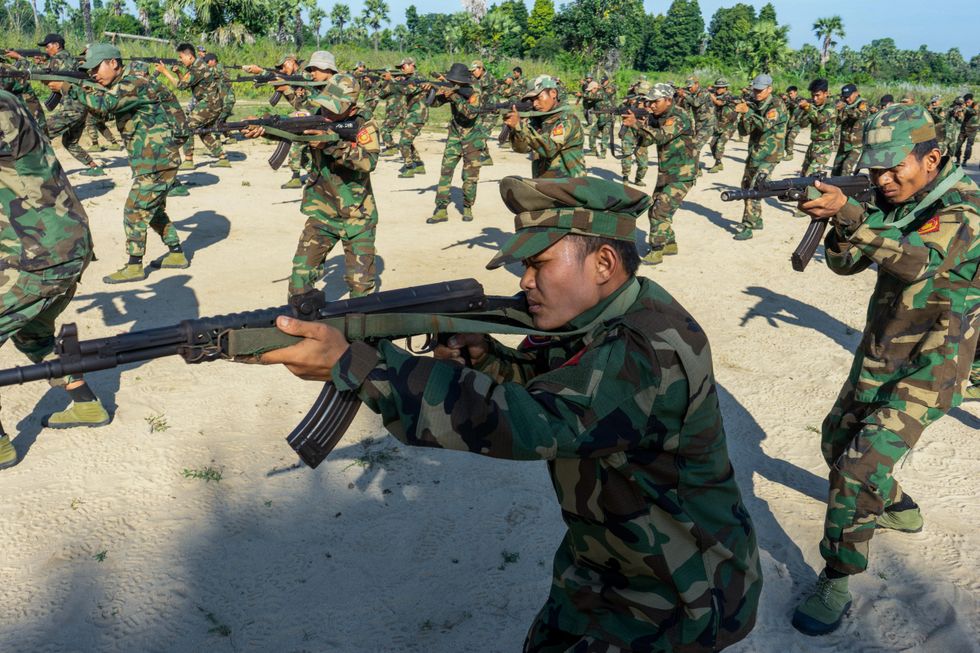
Beijing’s support may have prevented the Tatmadaw’s defeat, but the regime is still unlikely to prevail. It is estimated to control only about one-fifth of the country, half the share held by opposition forces, with the rest of the land contested. According to a Council on Foreign Relations analysis: “The People’s Defense Force (PDF) and its allies continue gaining key territory, pushing the military on the defensive in the Bamar heartland and advancing towards Mandalay. The military junta especially struggles to fight ethnic armed organizations across the country, which have made most of the territorial gains so far.”
Washington’s ability to influence the junta is limited. Economy-wide sanctions targeting the energy industry would injure Burma’s people more than the junta and probably would not crash the regime, given Chinese backing. Washington should do what it can to weaken the Tatmadaw, but that requires cooperating with European governments and especially Burma’s neighbors.
That won’t be easy, since China will remain the most influential foreign actor. The administration should engage Beijing on the issue, seeking to reduce its aid to Naypyidaw. Washington could offer a modus vivendi of sorts, indicating that its primary concern is humanitarian. Thus, Washington could promise to forgo any efforts to court a Burmese government resulting from changed Chinese policy.
An international reform effort led by Xi could better serve Chinese as well as international interests. The Tatmadaw’s ostentatious brutality and corruption ensure continuing conflict, while Beijing’s ability to positively influence events is limited. Cornell University’s Aung Thura Ko Ko observed: “Myanmar is not a chessboard Beijing can fully control. … The greatest long-term risk for China may be anti-China sentiment, which has long existed in Myanmar.”
In contrast, a push for regime change or at least reform, returning basic control to the Burmese people, could better protect Chinese interests. Defusing the conflict would reduce concerns over the security of energy supplies. Ending perceived Chinese support for the junta would relieve popular hostility toward Beijing. Indeed, the civilian regime overthrown by Hlaing had established good relations with its dominant neighbor, and China has maintained contact with opposition forces.
The conflict in Myanmar rarely makes the top of the news in any Western nation. However, it remains one of the world’s worst humanitarian horrors, which President Donald Trump should address. Obviously, Myanmar, under military rule for more than six decades, is a tough case. However, China, despite its official hospitality for Hlaing, should recognize that most of its contacts with Myanmar are about problems, many of them violent. Even for China, a more democratic peace might be a better option than continued unpredictable civil war.
From Your Site Articles
Related Articles Around the Web




+ There are no comments
Add yours