



Truthout is an indispensable resource for activists, movement leaders and workers everywhere. Please make this work possible with a quick donation.
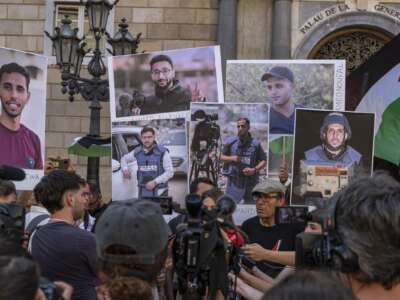
At a moment when Gaza’s journalists urgently need international protection and the solidarity of journalists and press freedom organizations worldwide — for their courage, their commitment, and their decision to remain in Gaza, sometimes sacrificing their lives to document the suffering of a population that has endured genocide for the past three years — the Committee to Protect Journalists (CPJ) has released a statement stating that some Gaza-based journalists will be removed from international protection lists because of alleged affiliations with military wings of Hamas and the Palestinian Islamic Jihad.
The decision cannot be separated from the broader Israeli policy of silencing Gaza’s remaining voices and further isolating the territory from the outside world, ensuring that the reality facing its civilian population remains unseen.
More fundamentally, however, the decision reinforces a narrative that casts Palestinian journalists as terrorists rather than reporters, replacing cameras with rifles in the public imagination.
That narrative bears little resemblance to the reality we have lived. I have worked as a journalist in Gaza for nearly a decade, and throughout this genocide, I have lost many colleagues.
Among them were Hassan Eslayeh, Fatima Hassouna, Muhammad Al-Jajeh, Hassouna Salim, Mahmoud Issa, and many close friends with whom I reported, investigated stories, and debated what needed to be covered.
According to the Gaza Government Media Office, as of May 3, 2026, 262 journalists had been killed during the war, 50 remained imprisoned, three were still missing, and 420 had been wounded, some with life-altering amputations.
Hassan Eslayeh was one of Gaza’s best-known journalists. He maintained professional relationships across the political spectrum — with various Palestinian factions, their media offices, local officials, and ordinary people alike. That is not evidence against Hassan being a journalist; it is evidence of journalism. Reporters depend on broad networks of sources to do their work. Contact with the media office of a political faction does not make a journalist a terrorist or a member of that organization.
The Israeli military tried to kill Hassan twice. The first attempt targeted the journalists’ tent. He survived but spent nearly a month recovering at Nasser Hospital in Khan Younis. I spoke with him almost every day whenever he was well enough to answer the phone. I once asked him, “They already tried to kill you once. Aren’t you afraid they’ll come back?” His answer never changed: “They want to kill every journalist in Gaza. After they kill me, they’ll say I was a terrorist or that I belonged to Hamas, even though I belong to no faction. That is how they will justify my death. The truth is that they want to silence my voice and erase my images from the world.”
During the second assassination attempt, Israel killed Hassan in an airstrike on the hospital burn unit, where he was getting follow-up treatment. The Israeli army released a statement calling him a terrorist and member of Hamas, with no evidence.
But who is the terrorist journalist — the one documenting a genocide, or the one justifying them?
The CPJ does not include the names of slain journalists in its database “if there is evidence that they were engaging in combat or inciting imminent violence,” according to CPJ CEO Jodie Ginsberg.
But if these standards are to be applied, do they apply only to Palestinian and Lebanese journalists? What about Israeli journalists, all of whom served in the Israeli military? Does military service in an army carrying out a genocide raise no comparable questions? These journalists continue their work after receiving military training alongside other soldiers. And as journalists, they actively incited genocide against Palestinians around the clock.
And there’s more. Some Israeli journalists even participated in war crimes while they were covering them. In October 2024, Israeli journalist Danny Kushmaro participated in the demolition of a home in a village in Southern Lebanon while filming himself doing it for a Channel 12 report. After pressing the button that blew up the house, he signed off by saying, “Don’t mess with the Jews.”
Palestinian journalists documenting the suffering of an occupied people are portrayed as suspects, while the perpetrators escape meaningful scrutiny.
Before he was killed, Hassan repeated this observation to me many times. “The Israeli military calls Palestinian journalists terrorists,” he said. “At the same time, it brings Israeli journalists into Gaza to witness, document, and celebrate the destruction of civilian homes and the killing of unarmed Palestinians.”
The double standard is staggering.
What about journalists like Fatima Hassouna? She spent her days moving from one place to another in search of opportunities to practice the profession she loved. We worked together on numerous stories before she was killed, along with members of her family, when the Israeli military struck their home.
After reading the Committee’s statement, I spoke with my friend and fellow journalist, Ahmad Jalal. His reaction was remarkably restrained.
“My friend,” he told me, “we survived a real genocide. We lost dozens — actually, hundreds — of colleagues. Yet not once did we see an international organization take meaningful action on the ground to defend Gaza’s journalists, help them remain in their work, or even provide moral support.”
Jalal put it differently. “Perhaps we are terrorists in their eyes,” he said. “Perhaps the camera that captures the image and shows it to the world is the real act of terrorism, not the person pulling the trigger. We film a child shot in the head by a soldier, an unarmed child walking down the street. We document that child’s death. Maybe the world does not want to see such horrors. Maybe this is our terrorism.”
As he spoke, it became clear that decisions like these mattered little to him. His attention remained fixed on the field, on his work, and on delivering images and testimony with professionalism and integrity.
Before we ended our conversation, he left me with one final remark.
“My friend, these organizations are Israeli institutions wearing the mask of international bodies,” he said. “A decision like this does not come from anywhere other than the machinery of the Israeli military.”
Press freedom is under attack
As Trump cracks down on political speech, independent media is increasingly necessary.
Truthout produces reporting you won’t see in the mainstream: journalism from the frontlines of global conflict, interviews with grassroots movement leaders, high-quality legal analysis and more.
Our work is possible thanks to reader support. Help Truthout catalyze change and social justice — make a tax-deductible monthly or one-time donation today.

+ There are no comments
Add yours