





Honest, paywall-free news is rare. Please support our boldly independent journalism with a donation of any size.
On Friday, Lebanon and Israel signed a framework agreement at the White House after months of direct negotiations coordinated by the Trump administration. Lebanese human rights experts and critics have condemned the agreement, saying that it does not mark a step forward for Lebanon, but rather, is a capitulation that continues Israel’s invasion and threatens to further endanger the country.
In remarks at a press conference Saturday, Israeli Prime Minister Benjamin Netanyahu called the U.S.-brokered framework agreement a “historic milestone.” He celebrated the separation of Israel’s war on Lebanon from negotiations with Iran, saying, “Lebanon, Israel, and the U.S. are essentially saying to Iran: This is none of your business. You have no status here. You have no involvement and no role, not you, not Hezbollah, and not any terrorist organization.”
Netanyahu has faced backlash within Israel after the U.S. excluded him from negotiations with Iran, and has followed it with bluster and threats against Iran, Lebanon, Syria, and Gaza.
The framework agreement between the U.S., Israel, and Lebanon calls for the “disarmament of non-state armed groups” and dismantling of their infrastructure – referring to Hezbollah, and any other group engaging in armed resistance against Israel from within Lebanon. It calls for the Lebanese Armed Forces (LAF) to “restore effective sovereign authority over all Lebanese territory.”
But the Lebanese Army was created as an internal security force, and not one that could defend the country from Israel. Of course, this works well with Israel’s goals for Lebanon, as it pushes for the replacement of Hezbollah, a force that is capable of resisting Israel’s occupation, with one that is not.
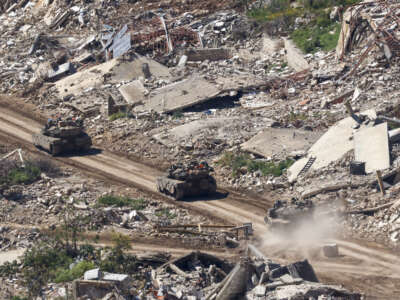
The LAF, the framework states, will then “gradually” assume control of so-called “pilot zones,” which will then lead to phased withdrawal of the Israeli army. But even this framing legitimizes Israel’s current occupation of south Lebanon, as if Israel is carrying out a necessary good rather than actively destroying vast civilian areas of the south.
The agreement notes that two initial “zones” have been agreed upon by Israel and Lebanon. On Friday, Netanyahu said Israel is leaving sites that it “does not need” in Lebanon. He also insisted that the framework allows Israel to maintain its “security zone” in Lebanon for as long as it needs – until Hezbollah is “disarmed” and “until there is no longer a threat to Israel from Lebanon.”
Calls for Hezbollah to be disarmed as Israel continues its invasion and occupation of Lebanon have already been rejected by many Lebanese, particularly those from the south. It is highly unlikely that the group could be forced to disarm as it is seen as the sole force protecting the south from Israel’s incursions.
The framework goes on to state that the U.S. and Lebanon will both work to prevent funds from reaching any individual, group, or organization “affiliated with non-state armed groups” and will “proscribe” any such group – again, referring largely to Hezbollah. But this will also be difficult, as Hezbollah is part of Lebanon’s government and has been for over 20 years.
Lebanese human rights and legal experts have also criticized Article 13 of the 14-point agreement, which directs Israel and Lebanon to “take good faith measures that demonstrate positive intent, including the cessation of all hostile or adverse actions in international political or legal fora.” This clause suggests that the Lebanese government has agreed not to pursue charges of war crimes against Israeli officials at the United Nations.
Human rights organizations have accused Israel of committing multiple war crimes during its war on Lebanon – including the forced displacement of over 1 million people, the deliberate targeting of civilians, and wanton destruction of civilian infrastructure.
The agreement concludes by thanking President Donald Trump for his “vision and leadership.”
Direct negotiations between Lebanon and Israel are unprecedented. Over the past year, factions of Lebanon’s government have turned against Hezbollah, under U.S. and Israeli pressure, and blamed Hezbollah for Israel’s latest war on Lebanon.
More than 4,200 people have been killed in Lebanon in the latest Israeli war on the country that began on March 2.
The war started after Hezbollah fired on Israel for the first time since 2024, in response to the U.S. and Israel’s killing of Ayatollah Ali Khamenei in Iran. But Israeli violations in Lebanon had not stopped since Israel’s 2024 war on Lebanon – with some 10,000 Israeli ceasefire violations recorded since the 2024 war.
Israel’s 2026 war on Lebanon has seen the largest invasion of the country since 1982, when Israel invaded and occupied the south of Lebanon until it was forced out in 2000. A multi-sect resistance movement in Lebanon fought against Israel’s incursions and occupation beginning in the 1970s, but ultimately, it was Hezbollah that forcibly ejected Israel from Lebanon in 2000.
Palestinian-Lebanese Ussama Makdisi, a historian at U.C. Berkeley, compared the agreement to a May 1983 agreement between the Israeli army and the weak, pro-U.S. Lebanese government installed after Israel’s 1982 invasion of Lebanon.
“Because it was so unpopular and illegitimate in the eyes of so many Lebanese, that ‘agreement’ was annulled following an uprising in February 1984 by various Lebanese militias and parties against the U.S.-backed government,” he said.
Today, Makdisi says, Israel has two models for Lebanon – one, the West Bank model, with a government that is subordinate to Israel’s will, and the other, the Gaza model, in which Israel ethnically cleanses and destroys the majority of south Lebanon, as it did in Gaza.
Ziad Abu-Rish, associate professor of human rights at Bard College and co-editor of Jadaliyya, told Truthout that the agreement is “impossible to successfully implement.”
“By signing onto this agreement, the participating elements of the Lebanese government have effectively conceded to Israel the latter’s framing of Israeli-Lebanese relations, Israeli strategic objectives in Lebanon, and Israeli military occupation of southern Lebanon—all in the context of a genocidal Israeli state without any constraints, whether they be in the form of international legal accountability, global arms embargo, bilateral sanctions, U.S. foreign aid cuts, or Israeli domestic opposition,” he said.
Press freedom is under attack
As Trump cracks down on political speech, independent media is increasingly necessary.
Truthout produces reporting you won’t see in the mainstream: journalism from the frontlines of global conflict, interviews with grassroots movement leaders, high-quality legal analysis and more.
Our work is possible thanks to reader support. Help Truthout catalyze change and social justice — make a tax-deductible monthly or one-time donation today.





+ There are no comments
Add yours