





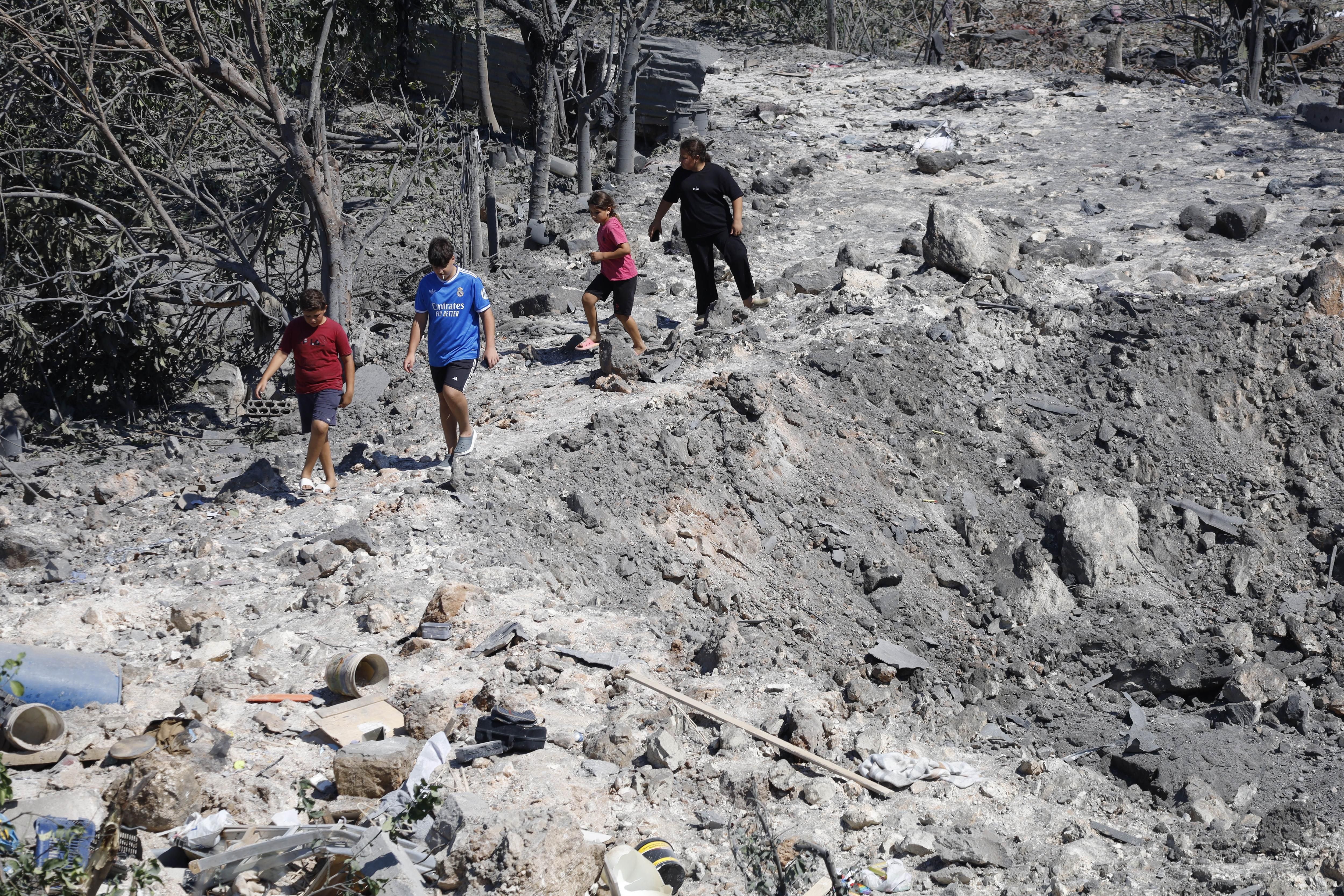
For two years, Israel’s war in Lebanon has been measured largely in a human toll: the dead, the wounded, the displaced. What has drawn far less attention is the destruction of the land itself.
Across southern Lebanon, a combination of incendiary munitions, systematic demolitions, and now aerial herbicide spraying has degraded large stretches of Lebanese territory to the point where it is difficult to farm, unsafe to inhabit, and in many places, unrecognizable.
American money and American weapons are behind nearly all of it.
Since the attacks on Lebanon escalated in late 2024, Israeli forces have made extensive use of white phosphorus munitions across the south of Lebanon. The Israeli military’s stated rationale is that phosphorus shells serve as smoke screens to mask troop movements and deny Hezbollah fighters cover; officials have denied using them intentionally to start fires.
But that rationale does not hold up well against the pattern of use. Investigations by outlets including Al Jazeera have documented phosphorus shelling that torched oak and pine forests, destroyed decades- and centuries-old olive groves, and left soil contaminated with lead and other heavy metals. These effects persist long after any potential tactical need for concealment has passed.
Lebanon’s National Council for Scientific Research has estimated $25 billion in environmental damages from strikes between 2023 and 2024 alone, including thousands of hectares of destroyed forest and orchard. Reporting from the border village of Ayta ash-Shaab documented the destruction of the Monk Forest, one of the last intact woodland refuges in the border zone, through phosphorus shelling and bulldozing that left what satellite imagery shows as white craters scattered across what had been continuous forest cover.
Where munitions have not flattened border villages outright, Israeli forces have often finished the job with remote-detonated explosives that level entire neighborhoods in seconds. Israel’s official justification is narrower than the phosphorus rationale: that Hezbollah has embedded military infrastructure – tunnels, weapons caches, command posts – inside civilian buildings over decades. But the scale, method, and permanence of what has followed makes that justification fall flat.
The Guardian reviewed footage of mass detonations in the villages of Taybeh, Naqoura, and Deir Seryan, in each case razing entire villages to the ground in a single blast rather than targeting individual structures; further mass detonations have been filmed and published by the Israeli military itself in Mhaibib and Majdal Zoun, in one case showing soldiers celebrating a village’s destruction on camera.
In Adaisseh and Kfar Kila, Lebanese state media reported explosions large enough that a single underground detonation was strong enough to trigger earthquake-warning systems in Israel.
Israeli Defense Minister Israel Katz has stated plainly that all homes in Lebanese border villages will be destroyed, comparing the plan to the demolition of Rafah and Beit Hanoun in Gaza, where the Israeli military leveled roughly 90% of homes. Journalist Lylla Younes, reporting from her own family’s region near Bint Jbeil, described entire villages reduced to “moonscapes,” terrain so thoroughly cratered and flattened that residents have resorted to purchasing satellite imagery just to determine whether their homes still exist, since they cannot physically reach the villages to check.
The detonations are also setting the land on fire, independent of the phosphorus shelling described above. “What our documentation increasingly shows, particularly over the past two months, is a sharp rise in fires coinciding with or following large-scale Israeli detonations and the demolition of entire neighbourhoods, particularly in occupied border areas and their immediate surroundings,” said Dr. Hisham Younes, president of Green Southerners, a Lebanese environmental organization working to protect South Lebanon’s natural heritage. “But the destruction is not confined to these areas; it extends further into different parts of South Lebanon.”
Israeli military maps released this spring marked a red line running through 21 villages and barred residents from returning to more than 50 others. A CNN review of satellite imagery identified newly built Israeli forward operating bases positioned inside Lebanese territory. NPR’s reporting from the village of Mansouri described a town center reduced to rubble – shops blown open, homes crumpled, a mosque burned with its minaret split in two – six miles from the border but now sitting inside the militarized “yellow line.”
U.N. human rights experts have described the pattern of blanket evacuation orders and systematic housing destruction as consistent with what has happened in Gaza, and rights groups have said the mass remote detonations, as distinct from targeted demolitions, could amount to wanton destruction under the laws of war.
In early 2026, Israel added a third tactic: aerial spraying of glyphosate, a controversial herbicide, across roughly 11 miles of the southern border. Israeli officials described this to Lebanon’s U.N. peacekeeping mission as routine vegetation management using “approved substances,” intended to clear dense brush that could conceal infiltration. Lebanon’s agriculture ministry found levels 20 to 50 times higher than normal agricultural use, which could sterilize soil and prevent regrowth for years. Independent Dutch research organization PAX estimated between 1,000 and 1,600 acres of land affected on the Syrian side of the border alone, with additional spraying on the Lebanese side that satellite imagery did not fully capture.
Israel initially told U.N. peacekeepers the sprayed substance was “non-toxic.” Laboratory testing subsequently confirmed Israel’s use of glyphosate, a chemical the World Health Organization’s cancer research arm classifies as probably carcinogenic to humans, which helps explain why it is banned outright in both Lebanon and the European Union.
The herbicide is blanketing land already stressed by years of phosphorus and heavy-metal contamination, compounding damage to soil, pollinators, and an agricultural economy that roughly 80% of southern Lebanon depends on. Lebanese President Joseph Aoun called the spraying “a flagrant violation of Lebanese sovereignty and an environmental and health crime.”
Each of these three tactics has an official Israeli justification that sounds reasonable in isolation: smoke screens, tunnel denial, brush clearing. What is harder to explain is why, in each case, the actual scale and persistence of the harm so far exceeds what the stated rationale requires.
“Heavy bombardment, incendiary attacks including white phosphorus, demolitions and chemical spraying have destroyed, contaminated and degraded these landscapes, while the extensive use of explosives has physically reshaped the terrain itself,” Younes said. “Taken together, we see this as a systematic process of destruction and place erasure, progressively dismantling the ecological and physical foundations that make return, recovery and continued life possible”
The practical result is a southern Lebanon that an estimated 600,000 residents, per Israel’s own defense minister, will not be permitted to return to, in villages that in some cases no longer exist in a form their own residents can identify from satellite imagery.
This is not the conduct of a few rogue units. It is what the entire U.S.-armed Israeli military has done, systematically, for two years, and it calls for a systemic response.
Most of what’s being destroyed won’t recover in any of our lifetimes, if it recovers at all. The response has to match the scale of the destruction: cut off the military aid sustaining it, before it’s too late.
From Your Site Articles
Related Articles Around the Web


+ There are no comments
Add yours