




Asia-Pacific, Biodiversity, Climate Change, Climate Change Finance, Combating Desertification and Drought, Conferences, Conservation, Development & Aid, Economy & Trade, Editors’ Choice, Environment, Featured, Global, Green Economy, Headlines, Indigenous Rights, Least Developed Countries, Natural Resources, Ocean Health, Small Island Developing States, Sustainable Development Goals, TerraViva United Nations
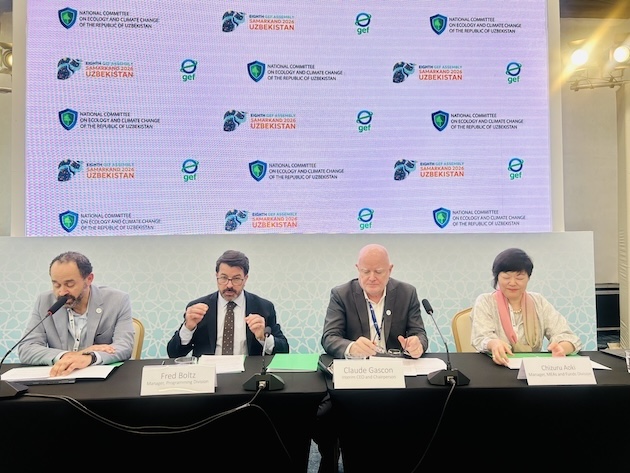
Alexandre Pinheiro facilitates a GEF press conference at the conclusion of 71st GEF Council in Samarkand, Uzbekistan. The conference was addressed by Fred Boltz, Manager, Programming, Claude Gascon, Interim CEO and Chizuru Aoki, Manager, MEAs and Funds Division. Credit: Stella Paul/IPS
– As the Global Environment Facility (GEF) steps into the starting blocks of its next financial cycle, the Interim CEO Claude Gascon reflects on what he termed a “moment of transition and delivery”.
He was speaking at a press briefing on the eve of the Eighth GEF Assembly, which is scheduled to begin tomorrow (June 4).
“We are looking towards the past successes of GEF-8 with very strong results as well as looking forward to the next four years launching GEF-9 with a “sharper focus on impact, speed and scale.”
The GEF-9 replenishment, which was approved in Council, will be presented in the Assembly tomorrow and sends a strong signal: “Multilateral collaboration still matters in the world,” Gascon said as the 71st Council of the GEF concluded in Samarkand, Uzbekistan.
Donor countries pledged an initial USD 3.9 billion to help developing countries accelerate their progress towards 2030 environmental goals.
“The USD 3.9 billion represents the initial set of pledges,” he said, adding that despite fiscal pressures globally, “In this climate, it is a very, very strong signal.”
Gascon emphasised that discussions with donor countries are still ongoing.
“We are confident that over the next six to 12 months, we will get significantly higher pledges,” he said, noting that these could be integrated into the GEF‑9 financial framework as they materialise.
Chizuru Aoki, Manager of the Multilateral Environmental Agreements and Funds Division, pointed to upcoming global environment meetings as likely venues for new commitments.
“We are expecting to hold pledging sessions on the occasion of CBD COP17 (the biodiversity COP), as well as other COPs (climate change and desertification),” she said. “The COPs tend to be a very good occasion for a new announcement to be made.”
With public finance under pressure, the GEF is placing greater emphasis on blended finance and other innovative mechanisms to stretch limited resources.
Fred Boltz, head of the Programming Division, said such instruments are “very much in demand” and increasingly central to GEF operations, though not a substitute for core funding.
Gascon clarified how blended finance is structured within GEF operations.
“The blended finance that the GEF puts in is, in fact, grants that we give to countries to develop blended finance projects,” he said. “The GEF portion… is not expected to be paid back by the country.”
He added that even if projects fail, “the GEF money basically is lost”, underscoring the institution’s role in absorbing risk.
This ability to take on risk is designed to attract private capital.
“GEF money can come in and decrease the interest rate or allow the technology to be adopted,” Gascon said, explaining that such support helps make projects commercially viable and encourages private sector participation.
Examples of innovative financing include biodiversity-linked instruments such as species bonds. These allow private investors to fund conservation efforts, with returns tied to measurable outcomes such as increases in wildlife populations. Such models avoid adding to public debt while expanding conservation funding.
The GEF-9 replenishment package introduces structural reforms to make the GEF faster, simpler, and more accountable, ensuring resources reach countries more efficiently, with key strategic priorities including:
- Integrated Programs targeting systemic transformations across nature, food, urban, energy, and health systems to integrate the value of nature in production and consumption systems.
- Blended finance at scale, with an aspirational target of programming 25 percent of resources to mobilize private capital.
- Whole-of-government and whole-of-society engagement, deepening participation of civil society, youth, women, and the private sector.
- Strengthened support for vulnerable countries, with 35 percent of resources directed to support LDCs and SIDS, and 20 percent to support Indigenous Peoples and local communities.
GEF-9 will also allocate USD 100 million to an Indigenous Peoples and local communities Conservation Initiative, four times more than in the previous GEF investment cycle. The initiative provides dedicated and direct funding to Indigenous-led organisations and contributes to their strengthening to enable their participation in GEF projects as executing agencies and funding intermediaries to enhance access.
Aoki highlighted that diversified funding approaches will complement, not replace, traditional sources. At the same time, she reiterated the importance of continued donor engagement.
“Please be on the lookout,” she said, referring to potential pledge announcements linked to upcoming COPs.

The stage is all set for the Eighth Assembly of the Global Environment Facility, which is scheduled to begin on June 4 at the Congress Center in Samarkand, Uzbekistan. Credit: Stella Paul/IPS
Eighth Assembly – a ‘Forward-Looking’ Forum
The financing discussion comes as the GEF prepares for its Assembly, which Gascon described as a “forward-looking” forum distinct from the Council’s administrative role.
“The assembly is much more to look forward – trying to bring new ideas and new thoughts,” he said.
Gascon stressed that the Assembly’s main task will be to consolidate emerging ideas into practical directions. “We want to distil those messages into a few key messages that the assembly can adopt,” he said, adding that these will guide implementation during the GEF‑9 cycle.
He also reiterated the GEF’s mandate within the broader global environmental governance system. “We are not here to decide what the COPs should do,” Gascon said. “We are here to implement the guidance that they give us.”
He added that COPs also review GEF performance and provide further direction.
Country Funding
Whatever funding was available, Gascon stressed that the GEF model ensures that recipient countries have 100 percent of the decision-making power in the use of their resources.
“And so, if you go to a restaurant, you have the choice of choosing different dishes on the menu. The same applies to countries; they have GEF programming directions, which serve as a menu for how they can spend their dollars,” said Gascon.
On country eligibility, Aoki confirmed that countries graduating from Least Developed Country (LDC) status will continue to receive support during a transition period.
They will have two more rounds of funding,” she said, describing the approach as a “soft landing”.
These countries include Vanuatu, which graduated from LDC to Developing Countries during the GEF-7 and Bhutan, which just graduated. She added that countries like Bangladesh that chose not to graduate despite being qualified remain unchanged in status.
“If they have not graduated, they have not graduated… nothing changes.”
Addressing suggestions raised informally during Council discussions, which included removing China from the list of GEF’s funding recipients and moving the Cali Fund from the UN Convention on Biological Diversity (UNCBD) to the GEF , Gascon made clear that the GEF does not independently consider proposals outside established governance processes.
“Our guidance comes from the COPs,” he said.
Looking ahead, Gascon identified adoption of the GEF‑9 package as the primary benchmark for Assembly success. “The most important [outcome] is for the Assembly to adopt the GEF‑9 package,” he said, calling it a key signal to the institution’s 186 member countries.
The overall message from GEF leadership is a recalibration rather than a shift: continued reliance on public pledges, expected to grow over the coming months, combined with a stronger push to use grant capital to unlock private and philanthropic investment.
“We are looking towards the past successes of GEF-8 with very strong results as well as looking forward to the next four years, launching the GEF-9 with a sharper focus on impact, speed and scale,” Gascon said.
IPS UN Bureau Report
Note: The Eighth Global Environment Facility Assembly is underway until June 6, 2026, in Samarkand, Uzbekistan.
This feature is published with the support of the GEF. IPS is solely responsible for the editorial content, and it does not necessarily reflect the views of the GEF.





+ There are no comments
Add yours