







On July 28, Saudi air defenses shot down drones launched from Iraqi territory by “Iran-affiliated terrorist militias,” a Saudi ministry of defense statement read.
The attacks targeted oil facilities in the Eastern Province and at the capital, Riyadh, itself. Days earlier, Houthi forces in Yemen said they had hit “sensitive” oil transport sites linking the Eastern Province to the Red Sea export hub of Yanbu. Satellite images showed smoke over the kingdom’s most important oil infrastructure.
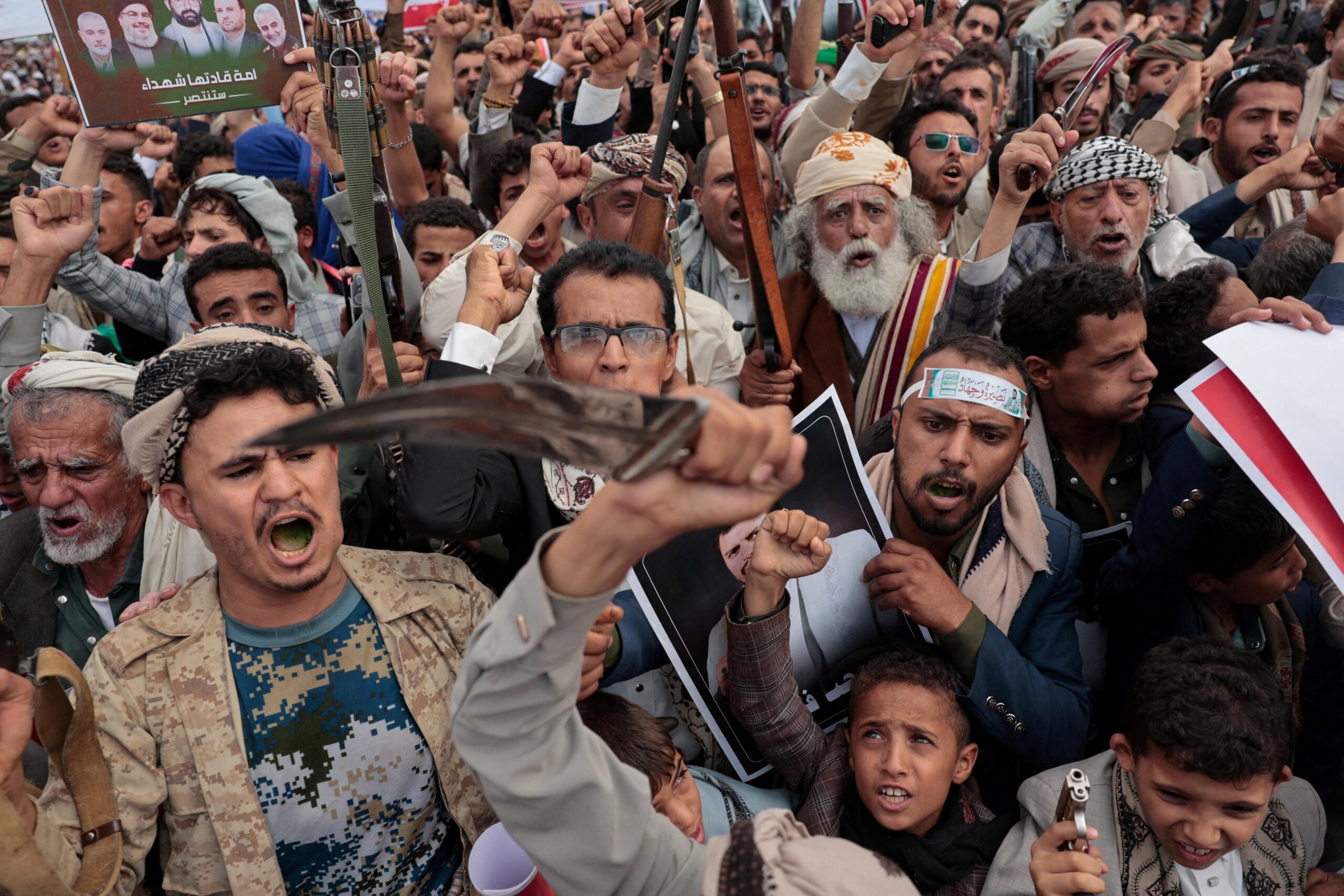
Both attacks come amid a wider escalation that began with the Houthis’ declared naval blockade of Saudi ports, followed by strikes on several ships and an exchange of missile fire with the kingdom. The Houthis say they will lift the blockade only once Saudi Arabia ends what they call a “blockade” on Yemen; they also have separate financial demands, chiefly, a demand for public-sector salaries and a share of the revenue from Yemen oil industry, which is located in territory held by the internationally recognized, Saudi-backed government of Yemen.
Saudi Arabia is now being squeezed from three directions in the widening U.S.-Iran war — Iraq to its northeast, Yemen to its southwest, and Iran to its east. (On July 18, Tehran struck Prince Sultan Air Base near Riyadh, its first direct hit on Saudi soil in nearly four months.)
To understand why this matters beyond the price of oil, it helps to picture the crises as a set of nesting dolls.
The innermost doll is Yemen’s own civil war: a decade-old fight between the Houthis (officially known as Ansar Allah), who rule the populous north from Sana’a, and Yemen’s internationally recognized government, formally led by a body called the Presidential Leadership Council. The roots of this war trace to the 2011 Arab Spring revolution, which toppled Yemen’s long-serving president and left a power vacuum the Houthis moved to fill, seizing Sana’a in 2014. Saudi Arabia and a coalition of partners intervened in 2015 with the explicit aim of reversing that takeover and restoring the internationally recognized government, and the war has continued in one form or another ever since.
The middle doll is Saudi Arabia’s broader rivalry with Iran, a contest for regional leadership that has run since Iran’s 1979 Islamic Revolution, when Tehran’s new theocratic government began exporting a revolutionary, Shia-inflected challenge to the Gulf’s Sunni monarchies.
Since the Houthis’ seizure of Sana’a in September 2014, Iran has absorbed the group into what it calls its “axis of resistance,” supplying it with weapons, funding and technical know-how, turning Yemen into an arena of proxy war between Tehran and Riyadh.
The outer doll is the American-Iranian war itself, now in its sixth month, which has all but closed the Strait of Hormuz and pushed oil prices to record highs. This conflict set the other two into motion.
Since March 2022, an unofficial truce kept Yemen’s civil war, the Houthi-Saudi war, and the Saudi-Iranian rivalry in Yemen quiet even as the outer dolls rattled. That calm helped pave the way for a Saudi-Iranian rapprochement in 2023. What is new, and dangerous, is that all are now moving together.
This month saw the fiercest clashes in years between Houthi fighters and government-aligned forces in the southern province of Dhale, which left dozens killed on both sides. Briefing reporters in Riyadh — where much of the official Yemeni government’s leadership operates — Yemen’s new foreign minister, Afrah al-Zouba, said, “at the end of the day, we are prepared for any escalations.” She also warned that the “Houthis want to copy the Iran experience in Hormuz.”
The trigger for current tensions was a July 3 Iranian Mahan Air flight, which landed in Houthi-held Sana’a to collect a delegation traveling to Iranian Supreme Leader Ali Khamenei’s funeral, the first such direct flight in more than a decade. Riyadh had long blocked exactly this kind of corridor, fearing it would be used to send weapons or military advisers to the Houthis.
That fear proved well-founded, according to Reuters, which reported that the return flight on July 13th brought with it Iranian Islamic Revolutionary Guard Corps personnel, along with missile and drone components. The Houthis have denied the accusations.
Yemen’s internationally recognized government, backed by the Saudi-led coalition, has always treated the country’s airspace as remaining under its own legal authority. When that plane returned on July 13th, the government struck the airport runway to stop it landing again. The aircraft diverted to Hodeidah instead.
That strike was not a unilateral decision. According to Axios, Saudi Crown Prince Mohammed bin Salman personally sought and received President Trump’s backing for the operation in a phone call days beforehand. Riyadh, it appeared, knew it was gambling with the Houthi truce and risked inflaming the already tense standoff between the U.S. and Iran, and wanted American cover before it moved.
The Houthis retaliated within hours, firing missiles at Abha Airport in southern Saudi Arabia, the first direct strike on the kingdom in four years.
All of this demonstrates how entangled Yemen’s civil war has become with the wider U.S.-Iran war. Iranian officials made this connection explicit while the Houthi delegation was in Tehran for Khamenei’s funeral.
Ali Akbar Velayati, the supreme leader’s adviser, told the group that the siege of Yemen “must end immediately.” Parliament speaker, Mohammad Baqer Ghalibaf, praised Sana’a’s loyalty, stating that Ansar Allah “always stood by the resistance in defending Lebanon and Palestine.”
Iran’s foreign ministry has stuck to a more measured public tone. Foreign Minister Abbas Araghchi said there is “no military solution to the issue of Yemen,” and the ministry spokesman called for the U.N.-brokered 2023 roadmap to be “fully implemented.” However, this diplomatic call quietly endorses the Houthi narrative. Both officials characterized Sana’a as being under “siege,” and under “continued blockade,” a clear acceptance of the Houthi framing of Saudi restrictions.
Saudi Arabia, notably, has not pointed blame at Iran directly for inflaming tensions in Yemen. Instead, Yemeni officials have leveled these accusations. Yemen’s information minister, Moammar al-Iryani, stated outright that Houthi military decisions are now “more closely tied to directives from the Iranian Revolutionary Guard.”
Riyadh has let its own client government make the accusations it avoids voicing directly, perhaps because naming Iran directly would foreclose the diplomatic space Riyadh still wants to maintain. That restraint would fit a broader pattern: Saudi Arabia has reportedly been keen to see the U.S.-Iran tensions resolved diplomatically rather than militarily, having already rejected Washington’s request to use Saudi airspace and bases for Project Freedom, the U.S. plan to escort ships through Hormuz.
Riyadh, in other words, is hedging on multiple fronts at once. It is avoiding a total rupture with Tehran even as it fights Tehran’s allies on its southern flank and in Iraq, where it conducted airstrikes on Iran-aligned groups with the U.S. on July 28.
That hedging leaves the door to de-escalation narrowed, but not fully shut. Oman, the traditional backchannel in Yemen’s civil war, said on July 23 that it was coordinating with Saudi Arabia, “Yemeni parties,” and the U.N.’s special envoy for Yemen to try to revive the stalled political process.
That same weekend, Omani officials were in Tehran running a parallel negotiation on the Strait of Hormuz, shuttling between Iranian and American positions on ship-routing and transit fees.
Oman is, in effect, trying to broker both of the region’s thorniest disputes at once — a measure of how much regional diplomacy now runs through Muscat, and of how intertwined the conflicts have become.
But diplomacy is losing ground. Reuters reported last week that Western officials involved in the Yemen mediation are increasingly pessimistic about reaching a negotiated resolution. Meanwhile, Houthi rhetoric towards its Yemeni rivals and Riyadh has grown increasingly fiery, and Saudi Arabia has made clear that attacks on its territory and tankers won’t go unanswered.
From Your Site Articles
Related Articles Around the Web






+ There are no comments
Add yours