






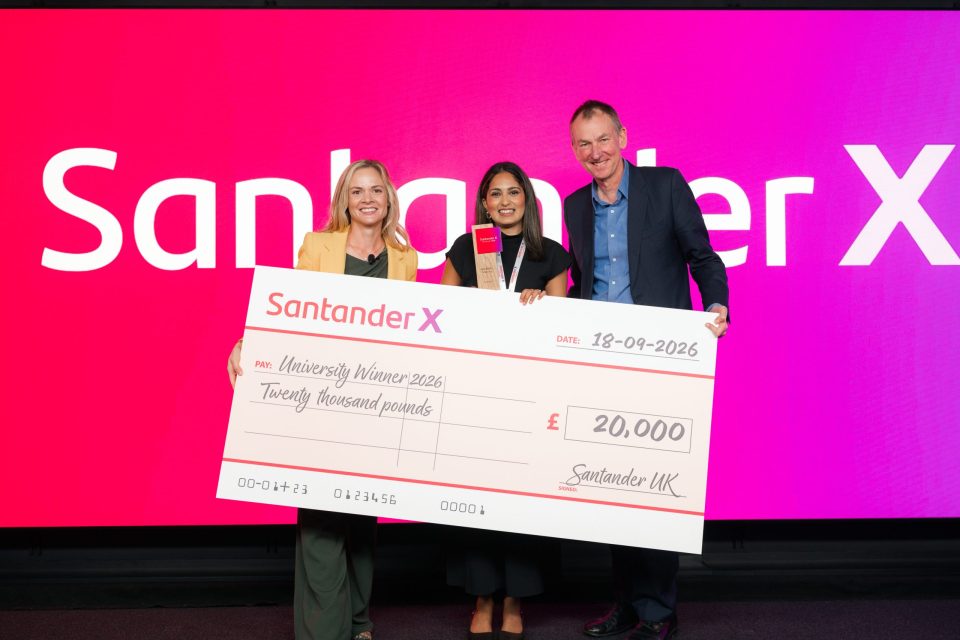
Santander’s flagship entrepreneurship competition, the Santander X UK Awards, gives university ventures, startups and SMEs the chance to pitch for a share of £150,000 in equity-free funding.
Some 90 businesses were shortlisted across three categories this year, before being narrowed down to nine finalists. The judging panel included Baroness Nicky Morgan, Google’s Adam Khalifa and Sibstar founder Jayne Sibley.
Morgan said she had been “blown away” by the finalists’ work across healthcare, tech and sustainability, adding that businesses like them would “help drive future economic growth in our country”.
Puja Patel, head of strategic programmes and universities at Santander UK, added that the winners demonstrated the “ambition, creativity and potential” of UK entrepreneurs.
“Whatever their route into entrepreneurship, having the right support, skills and connections can make a crucial difference”, she said.
Since launching in 2011, Santander X has awarded more than £1.2m to UK businesses. Here are this year’s three winners.
University winner: Olimera Therapeutics
Olimera Therapeutics is developing treatments for neurodegenerative diseases by targeting toxic protein clusters that existing technologies cannot reach.
The company is starting with Parkinson’s disease, but founder Dr Devkee Vadukul told City AM its approach could eventually be applied across several conditions in which toxic proteins accumulate.
“We are developing therapeutics to target toxic protein clusters in several devastating diseases”, Vadukul said. “Current technologies can’t target these toxic clusters, which means we have unlocked a previously inaccessible therapeutic target”.
Olimera remains at an early stage, and its technology has so far been in the lab, where Vadukul said its lead product had performed “extremely well”. The company is now raising money to incorporate and move into pre-clinical studies.
Fundraising has been the biggest hurdle so far, she said, with the next stage focused on formally setting up the company and building out its team.
The Santander X funding will go towards incorporation and other costs needed to de-risk the business, as it moves towards that development.
“The next stage of growth will be to incorporate and build out the team”, Vadukul said. “We are very excited for this to hit the ground running”.
Within the next few years, the company hopes to be in a position to raise its seed round.
Startup winner: Peripear
After more than 14 years working as a midwife, Peripear co-founder Nina spotted a gap between medical evidence and what was actually available in the delivery room.
Around nine in 10 people who give birth vaginally experience some form of perineal trauma, she said. Research has shown that applying a warm compress during the second stage of labour can reduce the risk and severity of tearing, but the technique can still involve little more than warm water and a towel.
“I looked at this and went, ‘Hang on a minute. We’ve had evidence for a mechanism like thermal therapy on the perineum… which can reduce injuries by 50 per cent’”, Nina told City AM.
Peripear is developing a purpose-built wearable compress designed to provide consistent warmth and support during labour.
Two-and-a-half years into the business, it has secured a patent and three Innovate UK grants and recently closed a £1.2m pre-seed funding package, after its original round collapsed just two days before completion.
The company is now preparing for its first human trials, initially in Singapore before moving into the US, which it expects to be its first commercial market.
The UK remains part of the plan, although Nina said lengthy NHS procurement processes meant Peripear would probably have to establish itself overseas first.
“I’m afraid we’re just another UK company that’s going to have to commercialise elsewhere, come back, and then do our procurement journey with the NHS”, she said.
Its Santander X prize will help fund US laboratory testing as it moves towards clinical trials and regulatory clearance.
SME winner: Think for the Future
Think for the Future began as a university project in Nottingham more than a decade ago. It now employs more than 100 people and generates annual turnover of around £4.3m.
The company works with schools to keep pupils at risk of permanent exclusion within mainstream education, creating what founder Cherie describes as a “school within a school”.
Its internal inclusion centres provide additional behavioural and educational support for pupils who might otherwise be sent to external alternative provision.
Sending a pupil to external provision can cost around £25,000 a year, Cherie said, compared with roughly £12,000 per pupil under Think for the Future’s model.
Unlike many organisations operating in education, the business is funded through contracts with schools rather than relying on grants.
“We can sustain our costs as an organisation off of those contracts”, Cherie said.
The company recently opened a centre in Manchester and plans to expand into more parts of the country. It is also developing Powerpupil, its analytics platform for schools and multi-academy trusts.
Think for the Future won both the SME category and the People’s Choice award, with the prize money set to be reinvested into its expansion and additional hires.
“We don’t often go for awards”, Cherie said. “It’s quite nice to go up against a lot of medical and tech organisations. What we do is a little bit different”










+ There are no comments
Add yours