






Truthout is an indispensable resource for activists, movement leaders and workers everywhere. Please make this work possible with a quick donation.
Months after the Trump administration announced the end of Operation Metro Surge, Minnesota immigrants are still grappling with the impacts of the largest federal immigration crackdown in recent U.S. history. Lost jobs, shattered businesses, missed rent payments, mounting legal fees, family separations, emotional distress, and uncertainty about the future have become part of daily life for many in the state.
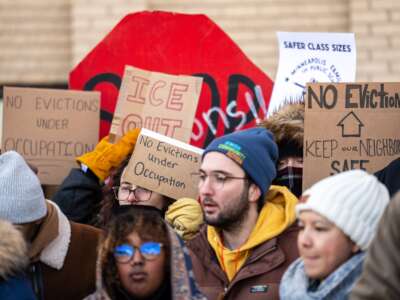
The operation, which lasted from December 2025 through February 2026, brought some 4,000 Immigration and Customs Enforcement (ICE) and Border Patrol agents to Minnesota. Agents aggressively targeted immigrants — including naturalized citizens and permanent residents — in apartment buildings, on sidewalks, at workplaces, and in school parking lots. Fearing detention or deportation, many limited their movements or stayed home altogether. In a state with nearly half a million foreign-born residents, the impact of the operation quickly became evident across communities. But Minnesotans remained focused, as Barbara Peterson explained, on resisting “the federal invasion of our community” and meeting more immediate needs: organizing protests, delivering groceries to affected families, offering rides to and from appointments, providing rental assistance.
Now, government officials, community leaders, and researchers are examining the extent of the operation’s impact both in economic losses and human costs — and are developing strategies for recovery.
Minneapolis city officials recently unveiled a report examining the toll the operation took on city residents and businesses between December and April. The report estimated the cost at nearly $700 million, a figure that includes wage and job losses, reduced hours, missed work, business disruptions, and financial assistance the city provided to impacted businesses and families. Factoring in losses in surrounding regions, the total could easily exceed $1 billion.
“The impact is felt far beyond those who were directly targeted,” Minneapolis Mayor Jacob Frey said at the report’s release event. “We’re talking about businesses that lost customers, workers that lost wages, families that struggled to put food on the table, mental health distress, children that missed meals and were unable to attend school, and of course, people that had delayed medical support.”
One of the many immigrant businesses enduring the ripple effects of Metro Surge is Colonial Market and Restaurant. Its owner, Daniel Hernandez, an immigrant from Mexico, said at the event that his business had come to a near standstill, with sales dropping to 15 percent of what they had been before the operation. As a result, Hernandez said, Colonial Market has reduced its staff from more than 20 employees to just two. More than that, Colonial Market is expected to close its south Minneapolis location. “The families who depended on this store no longer have jobs,” he said.
Lost jobs, shattered businesses, missed rent payments, mounting legal fees, family separations, emotional distress, and uncertainty about the future have become part of daily life for many in the state.
For many Minneapolis residents, job losses have made it harder to pay rent. According to the report, 35,000 low-income residents were already unable to pay their rent before the operation. Additional income losses tied to the operation have worsened those challenges, creating an additional $15.7 million monthly rent assistance need. “Despite some resumed economic activity in March,” the report states, “income loss persisted for the cost-burdened population, indicating a monthly need consistent with previous months.”
The ongoing fallout has placed sustained demands on nonprofit organizations serving immigrant and refugee communities. Many organizations continue to provide support at levels similar to those during the operation. Malika Dahir, who leads Reviving the Islamic Sisterhood for Empowerment (RISE), a leadership development and advocacy nonprofit serving Minnesota Muslim women, told Truthout that Metro Surge forced the organization to pivot to direct service, including providing legal and rent assistance to impacted families and individuals, and funding small businesses.
“We found that all of our regular programming was disrupted,” Dahir said. “Through community partnerships and direct outreach, we started mutual aid efforts. We connected families to legal support. We did some ‘know your rights’ training. We also ensured that those who were most impacted had access to culturally responsive mental health services. We partnered with our local clinics here to make sure those impacted could access medical care either via Zoom or in their homes.”
Even in this seemingly “post-Metro Surge” period, Dahir said, some members of the impacted communities are still calling the organization for rent assistance for their apartments or businesses because many once-bustling establishments centered in immigrant communities continue to struggle to find customers, and workers who lost their jobs during the operation have not been invited back to their workplaces.
Like RISE, the African Career Education and Resource, Inc. (ACER) has continued to support impacted immigrant businesses and families since the beginning of the immigration crackdown. Its executive director, Nelima Sitati Munene, told Truthout that the nonprofit provides various services to its mostly African clients. These include grants and technical assistance for small businesses. As an economic development organization that owns and operates a strip mall, Munene said, ACER has waived rent for several tenants. “It was not their fault that they lost income,” she said.
Julia Decker, the policy and public affairs director for the Immigrant Law Center of Minnesota (ILCM), told Truthout that her organization has also seen clients still grappling with the impact of the operation. Many of the immigrants taken by ICE during the operation are, in the words of Decker, still detained across the country “in horrible conditions.” As the federal government continues detaining and deporting people, Decker said, many immigrants and refugees are experiencing heightened anxieties and uncertainties about their future in the U.S.
Many of the immigrants taken by ICE during the operation are, in the words of Decker, still detained across the country “in horrible conditions.”
“There are continued legal and policy developments at the administration level, which make many cases very uncertain,” Decker said. “Even if you have a pending case, that could change tomorrow — all of a sudden, you might become subject to detention. It just feels very, very unstable for people who did all the right things: they applied, they met all the deadlines, and now the administration is sort of pulling the rug out from under them.”
RISE, ACER, and ILCM are among nearly 40,000 registered nonprofits in Minnesota. During and after Metro Surge, many of these organizations, along with government agencies and foundations, have adapted to a changing landscape to better address the social and economic challenges facing immigrant communities. Yet community leaders say that, given the significant harm the operation has caused, the funding allotted thus far barely scratches the surface, a sentiment echoed in a recent MinnPost article. Moreover, many immigrants face barriers to accessing available funds, as application processes often require navigating lengthy and complex paperwork.
“The biggest work we’re doing right now is advocacy,” Munene said. “We continue to engage with lawmakers on how to sustain support for the most impacted members of our community. People cannot move on before they’re made whole.”
An important fundraising appeal: Fell Short of Our Goal
Truthout is one of only a few platforms for justice-oriented, grassroots journalism. Today, as political censorship from the right intensifies, we have no choice but to ask for your help.
We just finished a fundraiser to cover our basic operating expenses for June, but we fell short of our goal. If you can support Truthout with a one-time or monthly donation, you will make a significant impact on our work. Anything you can do makes a difference — we appreciate your support.










+ There are no comments
Add yours