







Honest, paywall-free news is rare. Please support our boldly independent journalism with a donation of any size.
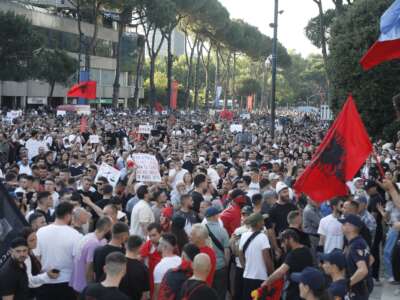
Albania, a country in the southwestern region of the Balkan peninsula, is witnessing one of the biggest waves of anti-government protests since the final end of socialism in 1992. The protests began in late May in opposition to the construction of a multibillion-dollar luxury resort backed by Jared Kushner, Donald Trump’s son-in-law, in the protected delta area of Vjosa-Narta, but they have now become a common sight in the capital city of Tirana. The protesters, who have faced riot police and water cannons, are demanding the resignation of socialist Prime Minister Edi Rama as activists aim to put an end to politics as usual in a country where corruption and organized crime are prominent features. In the meanwhile, Rama continues to support the luxury resort project linked to Jared Kushner and alleges that the enemies of Albania and Israel are behind the unrest.
In the interview that follows, Albanian activist Ariela Zeneli discusses the aims and goals of the ongoing protests in Albania and highlights possible outcomes. She is a social activist and project coordinator actively involved in student and social movements advocating for youth rights, education, social justice, and democratic participation.
C. J. Polychroniou: Ariela, can you put into political context Albania’s protests over the Kushner-backed resort in the protected delta area of Vjosa-Narta? Why would a luxury resort plan spark massive protests?
Ariela Zeneli: As you mention, the protests began in response to a project planned for the Vjosa–Narta area. The main concern is that what the government presents as a major investment and a development opportunity for Albania would be built in a protected ecosystem with rich biodiversity and significant environmental value.
The protest was initially organized by local residents and environmental activists, including the Movement TOGETHER. The area is known for its untouched natural beauty and its lagoon, which serves as a habitat for migratory birds such as flamingos. Because of its ecological importance, it has protected status. Despite this, the government has continued to push forward with its development plans.
Another issue that fueled the protests was the situation of local residents and their property rights. These are families who have lived in the area for generations and have long-standing claims to their land. However, many residents argue that they have been stripped of those rights through irregular and often fake processes. Tensions escalated on the very first day of the protest, when one demonstrator was dragged away by private security guards while the police stood idly by. The incident sparked outrage and drew even more people to the cause.
Under the slogan “Albania Is Not for Sale,” protesters have called for the cancellation of the Zvërnec project, the resignation of Prime Minister Edi Rama, and an end to policies that prioritize oligarchs and politically connected investors over the public interest.
What has also angered many people is the lack of transparency surrounding the project. On the one hand, the prime minister has promoted it as a €4 billion investment that will transform the region. On the other hand, he has admitted that there is still no final project and that the company is only in the environmental assessment phase. These statements do not add up. Almost every day, a different explanation is offered, which gives the impression that the government is reacting to public pressure rather than presenting a clear plan. Rama has even called for dialogue and negotiations, but the dominant message from the protests remains: “Resign.”
To me, these protests are much more than a single tourism project. They reflect growing frustration with an economic model that generates profit through the dispossession of local communities while presenting itself as development. The question is not only what is being built, but who benefits from it. Supporters of the project speak about investment and growth, but many local residents see a future in which they lose control over their land and are left with little more than low-paid, seasonal jobs in hotels and resorts. That is why this struggle has resonated so strongly: it is not only about protecting a landscape, but also about defending the right of communities to shape their own future.
Movement TOGETHER, of which you are a member, opposed the luxury resort project from the beginning. Is this a movement of activists or an actual political party, and what does it stand for?
Lëvizja BASHKË (Movement TOGETHER) was founded on December 18, 2022, at the initiative of activists and members of Organizata Politike, a leftist grassroots organization that has been operating in Albania since 2011.
Organizata Politike used the Red Robin (Erithacus Rubecula) as a symbol of freedom and resistance. The robin represents the movement’s organizational and political worldview in what they see as a “frosty Albania,” quickly depopulating due to emigration, especially among the young. To be red robins, the party says, “is to stay here in Albania, to resist, to live vigorously and sing, by working day after day, every day for a fairer and more democratic society.”
Initially, we functioned as a grassroots movement and helped several causes. For example, we helped miners, oil, and construction workers with protests and forming unions. We supported the student cause, which began as an initiative of students and professors in public universities to oppose neoliberal and clientelist reforms in higher education. We helped in various other social causes, ranging from the draft law for the recognition of a guaranteed minimum wage to opposition against the concreting of Tirana and the destruction of the Vjosa River, and from support for public transport to gender equality, among others.
After this first phase, we became a proper political party with a clear left-wing, progressive identity. Lëvizja Bashkë was first elected to the Albanian Parliament in the 2025 Albanian parliamentary elections, with Redi Muçi becoming a member of parliament on September 12, 2025. Previously, the party had participated in the 2023 Albanian local elections in Tirana, where party leader Arlind Qori ran for mayor of Tirana, receiving nearly 5 percent of the vote, and where Mirela Ruko was elected a member of the municipal council. But we do not want to be just another political party. Our slogan has always been “More than a party” because we believe that political change alone is not enough. Our goal is a broader social transformation that goes beyond elections and institutions, addressing the way the economy is organized, how communities function, and how people participate in public life.
For us, politics is not limited to competing in elections and winning seats. It is an ongoing process of collective organizing, nurturing solidarity, and creating the conditions for a more just, democratic, and equal society. That is why we see ourselves as more than a political party: We aim to be part of a wider movement for social change.
The protests, dubbed the “Flamingo Revolution,” have now spread into the capital and people are calling for the prime minister’s resignation. First, do you expect Edi Rama to resign or anticipate moves on the part of his government to repress the protests; and second, is the “Flamingo Revolution” actually about flamingos or an actual revolution in the making?
The expression “Flamingo Revolution” grew out of the central role that flamingos came to play in the protests. As one of the most recognizable inhabitants of the Narta Lagoon, the flamingo symbolizes the ecological richness of an area that hosts hundreds of bird species and represents one of Albania’s most valuable protected ecosystems. As opposition to the Zvërnec project expanded, the flamingo became more than a bird; it became a symbol of a broader struggle over the future of the country. For protesters, it embodies the defense of nature, public resources, and local communities against a model of development driven by large private corporations in pursuit of massive profits and corrupt political interests.
Regarding the issue of Rama’s possible resignation, it is hard to tell whether that is going to happen, as the dynamics of the protest depend on many factors and are therefore unpredictable. Given the reaction of various governments throughout the Balkans towards large protests and demonstrations, to which Albania is similar in terms of governance and the rule of law, one possibility is that repression might ensue in case the protests continue and become more radical. For the time being, this is probably not likely to happen since the protests have been totally peaceful and the European Union is closely monitoring the situation and has expressed concerns over the government’s intention to support the Kushner-linked luxury resort. In fact, the European Parliament is putting pressure on the Rama government by calling for the suspension of all new developments within protected areas.
Another possibility is that if there is enough pressure, the government may indeed end up making concessions in order to appease the protesters.
The best-case scenario is the one which involves the resignation of Rama and his government, i.e., the main demand of Albanian protesters, and the announcement of snap elections. But given the authoritarian nature of the current government and its firm grip on power, the odds of this happening at the present juncture are not that great.
The protests have also expressed a deeper dissatisfaction with the economic and political model that has shaped Albania since the 1990s. For decades, Albanians have been told that prosperity would arrive through privatization, foreign investment, and market-led development. Yet for many, these promises have remained unfulfilled, turning the so-called transition into a prolonged period of uncertainty, inequality, and disappointment.From this perspective, the demands emerging from the protests go far beyond opposition to a single project or even a single government. Many participants see the problem as systemicin nature and scope. They no longer believe that alternating power between the Democratic Party and the Socialist Party can result in meaningful change, as both parties have embraced pretty much the same economic priorities and patterns of governance. As a result, the protests reflect a growing desire not simply for a change of leaders, but for a different political and economic future altogether. This sentiment is captured in one of the movement’s most popular chants: “Rama in jail, Berisha in jail!” — a slogan that rejects both political figures and symbolizes frustration with the entire political establishment. (Edi Rama is the head of the Socialist Party, Sali Berisha is the head of the Democratic Party.)
How popular is the left in Albania? Is there anything resembling a united front that may succeed in creating a “new” Albania?
Although the ruling party presents itself as left-wing and socialist, many of us do not consider it a genuine representative of the left. In practice, it has moved away from the core principles traditionally associated with left-wing politics: social justice, reducing the gap between rich and poor, strengthening public services, protecting workers’ rights, and ensuring that economic development benefits society as a whole rather than a privileged wealthy minority.Instead, over the years, we have witnessed the implementation of policies that have concentrated wealth and power in the hands of a small economic elite, while many Albanians continue to struggle with low wages, precarious employment, rising living costs, and limited opportunities. Rather than addressing social and economic inequalities, the current model has often deepened them. At the same time, the government has faced repeated allegations regarding its proximity to oligarchic interests and its tolerance of networks linked to organized crime.
On the other hand, there has been an absence of alternative left-wing parties in the last decades, due to the negative association, in the public sphere, of the left in general with the communist past, but also because of the neoliberal march carried out by both main parties, which has suffocated every attempt at creating genuine left organizations, parties, and movements.
In this sense, what is emerging is not exactly a united front, but rather a broader social coalition of people who are deeply disappointed with the traditional parties and the political model they represent. After many years, we have managed to rebuild a culture of civic protest, solidarity, and collective action. This is visible during our marches through the capital, where we are greeted with applause from elderly people on their balconies, restaurant and café workers, and drivers who honk their horns in support despite being stuck in traffic. The same spirit is reflected in the solidarity shown to the protests by Albanian diaspora communities in various countries.
The faces of this movement are young workers, students, the elderly, parents, women and men tired of unfulfilled promises, low wages, insecurity, lack of quality health care and education, and the constant pressure to emigrate. It remains to be seen whether this will be a force that can create a “new” Albania. What is clear is that the young generation is no longer satisfied with a choice between the same political elites and is looking for a different societal vision for the future. The hope for a “new” Albania stems from the belief that change can come about not merely through elections but from the growing capacity of ordinary people to organize themselves, to imagine alternatives, and to work together to bring them to life.
An important fundraising appeal: Fell Short of Our Goal
Truthout is one of only a few platforms for justice-oriented, grassroots journalism. Today, as political censorship from the right intensifies, we have no choice but to ask for your help.
We just finished a fundraiser to cover our basic operating expenses for June, but we fell short of our goal. If you can support Truthout with a one-time or monthly donation, you will make a significant impact on our work. Anything you can do makes a difference — we appreciate your support.





+ There are no comments
Add yours