





Part of the Series
Struggle and Solidarity: Writing Toward Palestinian Liberation
Truthout is a vital news source and a living history of political struggle. If you think our work is valuable, support us with a donation of any size.
After the so-called ceasefire was implemented in Gaza in 2025, I did not at first have the courage to return to Gaza City, which I had not seen since before October 2023. All the other Palestinians who went back described with deep sorrow the experience of reentering a city they no longer recognized. The beautiful Gaza City they once knew had become strange to them — unfamiliar to both their eyes and their hearts.
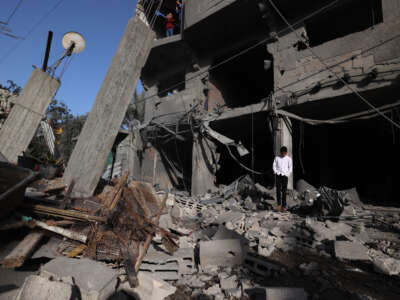
When I finally summoned the courage to face the devastation in March 2026, I was shocked by what I saw. Throughout my journey — from Nuseirat camp, passing along the coastal road, all the way to Gaza City — piles of rubble dominated the landscape. I was walking through a maze of streets I no longer knew.
I made that trip in order to apply for a press card membership from the Journalists’ Syndicate, which was operating out of a large tent set up in the courtyard of the Rashad Al-Shawa Cultural Center. The state of the cultural center itself reflected the scale of transformation the city had undergone: It was filled with displaced people who had sought refuge there from the destruction
When I reached the heart of the city — the place I used to know so well, around the university street, where I would leave campus and head to the nearby cafés — I no longer recognized where I was.
I stood in the middle of what used to be known as Telecommunications Street, named after a company building that once stood there, adjacent to the Rashad Al-Shawa Center. As I walked a little further, I was met with a suddenly incongruous sight: a large number of new cafés.
Every few meters, there was another café. And these were not makeshift or temporary places, as one might expect — they were built with expensive materials, carefully finished, furnished with elegant tables, sofas, and chairs, and fronted with glass façades that conveyed a sense of luxury.
Amid this widespread devastation, it was only the lights of these cafés that seemed to shine.
As I wrote in Al Jazeera, what is striking is that many of these establishments, which now appear as signs of “life returning,” did not exist before the war. They were born in its midst, at its most difficult moments. This contradiction cannot be separated from a distorted economic reality that took shape during the war itself.
While the overwhelming majority of people sank into poverty and helplessness, a limited group accumulated rapid wealth — benefiting from aid channels or monopolizing essential goods. These groups were not necessarily organized entities, but rather included individuals, traders, and intermediaries who took advantage of the chaos and the lack of oversight over the movement of goods and aid. In the absence of stability and viable alternatives, essential goods were transformed into tools for quick and excessive profit rather than resources to meet urgent humanitarian needs.
As famine worsened and people’s purchasing power declined, the activity of these networks increased. Prices skyrocketed in shocking ways: A 25-kilogram sack of flour that used to cost around 25 shekels before the war reached thousands of dollars at the height of the crisis. This revealed a stark disconnect between people’s suffering and market greed.
Yes, cafés are opening, and people are trying to practice fragments of everyday life, but these scenes do not mean that conditions are improving or that recovery has begun.
This reality created a new class with financial surplus, which it invested in projects that may appear “normal,” such as cafés. In truth, however, they are a direct reflection of an unjust war economy, where illuminated spaces are built upon heavy shadows of need and deprivation. This unjust economy is the consequence of Israel’s blockade, which intensified during the war. Since June 2025, the blockade has at times slightly relaxed and at other times tightened, and Palestinians in Gaza still struggle to obtain medication and materials for reconstruction.
Yes, cafés are opening, and people are trying to practice fragments of everyday life, but these scenes do not mean that conditions are improving or that recovery has begun. They are merely individual attempts to maintain a minimal sense of psychological balance in a harsh reality — nothing more.
The situation on the ground is entirely different: We are living amid widespread destruction of infrastructure, severe shortages of basic services, and ongoing humanitarian crises affecting every aspect of life. Moreover, the majority of Gaza’s population now lives in temporary tents lacking even the most basic necessities. They cannot afford these cafés or restaurants; many can barely secure their daily food and rely on communal kitchens for a simple meal.
Therefore, it is wrong to consider these images as indicators of stability, as some news articles might suggest. They unintentionally obscure the true scale of suffering and raise serious questions about priorities. Resources could have been directed toward initiatives that genuinely support people and alleviate their hardship, rather than projects that serve only a limited segment of society.
A more equitable approach to reconstruction would prioritize the essential needs of the population, including the rehabilitation of hospitals, water and electricity networks, and schools, rather than focusing on consumer-oriented or commercial projects that do not reflect the scale of destruction or the real priorities of recovery. Reconstruction efforts should also be guided by transparent mechanisms that ensure a fair distribution of resources to prevent the deepening of existing inequalities.
Lifting the blockade is a fundamental condition for balanced and meaningful reconstruction. Restrictions on the movement of goods and people create a distorted economic environment that channels investment toward limited, profit-driven projects such as cafes and small commercial ventures, rather than enabling comprehensive and sustainable development plans that genuinely serve the broader needs of society.
True understanding begins with acknowledging that what may appear as “life” in some images is, in fact, a form of forced adaptation to abnormal conditions — not a sign that life has returned to normal.
Media that fights fascism
Truthout is funded almost entirely by readers — that’s why we can speak truth to power and cut against the mainstream narrative. But independent journalists at Truthout face mounting political repression under Trump.
We rely on your support to survive McCarthyist censorship. Please make a tax-deductible one-time or monthly donation.



+ There are no comments
Add yours