







Did you know that Truthout is a nonprofit and independently funded by readers like you? If you value what we do, please support our work with a donation.
Imagine a beach where the rules of the outside world simply do not apply. A place where people of every background, every identity, every body, and every expression of queerness arrive and exhale. Where the person next to you on the sand might be a drag queen in full regalia, a family chosen rather than born into, an elder who has been coming since the 1970s, or a young trans person experiencing safety in public for the first time. A place where, for a few hours on a summer afternoon, the world feels like it was built for you rather than against you.
That place is real. It is called Jacob Riis Beach, and it sits on the Rockaway Peninsula in Queens, New York. For nearly a century it has functioned as one of the oldest and most historically significant LGBTQIA+ public sanctuaries in the United States. And right now, it is being taken away.
What is happening at Jacob Riis Beach is not a series of separate threats. It is one coordinated pattern of displacement playing out simultaneously on multiple fronts. A private developer holds a 60-year federal lease on the bathhouse. Federal park police are partnering with ICE in the parking lot. Elected officials at every level have offered silence or endorsement. Each threat targets the same communities. Each one follows the same logic of extraction, privatization, and erasure.
A Sanctuary Under Siege
The demolition of the Neponsit Beach Hospital in 2023 marked a turning point that the community had long feared. For decades the abandoned hospital building had functioned as more than a relic of the past. It had served as a natural visual barrier, shielding the queer section of the beach from the surrounding conservative residential community that has historically been hostile to the LGBTQIA+ people gathering just beyond its walls. With the building gone, the People’s Beach lost something more than a landmark. It lost its anonymity.
The surrounding communities of Belle Harbor, Neponsit, and Breezy Point have documented histories of racism and consistent conservative voting patterns that place them in direct ideological opposition to the queer, multiracial, immigrant, and working-class communities that have made Jacob Riis Beach their sanctuary. Council Member Joann Ariola, the Republican who represents this district, has consistently sided with the conservative residential community while ignoring the presence of LGBTQIA+ beachgoers who have gathered on the sand within her own district for nearly a century.
The demolition of the Neponsit Hospital did not just expose the beach physically. It exposed the community politically. And the forces that have always wanted them gone now have a clearer line of sight.
The enforcement is already changing on the ground. In late May 2026, a longtime beachgoer who asked not to be named told me how she was stopped by park police near the historic bathhouse while walking topless to use the restroom, something she had done regularly for years without incident. She said the officer told her she would need to cover up to be in that area going forward. When she pushed back, citing years of visiting the beach without issue, the officer told her that “things are about to change,” that the area was becoming “a family-friendly zone,” and that she needed to be mindful of the changes that were coming. She complied. On the same visit, park police arrived at Bay 1 and ordered approximately a dozen beachgoers who had gathered there to move, erecting rope barriers and posted signs citing erosion. For weeks prior, those same beachgoers had gathered at Bay 1 without incident.
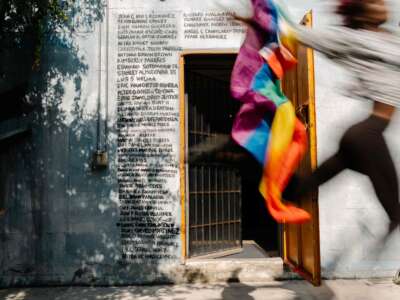
The timing is difficult to ignore. The historic Jacob Riis Bathhouse, a 1930s Art Deco landmark designed as a public facility to serve the diverse communities of New York City, sits directly adjacent to Bay 1. For decades the bathhouse was exactly that, a free and accessible public space where generations of New Yorkers could shower, change, and gather regardless of their background or income. It fell into disrepair over the years and sustained significant additional damage during Hurricane Sandy in 2012, leaving it abandoned and deteriorating for over a decade. Rather than restoring it as the public facility it was always meant to be, the National Park Service (NPS) instead granted a 60-year concession lease to a private developer who is converting it into a private luxury club. According to reporting by The New York Times, its membership fees range from $1,000 per year for local Rockaway Peninsula residents to $3,500 for families outside those ZIP codes. The community that actually built the cultural life of that space for nearly a century cannot afford even the discounted rate.
Three Administrations, One Outcome
The process that led to this outcome spans three presidential administrations and nearly a decade. According to National Park Service records, under the first Trump administration in 2017 the NPS issued a competitive request for proposals inviting private developers to propose plans for the rehabilitation of the historic bathhouse. Brooklyn Bazaar was selected as the winning applicant and a letter of intent was signed in March 2018.
The conversion of this publicly administered historic landmark into a private luxury amenity has been substantially subsidized by federal tax dollars.
Under the Biden administration in October 2022, the 60-year concession lease was formally signed. According to financing records reported by the Commercial Observer, the initial 2023 financing package included a $32.5 million construction loan from private lender Procida Funding and a $15 million historic tax credit equity investment from Foss & Company on behalf of undisclosed institutional investors. The total renovation cost has since been reported at approximately $88 million, meaning the conversion of this publicly administered historic landmark into a private luxury amenity has been substantially subsidized by federal tax dollars. The LGBTQIA+ community that had used this space for nearly a century was not consulted at any point in this process under any administration. The first Trump administration chose the developer. The Biden administration signed the lease and provided the federal funding. The second Trump administration is presiding over the opening. Three administrations. Not one protected the community.
The Developer: A Slumlord
The developer behind the Rockaway Ocean Club is Jonah Bamberger, founder and managing partner of Aulder Capital, a real estate investment firm whose entire senior leadership was professionally formed within Israel. In a 2024 interview on The Deal Makers podcast, Bamberger confirmed that he “lives in Tel Aviv, Israel with his wife and three children.” He is managing a 60-year federal concession lease on one of the oldest LGBTQIA+ public spaces in the United States from his home in another country entirely.
Before founding Aulder Capital, Bamberger managed investments for the Israel Infrastructure Fund, a private equity fund headquartered in Tel Aviv with over one billion dollars in assets, and provided project finance consulting directly to the Israeli government. His chairman, Zvi Chalamish, spent 15 years as a senior official of the Israeli Ministry of Finance, served as CEO of a company fully owned by the Government of Israel, and served as a captain in the Israeli military. His co-CEO, Amir Heldi, built his career at TASC Strategy Consulting, Israel’s largest management consulting firm, before joining Aulder Capital.
But Bamberger’s record in New York City long predates the bathhouse project, and it should not inspire confidence in any community depending on him to steward a public space. According to New York City’s Worst Landlords watchlist, Bamberger ranked number 16 in 2024. And according to Glassdoor reviews, employees gave Aulder Capital a 2.5 out of 5 rating, citing dangerous conditions, discriminatory practices, and timesheet alterations by management.
In a separate 2024 interview on the Best Ever CRE Podcast, Bamberger described his New York City residential tenants in working-class communities as a financial burden, said he had “been spitting blood dealing with New York’s tenant protections, and stated that evictions are much easier in Myrtle Beach where the process takes weeks rather than years.”
When The New York Times reported on the Rockaway Ocean Club in May 2026, the piece treated it purely as a real estate story. There was no mention of the LGBTQIA+ community. No acknowledgment of the nearly century-long queer history of the space. No question about what the membership fees would mean for the communities that had always used it for free. The people who have actually loved that space for nearly a century, and who cannot afford $3,500 a year to access it, were not part of Bamberger’s vision and were not part of the story being told about them.
Aulder Capital does not operate alone. The Rockaway Ocean Club is the product of an interlocking network of developers, lenders, and investors. CBSK Developers — led by Scott Shnay, Abe Shnay, and Charles Blaichman — is the primary development partner and the entity whose name appears on the 60-year NPS lease. Brooklyn Bazaar, founded by attorney Aaron Broudo and musician Belvy Klein, has spent the past decade methodically consolidating concession control over the entire Rockaway shoreline, displacing beloved existing boardwalk vendors along the way, and now holds concession agreements at both Jacob Riis Park and the Rockaway Beach boardwalk.
Studio Robert McKinley is designing the interior to reflect the luxury hospitality aesthetic Bamberger described as Miami style, while Ursula Damani, described in reporting as a co-owner of the Rockaway Ocean Club, leads its communications and marketing efforts. Together this network represents a convergence of private capital, federal subsidy, and institutional real estate expertise assembled to extract maximum financial value from a space that was never theirs to take.
The Slumlord Next Door
Brandice Taylor Davis has been living in one of Jonah Bamberger’s Brooklyn buildings for over a decade. She moved into the Bedford Avenue building in Flatbush in 2014. Bamberger purchased it in 2015. By the winter of that same year the heat was gone.
“I had a baby and I came home from the hospital and I thought I was going crazy because it was freezing cold,” she said. Her daughter is 10 years old now. “We’re going into the eleventh year of there being heat and hot water issues.”
Davis told me that the conditions she and her neighbors have endured go far beyond cold winters. Mice. Roaches. A leaking roof. Electrical problems. A sewer backup that sent other tenants’ wastewater up through her sink for more than five years. Illegal construction. Court-ordered repairs that have been open since 2016. She was electrocuted in her own apartment and had to seek urgent care. The building has been in the city’s Alternative Enforcement Program, a two-year remediation program for the most distressed buildings in New York City, for six years with no resolution.
Getting Bamberger or his management team to respond has not just been difficult. It has become dangerous. “Myself and some of my neighbors actually have a restraining order against Jonah and his management team,” Davis said. “They can only contact us through our legal team because of how they treat people.” In early 2024 a property manager employed by Bamberger’s company attempted to physically fight her. She called the police.
Davis has not been passive in the face of these conditions. She has filed complaints with the city, contacted elected officials, met with the heads of Housing Preservation and Development and the Department of Buildings with her attorneys, and reached out to eight city officials asking how a landlord on the worst landlords list was simultaneously receiving city concession contracts at Rockaway Beach and McCarren Park. Not one person responded. She contacted the Department of Interior. She called the National Park Service. She called the Bureau of Land Management. She wanted to know how Jonah Bamberger, a slumlord up and down the I-95 corridor, qualified for a 60-year federal concession lease on a historic public landmark.
Nobody answered.
“Somebody in the city is in his pocket,” she said. “I can’t prove it, but I know it.”
In August 2025, a Manhattan court imposed a civil penalty of $2,124,845 against Bamberger’s company for 148 open housing violations and documented tenant harassment at his building at 2647 Broadway. The city has sued him. Judges have agreed that tenants are being harassed. And still, Davis says, nothing gets fixed. The city’s own housing agency argued against holding Bamberger in contempt in her building’s case.
“The residents are the people living through this problem,” she said. “The city hasn’t fixed anything. What do you mean he owes the city 2 million dollars and those people living through these conditions get zilch?”
At one point Davis said she sat across from Jonah Bamberger himself at a meeting and asked him directly whether his own family lived without heat and hot water. She wanted him to understand what he was doing to her neighbors. She wanted him to feel something.
“He looked me dead in my face and told me that that is irrelevant,” she said.
What Davis wants is straightforward. She wants Bamberger investigated. She wants the city to explain how he has been allowed to collect city concession contracts while simultaneously failing his tenants for over a decade. And she wants the buildings handed over. “I think he should give the building to the tenant association of each respective building and allow them to put it in a land trust or develop a co-op,” she said. “If I owned this space, I would fix this space.”
For Davis the connection between what is happening in her apartment and what is happening at Jacob Riis Beach is not abstract. It is the same man. The same indifference. The same pattern of extracting money from communities while giving nothing back. “He’s going into these communities that are underserved and taking advantage of people and displacing people,” she said. “And it’s not okay.”
The Political Landscape: No Champions, No Protection
The political landscape surrounding Jacob Riis Beach offers no protection and, in some cases, active hostility toward the communities it has historically served. Council Member Ariola voted against multiple gender-affirming care protection bills in April 2025, has publicly stated that migrants accused of crimes are not entitled to any due process, and has calledfor expanded ICE enforcement. Congressman Gregory Meeks, who represents the entire Rockaway Peninsula at the federal level, has received over $500,000 from AIPAC and the Israel lobby according to campaign finance tracking by Bought by Zionism, and in June 2024 signed off on an $18 billion arms sale to Israel. He has said nothing about the privatization of a historically LGBTQIA+ public space within his district. State Senator James Sanders Jr., Queens Borough President Donovan Richards, and Council Member Ariola all publicly celebrated the bathhouse financing in March 2023. Every other elected official representing this community has offered either silence or endorsement. The communities of Jacob Riis Beach have no champion at any level of government.
The threat to immigrant communities at Jacob Riis Beach extends beyond the bathhouse privatization. According to reporting by The Reconstruction Era and the Capital News Service Howard Center for Investigative Journalism, National Park Service Police have been formally partnering with ICE for immigration enforcement operations on federally administered land. Jacob Riis Park has a 9,000-car parking lot on federal land, making it a site of potential ICE enforcement activity. The immigrant communities of the Rockaway Peninsula, who have historically shared the beach with the LGBTQIA+ community, are being targeted by the same federal administration that is presiding over the bathhouse privatization.
The People Who Made the Beach
For Carlos Alberto Villacrés, who has been going to Jacob Riis Beach for over a decade, the beach found him before he found it. He was walking toward Fort Tilden one afternoon with his dog Sissy when she bolted in the opposite direction and refused to stop until she reached the queer section of the beach. He sat down, spread out his things, and instantly met people. That was how he met Victoria Cruz, a celebrated civil rights activist and longtime advocate for transgender and gender nonconforming New Yorkers, and Ms. Colombia, one of the most beloved LGBTQIA+ icons in New York City history, along with the chosen family that would become the center of his summers for years to come.
“A little corner where we feel secure and safe to go be whoever we want to be. That is what is being taken from the community.”
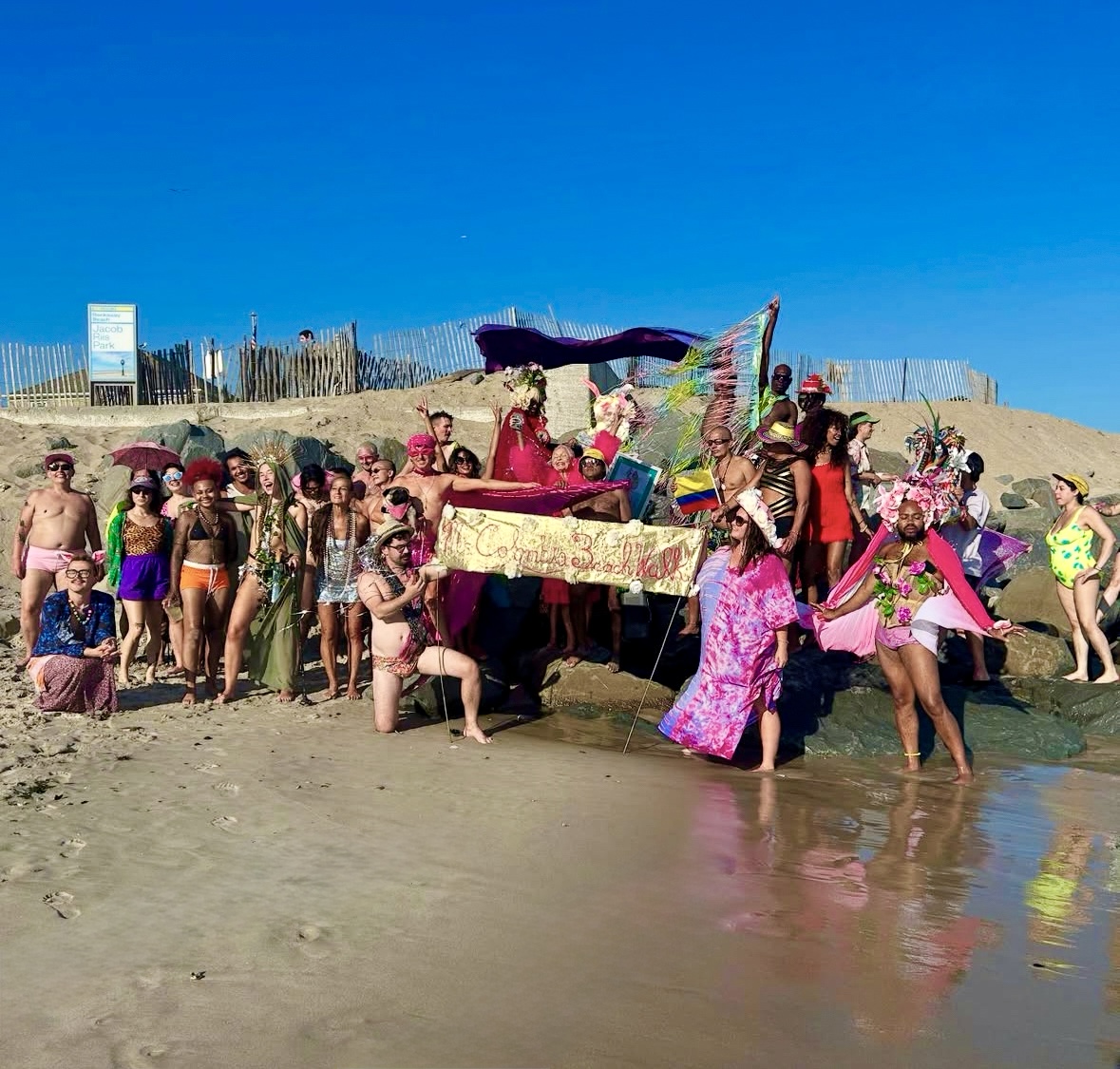
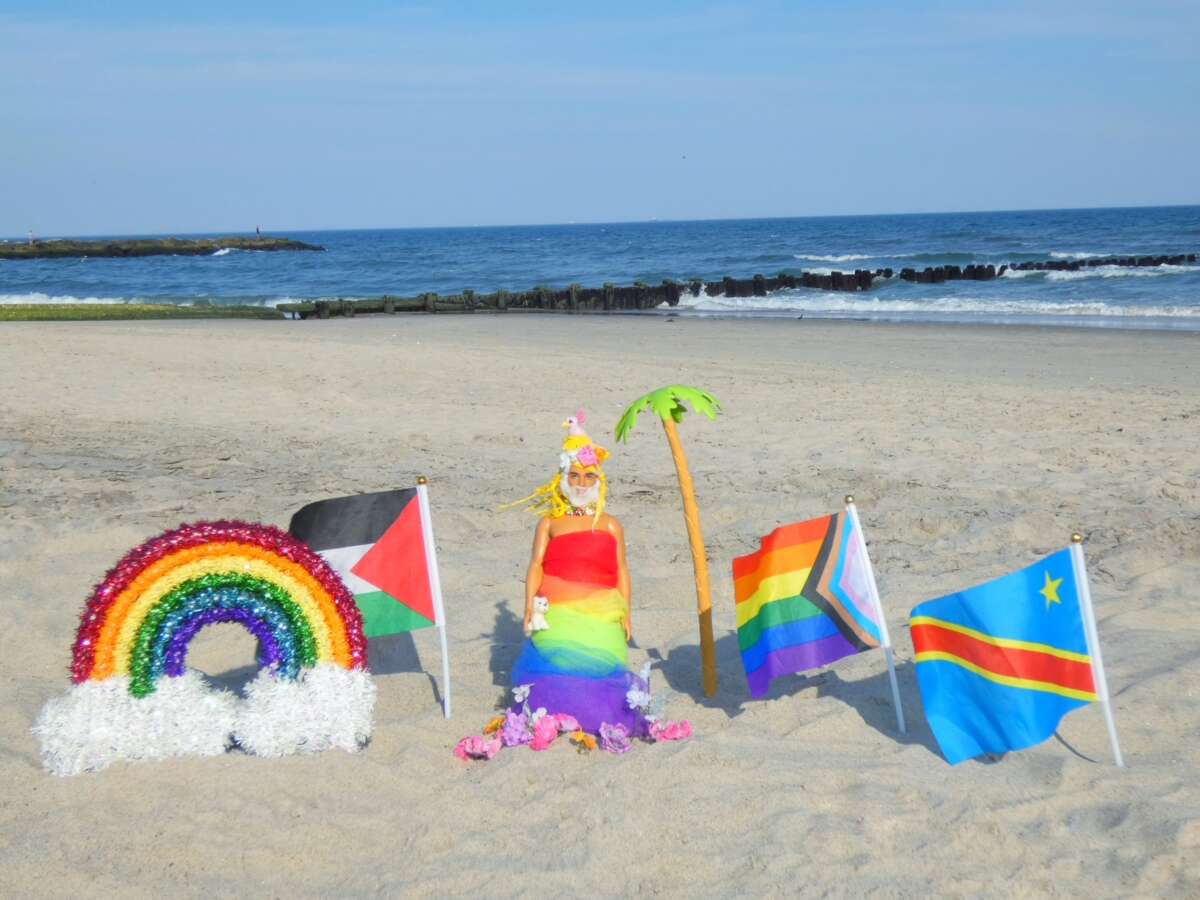
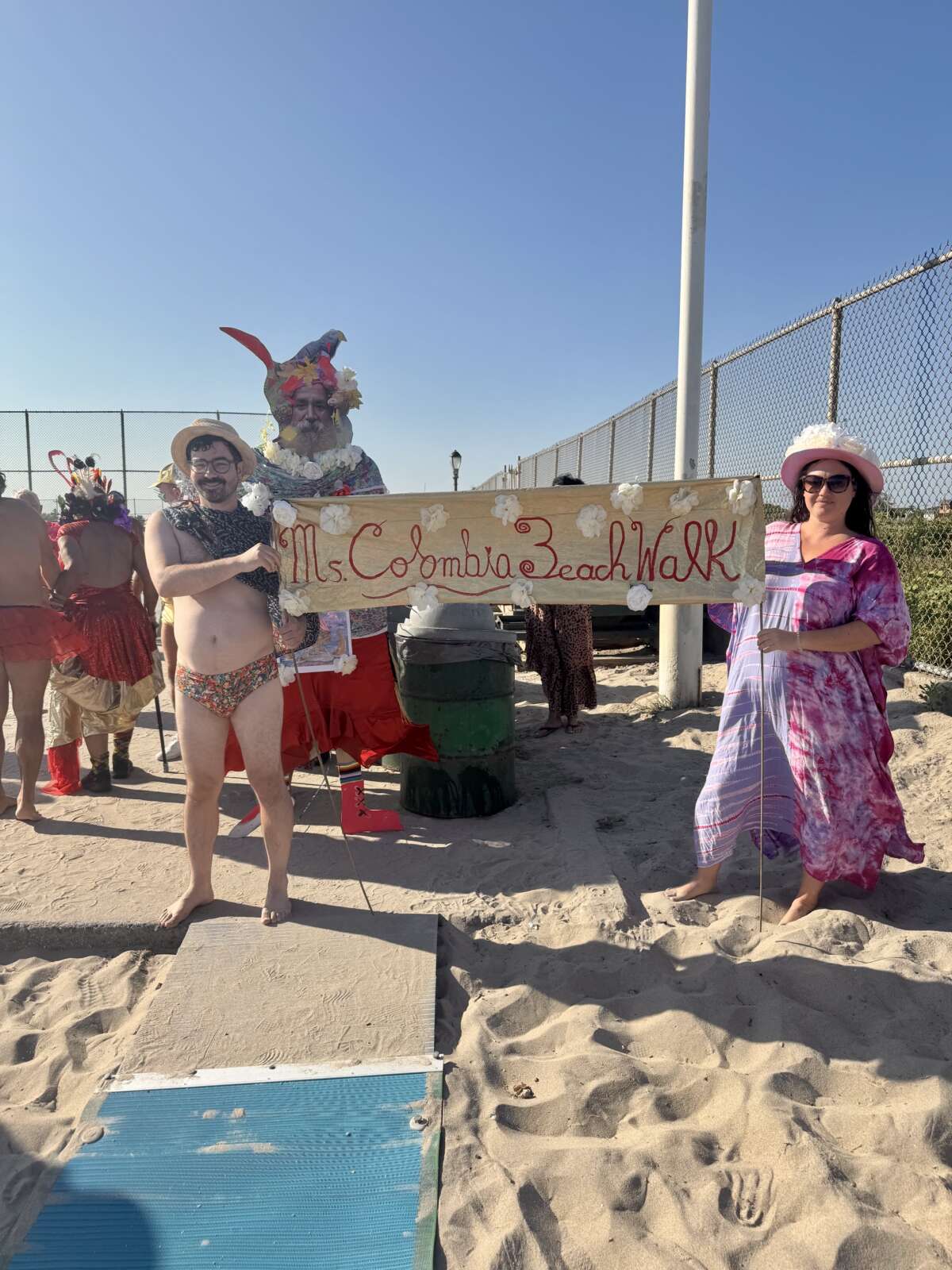
Ms. Colombia, born Oswaldo Gomez in Medellín, Colombia, was one of New York City’s most legendary queer figures. Known as La Paisa, Queen of Riis Park, and the Queen of Queens, she immigrated to New York in 1975 seeking freedom of expression and became a fixture at public events across the city, appearing in colorful outfits reflecting her Colombian heritage with her poodle Cariño and her parrot Rosita by her side. Diagnosed with HIV in 1988 and told she had one year to live, she spent the next three decades living fearlessly and unapologetically as herself. On October 4, 2018, her body was found in the Atlantic Ocean at Bay 1 of Jacob Riis Beach, the place she loved most.
Sissy also passed away on that same beach. “It’s a sacred space,” Villacrés said. “The community passed there, the queers passed there. Sissy passed there. Their spirits remain.”
After Ms. Colombia passed, Villacrés founded Ms. Colombia Day, the annual memorial that has become the premier community event of the summer at Jacob Riis Beach. He also founded Riis Porn, an Instagram community arts and culture project that transforms a derogatory term used against the queer community into a celebration of the beauty and cultural life of the beach through photography, t-shirts, and zines.
Villacrés describes what is happening now in terms that are simple and unambiguous. “You own the property,” he says of the surrounding community and the private developers moving in. “Yes, we respect you, we applaud you. But you don’t own the beach.” He draws on his Puerto Rican heritage to explain the community’s response, “In Puerto Rico, when someone tries to claim a beach, the community shows up the next day with dominoes and salsa music and their presence. That’s your house over there. This is not yours. The beach is not yours.”
“We need to declare it our space,” Villacrés said. “A little corner where we feel secure and safe to go be whoever we want to be. That is what is being taken from the community. Not just a bathhouse. Not just a beach. A place where people can go to the rocks and release what they have been carrying and know they are not alone.”
han hansen, who uses a lowercase presentation of their name, has been going to Jacob Riis Beach since 2021 and says they did not know they were nonbinary the first time they visited. “I feel like Riis has been a huge part of my gender discovery,” they said. “There’s something about being able to be outside in community in beachwear and feel comfortable and see so many different types of human bodies all around, all just enjoying themselves.”
hansen grew up in Iowa, in an environment they describe as homophobic and transphobic to a violent degree. They were repressed. Years later, after reconnecting with a childhood best friend who had also come to understand themselves as gender fluid and nonbinary, hansen brought them to Jacob Riis Beach. “We literally were living all of our childhood dreams together,” they said. “Riis was a catalyst for that.”
On the changes happening at the beach, hansen is clear. “It’s really clear when decisions are being made not with community in mind,” they said. “My only feelings really are that me and queer community are just going to keep showing up because this has been a safe space for us since the 1940s and that doesn’t just go away overnight.”
What hansen wants people to understand about this space is simple. “You really can see such a diverse array of backgrounds, identities, perspectives, all enjoying their time. You can hear so many languages being spoken, so many generations, so many races. This is something powerful to experience, that level of harmony and integration.”
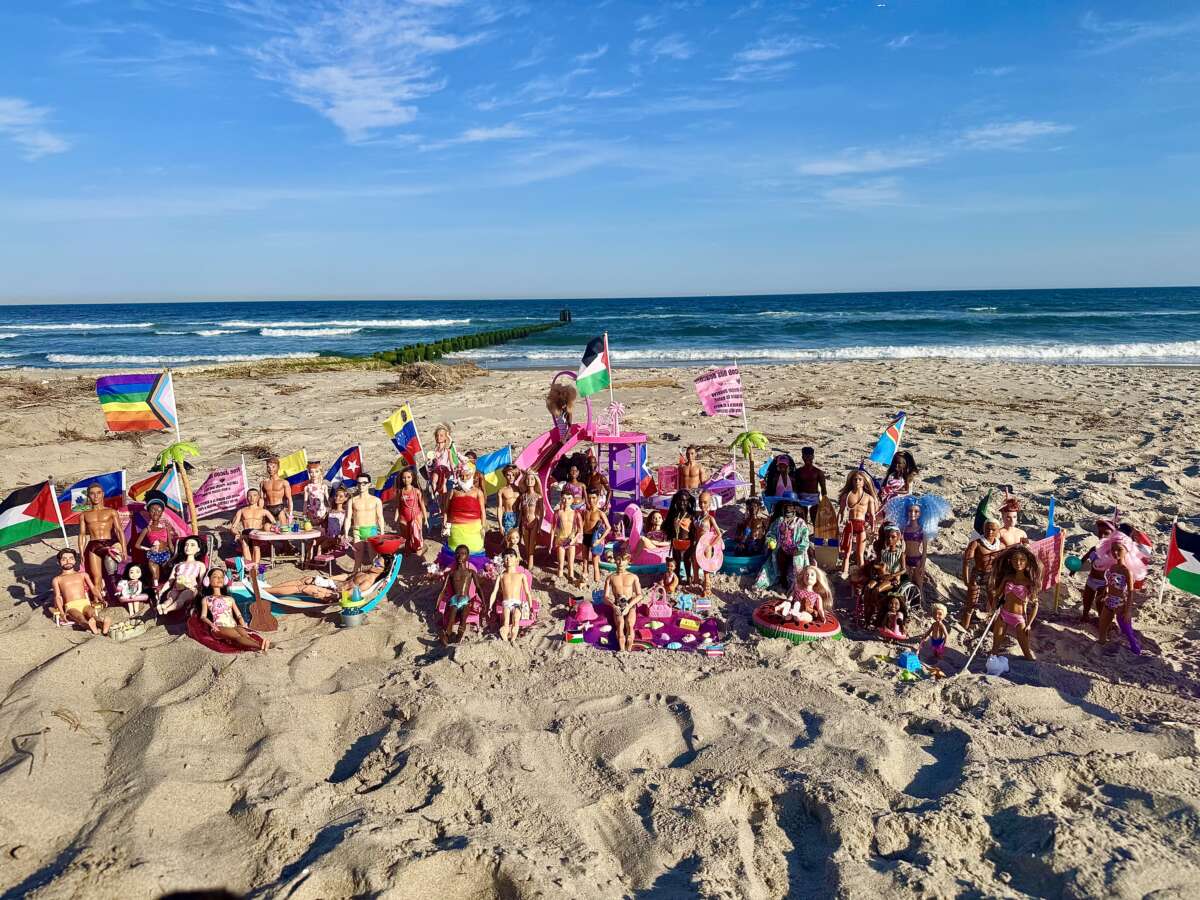
The Community Fight and the Vision for What Could Be
Despite these threats, the communities of Jacob Riis Beach are not passive. A growing coalition of community members, organizers, researchers, artists, and longtime beachgoers is actively working to protect Jacob Riis Beach and build the organizational infrastructure needed to mount a sustained and effective advocacy campaign on behalf of the communities that have always called it home.
They are not just taking the bathhouse. They are taking the beach. They are taking the parking lot. They are taking the shoreline. They are taking the safety. They are taking the history. They are taking the future.
And for the first time in the history of this advocacy effort, there is a political opening at the city level. Mayor Zohran Mamdani, the first Muslim mayor of New York City and a documented supporter of LGBTQIA+ rights, Palestinian liberation, immigrant protections, and public space accessibility, has established the first-ever Mayor’s Office of LGBTQIA+ Affairs, appointing Taylor Brown, the first openly transgender person to lead any New York City office, as its inaugural director. Parks Commissioner Tricia Shimamura has committed to making parks genuinely accessible to all New Yorkers. Deputy Mayor for Operations Julia Kerson oversees both the Parks Department and the Department of Environmental Protection. The Mamdani administration represents the most significant political opportunity this community has had in the entire history of this fight, and the window to act is now.
The city-controlled land at the former Neponsit Hospital site presents a concrete opportunity to build something that has never existed at Jacob Riis Beach. A permanent community structure designed by and for the communities that have always been there. Free public restrooms. Changing rooms. Water stations. Healthy food options. HIV and STD testing. Queer arts programming. And permanent monuments honoring the LGBTQIA+ figures whose lives and legacies are woven into the history of this place — people like Ceyenne Doroshow, Ms. Colombia, Victoria Cruz, and the other monumental figures who made the People’s Beach what it is and whose contributions deserve to be permanently honored there.
We Are Still Here
Jacob Riis Beach has always been, at its heart, a simple and profound thing. A place where people who were told they did not belong anywhere found somewhere they belonged. Where queer people, people of color, immigrants, and working-class New Yorkers could lay down their burdens for a few hours on a summer afternoon and simply exist. Not perform. Not justify. Not fight. Just exist, breathe, and be free in their bodies in the sun beside the people they love.
That is not a complicated ask. It is the most human ask there is. And yet the city, the state, and the federal government have responded to that ask not with protection but with erasure. A slumlord holds a 60-year lease on the bathhouse. A council member votes against trans health care in the same district where trans people have found safety on the sand for generations. A governor makes backroom deals with a president whose administration is simultaneously privatizing the beach, partnering park police with ICE in the parking lot, and dismantling every legal protection the community has spent decades fighting to secure.
Neither a $3,500 membership fee nor political indifference can erase a century of chosen family, radical joy, and unapologetic queer life from the sand.
They are not just taking the bathhouse. They are taking the beach. They are taking the parking lot. They are taking the shoreline. They are taking the safety. They are taking the history. They are taking the future.
But the community that built this space has survived worse. They survived the AIDS crisis on this beach, holding each other in the water when the rest of the world had turned away. They survived Hurricane Sandy. They have survived decades of being marginalized in society. They have been making something from nothing on this shoreline since before most of their elected officials were born.
Jacob Riis Beach belongs to the people who made it the People’s Beach. It always has. And neither a $3,500 membership fee nor political indifference can erase a century of chosen family, radical joy, and unapologetic queer life from the sand.
We are still here. We are still queer. And we are not leaving.
Press freedom is under attack
As Trump cracks down on political speech, independent media is increasingly necessary.
Truthout produces reporting you won’t see in the mainstream: journalism from the frontlines of global conflict, interviews with grassroots movement leaders, high-quality legal analysis and more.
Our work is possible thanks to reader support. Help Truthout catalyze change and social justice — make a tax-deductible monthly or one-time donation today.











+ There are no comments
Add yours