








Honest, paywall-free news is rare. Please support our boldly independent journalism with a donation of any size.
A new report by the Private Equity Stakeholder Project (PESP) shows that private equity firms now own almost 3 million apartment units in the U.S., which amounts to one in eight apartment units, some 13 percent of apartment units in the country. Approximately half of these units were bought since 2021, highlighting private equity’s turn to the housing market even as the U.S. suffers from a housing crisis.
Private equity firms invest money from pension funds and endowments to buy assets in order to make significant profit. In the housing market, private equity firms look for rents that are unregulated, with capped property taxes, in order to maximize their profits. According to the private equity business model, firms aim to increase the value of buildings before quickly selling them for a higher profit.
The PESP report found that private equity companies bought up almost 1.7 million apartment units — some 57 percent — since 2018, and 1.3 million of them since just 2021.
PESP’s report found that private equity’s expanded presence in the housing market “has exacerbated housing affordability issues, displacing local communities through large rent hikes and aggressive evictions, and diminishing tenants’ quality of life.”
Texas has the largest number of apartments owned by private equity in the country, with almost 580,000 units — and this is likely due to the state’s lenient zoning regulations, weak tenant protections, and lack of state income tax. Though there is a high level of private equity ownership of apartments in New York, California, and the Washington, D.C. area, private equity ownership is concentrated in the Sunbelt states as they have weaker tenant protections and also have seen significant population growth since 2020.
Blackstone, the world’s largest private equity firm, is also the largest owner of apartments in the U.S., owning over 230,000 apartment units. The PESP report found that in some cases, Blackstone raised apartment rents in buildings it bought since 2018 by over 30 percent. The report also noted that tenants in apartments bought by Blackstone have complained of “maintenance issues, aggressive evictions, undisclosed add-on fees, and large rent hikes.” This was not unusual in apartments acquired by private equity investors.
Private equity’s expansion into housing comes at the same time as Americans are increasingly struggling to afford rent. Half of U.S. renters spend nearly a third of their income on rent.
“Our country is in the midst of a housing affordability crisis. The last thing we need is private equity billionaires extracting wealth from tenants through unaffordable rents and junk fees,” said Jordan Ash, co-author of the report and director of housing research at the Private Equity Stakeholder Project (PESP). “Now more than ever, policymakers should take action to protect tenants from the private equity industry’s widespread infiltration of the U.S. housing market.”
Though private equity has rapidly encroached into the housing market over the past five years, the problem started earlier. During the 2008 financial crisis, private equity investors bought up hundreds of apartment buildings that held thousands of rent-regulated units, and pressured residents to leave so that they could raise rent prices. Intent on high profits, private equity firms have “at times led the market in rent increases and mortgage foreclosures.” While millions of Americans were financially devastated in the wake of the 2008 Great Recession, private equity firms profited.
A 2022 analysis by ProPublica found that the encroachment of private equity into housing has been fueled in part by Freddie Mac, the U.S.’s largest rental housing finance company. Freddie Mac offered lower interest rates and other advantages to investors. ProPublica found that large private equity firms made up the vast majority of Freddie Mac’s deals financing apartment complex purchases, and almost all of these occurred after 2015.
ProPublica also found that another real estate investment company, Greystar, had helped pave the way in connecting large investors with apartment complexes, by raising funds from pension funds, hedge funds, and life insurance companies. Greystar’s acquired apartments nearly doubled between 2016 and 2021 to over 75,000 apartments.
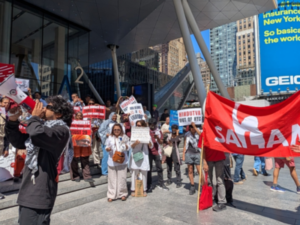
But grassroots mobilization against private equity has also been growing, with activists and communities organizing tenant unions and taking up lawsuits to protect tenants.
An important fundraising appeal: 6 Days to raise $39,000
Thank you for reading Truthout today. We have a brief message before you go.
Unfortunately, donations are down for Truthout at a time when media faces immense pressure. Yet, grassroots media is vital in the fight against Trump’s authoritarian reign. Our mandate to tell the truth, share strategies for resistance, and speak against fascism grows more urgent each day. We must appeal for your support.
If you can support Truthout with a one-time or monthly donation, you will make a significant impact on our work. Please donate during our fundraiser.









+ There are no comments
Add yours