







Honest, paywall-free news is rare. Please support our boldly independent journalism with a donation of any size.
In communities large and small, red and blue, all across the United States, residents are filling local council meetings in opposition to the explosive growth of high-tech police surveillance systems.
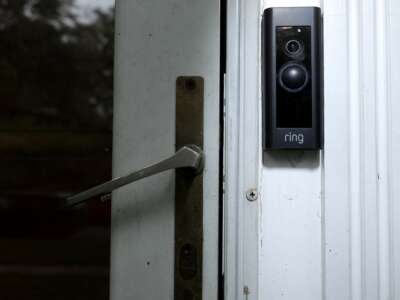
Local movements to rid city streets of AI-powered surveillance cameras and Automated License Plate Recognition (ALPR) networks used by law enforcement are growing rapidly amid scandals, mounting privacy concerns, and public backlash to AI and mass surveillance under the authoritarian Trump administration. The cameras and their associated systems are capable of building complex profiles of people and vehicles as they move through public areas.
Last week inside a packed city council chamber in Asheville, North Carolina, residents who had waited hours to share a public comment chanted “Shame! Shame! Shame!” as their elected leaders voted 6-1 to build a “real-time intelligence center” for local police. Unless the city changes course, police will soon have a “wall of screens” fed by high-tech cameras to monitor a city of 95,000 people.
In Bandera, Texas, a pro-surveillance councilmember proposed banning “cell phones, the internet, cameras, and nearly all technology” in retaliation after his colleagues in the small town voted 3-2 to end its contract with the surveillance company Flock Safety after months of debate, according to 404 Media. Residents were enraged after the town installed eight Flock license plate cameras with AI, which were damaged by vandals.
In Troy, New York, heated controversy over Flock cameras led the Republican mayor to declare a “state of emergency” to keep using the technology. The city council is now suing the mayor over her declaration as it considers putting legislative limits on the cameras. In Cleveland, Ohio, records unearthed by journalists this week show 160 immigration-related searches in Flock audit logs over a month-long period of the city’s Flock camera and surveillance drone network. The revelation comes months after city officials assured residents that protections were in place to prevent such searches and keep Immigration and Customs Enforcement (ICE) from exploiting the data for President Trump’s mass deportation campaign.
The push against Flock cameras, drones, and AI-powered surveillance in local communities comes in the wake of reported abuses by law enforcement, including the sharing of local surveillance data with the Trump administration to target immigrants for deportation.
In at least 16 recent cases, local police officers lost their jobs after accessing license plate reader data to stalk ex-partners or other romantic interests, according to the Institute for Justice. Internal investigations uncovered the abuse in only a few cases. Most of the cases came to light after victims reported the offending officers’ behavior to other police.
“A year ago, people really hadn’t heard of Flock,” said Patrick Conant, founder of the Asheville-based transparency group Sunshine Labs, in an interview. “But with increased media coverage, and rising concern about surveillance tech in general, a lot more people are all of sudden paying attention.”
A New Era of AI Surveillance
Often funded by federal grants promoting surveillance, thousands of police departments across the United States have installed ALPR networks with cameras that automatically capture images of every car that passes by, along with a timestamp. The data feeds into searchable platforms integrated with AI, allowing police to easily identify and track vehicles by license plates as well as dents, roof racks, and bumper stickers — all without a warrant.
The most well-known and controversial systems are built by Flock Safety, which is increasingly finding itself on the wrong side of public opinion.
Flock systems gather data to create a digital “Vehicle Fingerprint” for individual drivers that can be fed into proprietary, searchable artificial intelligence systems. In many cases, ALPR data can be accessed by dozens of law enforcement agencies outside of a local area without a warrant — including out-of-state police departments and federal agencies.
Flock’s systems are powerful. In 2025, 404 Media revealed that a local sheriff’s office in Texas used 83,000 ALPRs and 6,809 Flock camera networks across multiple states to track one woman suspected of self-managing an abortion with medication, which is standard care but banned in Texas. An officer used Flock in an attempt to track the woman as far as Illinois and Washington, where abortion is legal and protected by law.
Citing denials from the sheriff’s office in Texas, Flock initially called the story “misreporting” and “clickbait.” However, documents show the woman was indeed targeted for self-managing abortion on behalf of an allegedly abusive ex-partner who attempted to press criminal charges.
Flock Safety claims its surveillance networks are not “mass surveillance.” The company says most data collected is deleted on a set schedule, but critics point out that data and camera footage is retained to train AIs and even sent overseas to be reviewed by gig workers.
Flock Safety casts its technology as critical tools for fighting “crime,” and for police, surveillance networks are quickly becoming viewed as an industry standard — the sort of high-tech toys that every police department wants, and which federal and state grants often significantly subsidize.
However, civil rights attorneys argue Flock’s vehicle fingerprinting violates the Constitution’s protection against “unreasonable searches” by the government. For example, in San Jose, California, residents are suing the city under the Fourth Amendment over its network of nearly 500 ALPRs that allows any police officer to track an individual’s movement across the city for 30 days at a time without a warrant.
A notable legal challenge to ALPR surveillance comes from Norfolk, Virginia, where police have installed more than 170 Flock cameras since 2023. The complaint filed in federal court on behalf of two residents argues the surveillance system creates a “detailed map of the driver’s movements.” The local police chief boasted that it “would be difficult to drive anywhere of any distance without running into a camera somewhere.”
Federal judge Mark Davis ruled in late January that there was insufficient evidence to declare Norfolk’s surveillance system an unconstitutional invasion of privacy. However, citing previous privacy cases, Davis warned ALPRs could cross the legal threshold with technological advancements in the future, without detailing what those advancements might be.
The plaintiffs are appealing the ruling, marking the first time a Flock challenge has found its way up the federal court system. The Institute for Justice is representing the plaintiffs in both San Jose and Norfolk with its Plate Privacy Project, which helps “everyday people fight back against warrantless mass surveillance,” according to Michael Soyfer, an attorney for the group.
“Our clients and all people who drive through Norfolk should not be subjected to this warrantless mass surveillance, which is why they’re fighting back against the city’s ALPR system,” Soyfer told Truthout in an email.
An Anti-Surveillance Movement Rising
DeFlock, a group that tracks and does public education around the surveillance technology, recently announced a nationwide “week of action against ALPRs” that will begin on August 16. Members of Lucy Parsons Labs, an anti-surveillance collective involved in the organizing, said momentum behind the week of action is growing rapidly.
“Over the last year, we’ve seen thousands of people demanding that their elected officials remove these cameras,” Lucy Parson Labs members said in a collective statement. “We’re seeing with more clarity what these systems are. These technologies don’t deliver safety. In fact, they make us all less safe.”
As public backlash grows, local leaders nationwide are reconsidering contracts with Flock. At least 68 cities have canceled contracts with Flock so far, according to DeFlock. However, some cities are simply replacing Flock cameras with those made by competitors in response to public pushback.
For example, in Asheville, a city that frequently touts its progressive values, the city council is attempting to appease worried residents without scrapping plans for the “real-time” police surveillance center. During its May 12 meeting, the council passed a broadly worded resolution affirming civil liberties, and at least one councilor has told residents that the number of ALPRs would eventually be reduced from the 11 Flock cameras currently deployed by the police department to “potentially one.”
However, the city council also voted to accept a federal grant secured by a Republican senator for the surveillance center and secure a multi-year contract with Flock competitor Axon. Kim Roney, a mayoral candidate and the only councilmember to vote against the measures, said she opposed “AI-fueled, for-profit surveillance tech in Asheville” due to the community’s unanswered questions about unforeseen costs, data protection, and constitutional privacy rights.
“Tech companies exist to profit from data collection,” Roney said in an email. “In the absence of the pending service agreement contract, I reached out to Electronic Frontier Foundation. They warned that any resolution that claims to protect local data is null when the state and federal government do not allow cities to withhold data, plus there are unanswered questions as to which entity owns derivative data.”
Patrick Conant said activists are reviewing Axon’s contracts with other cities in order to gain an understanding of how a contract with Asheville might work.
“The general sentiment I am hearing from a lot of folks is that they were not aware that our city was using all of these tools, and they would like to know about what is already in place and what safeguards exist for what is in use, and they want to know more before they expand the system,” Conant said. “They are proceeding with accepting federal grants and directing the city manager to negotiate contracts before the full terms are available.”
However, Conant said the Asheville residents who showed up to oppose the police surveillance center were not deflated after the city council voted to accept the federal grant and surveillance contract. Instead, after waiting hours to share a public comment before the council, people gathered outside to discuss next steps.
“I’ve seen people continue to organize and connect, people are going to do more community forums, and people of course are saying, ‘how do we vote out the people who are in favor of this,’” Conant said. “And that is what we have been doing since that meeting.”
An important fundraising appeal: 6 Days to raise $39,000
Thank you for reading Truthout today. We have a brief message before you go.
Unfortunately, donations are down for Truthout at a time when media faces immense pressure. Yet, grassroots media is vital in the fight against Trump’s authoritarian reign. Our mandate to tell the truth, share strategies for resistance, and speak against fascism grows more urgent each day. We must appeal for your support.
If you can support Truthout with a one-time or monthly donation, you will make a significant impact on our work. Please donate during our fundraiser.










+ There are no comments
Add yours