






Did you know that Truthout is a nonprofit and independently funded by readers like you? If you value what we do, please support our work with a donation.
On June 25, 2026, the Committee to Protect Journalists announced that it had removed 20 names from its list of journalists killed in the Gaza Strip, confirming only eight names while leaving the remaining cases under review. When I read the announcement, I did not focus on the numbers. Instead, I found myself asking a single question that has haunted me ever since: If I am killed tomorrow while doing my job, will I be recognized as a journalist, or will my name also disappear from the list?
Since the beginning of Israel’s war on Gaza, more than 260 journalists in Gaza have been killed, according to the Palestinian Journalists Syndicate, making it one of the deadliest conflicts for media workers in modern history. Despite this unprecedented toll, international organizations dedicated to protecting journalists have been unable to stop their killings or provide meaningful protection.
I began working as a journalist in 2024, in the midst of the genocide unfolding in Gaza. My goal was never simply to report the news. I wanted to tell the world what we, as Palestinians, were living through. I wrote about our forced displacement, the complete destruction of my family’s home, and the interruption of my university education for an entire year. I documented the suffering of families who lost loved ones, people who were wounded or amputated, and women who became the sole providers for their households after losing their husbands.
I understood from the beginning that journalism in Gaza could cost me my life. Every story means leaving my home and traveling to places that could be bombed at any moment. Yet I constantly remind myself: We are all living under the threat of death in Gaza. If I am killed, at least I will have died doing my work as a journalist.
On July 18, 2026, that possibility came frighteningly close.
Journalism in Gaza could cost me my life. Every story means leaving my home and traveling to places that could be bombed at any moment.
I was on my way to Gaza City’s Al-Nasr neighborhood to interview a woman who had lost her husband and become the sole breadwinner for her family. As I approached the area, an apartment building approximately 200 meters away was hit by an Israeli airstrike. I watched shrapnel scatter through the air around me. Terrified, I turned back and rushed home.
When I arrived, the fear was written all over my face. Standing there, I asked myself a simple but devastating question: If I had been killed just minutes earlier, would the world have recognized me as a journalist? Or would my professional identity also have been questioned after my death?
Journalists in Gaza work with the bare minimum. I do not own a professional camera, a laptop, or even a microphone for recording interviews. Everything I do depends on my personal mobile phone. I record interviews, take photographs, write my reports, and submit them using that single device.
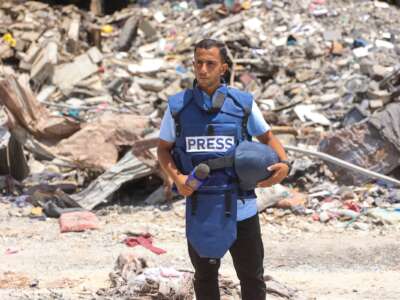
Nor do I have protective equipment such as a press vest or helmet. Without them, there are many places I simply cannot risk entering because doing so would put my life in even greater danger. Although protective gear has failed to save many journalists in Gaza — where journalists and human rights organizations accuse the Israeli military of deliberately targeting media workers — it can still offer some protection against shrapnel and stray bullets.
After I had spent a year and a half of working as a journalist, my father urged me to apply for a press card from the Palestinian Journalists Syndicate to formally establish my professional status.
I visited the syndicate’s office in Gaza, where I met Ahed Farwana, Secretary-General of the Palestinian Journalists Syndicate in Gaza. I told him that I wanted to obtain membership and a press card. He explained that membership is not merely symbolic; it is essential for protecting journalists’ rights. If a journalist is killed or injured, the syndicate obtains authorization from the journalist’s family to pursue legal action before the International Criminal Court and other legal bodies, even though these efforts have so far failed to hold those responsible for killing journalists accountable.
Obtaining membership, however, is not automatic.
Farwana explained that the Palestinian Journalists Syndicate does not grant membership to just anyone. Applicants must demonstrate that they are practicing journalists by submitting published work and official letters from the media organizations they work with.
I submitted links to my published reporting, along with official documentation from the media outlets that publish my work. Four months later, my application was approved, and I officially became a member of the Palestinian Journalists Syndicate.
Holding my press card in my hands felt like a personal victory. It was more than an identification card — it was official recognition that I was a journalist.
On July 21, 2026, I returned to the syndicate’s office to interview Ahed Farwana about the Committee to Protect Journalists’ decision to remove Palestinian journalists’ names from its casualty list.
Farwana said the Palestinian Journalists Syndicate categorically rejects questioning the identity of any journalist whose name it has recognized, stressing that the syndicate is the only body authorized to determine who qualifies as a journalist in Gaza, based on clear professional standards and criteria.
He added that the international community has failed to protect Palestinian journalists despite the unprecedented number of killings, limiting its response to statements of condemnation while journalists continued to be targeted.
He also urged international organizations not to adopt Israeli narratives questioning the identity and credibility of Palestinian journalists, arguing that such claims serve only to shield those responsible from accountability.
Today, I carry a press card that officially recognizes me as a journalist. Yet the question that first entered my mind after reading about the removal of journalists’ names from casualty lists has never left me: If I am killed while doing my job, will this card be enough for the world to recognize that I was a journalist? Or will I, too, become another case to be questioned after my death?
Fundraiser Deadline: Missed
Truthout is one of only a few platforms for justice-oriented, grassroots journalism. Today, as political censorship from the right intensifies, we have no choice but to ask for your help.
We missed our fundraising deadline, but there’s still time to help us meet our basic operating expenses before the end of the month. If you can support Truthout with a one-time or monthly donation, you will make a significant impact on our work. Anything you can do makes a difference — we appreciate your support.





+ There are no comments
Add yours