







Truthout is an indispensable resource for activists, movement leaders and workers everywhere. Please make this work possible with a quick donation.
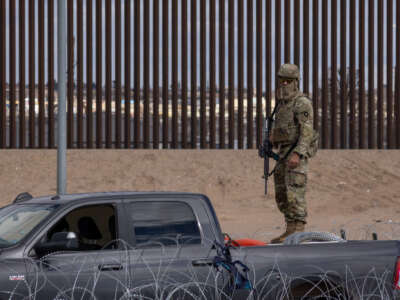
Fights over President Donald Trump’s border wall are erupting once again across the Southwest. Protesters are launching tree-sits in the Arizona-Mexico borderlands, and the Tohono O’odham Nation recently put up “no trespassing” signs to ward off the federal contractors bulldozing across the Sonoran Desert to build a secondary border wall on tribal territory and in the public parklands of Organ Pipe Cactus National Monument.
Flush with more than $46 billion in funding from Trump’s unpopular budget bill passed by the GOP in 2025, the administration is building a complex “border barrier system” that includes a “primary and secondary wall” with a road between them, as well as “waterborne barriers, patrol roads, and the technology required to tie it all together, such as cameras, lights, and other detection technology,” according to U.S. Customs and Border Protection (CBP).
Photos taken on August 16 and 17 and released by the Center for Biological Diversity this week show “significant clearing” of otherwise federally protected wild desert along the southern border just a few miles from Quitobaquito Springs, a rare desert oasis that is sacred for Indigenous people and home to endangered species. Protesters have erected a tree-sit near the spring in an ancient cottonwood known as the “grandmother tree” to block construction.
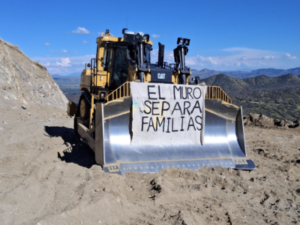
To build a secondary border wall parallel to the 30-foot-high wall already in place in Organ Pipe Cactus National Monument, contractors have leveled and cleared of wildlife two areas east of the spring. One area is a large staging yard for construction equipment, while the other area was cleared for the wall itself, which is slated to be built parallel to the existing border wall. There will be 100 feet in between the two walls for Border Patrol vehicles and surveillance technology.
Russ McSpadden, the southwest conservation advocate at the Center for Biological Diversity, hiked beyond road closures to take the photos. He said construction is moving toward the Quitobaquito Springs and threatening endangered species found nowhere else in country. Conservationists are removing endangered mud turtles to other locations to prevent them from being lost forever.
“The water runs just a couple dozen feet from the border; if they put a second wall there, they will destroy the hydrology,” McSpadden told Truthout.
While construction continues in Arizona, the Trump administration abruptly paused border wall construction in Big Bend National Park in Texas on August 17. That stretch of border wall has been unpopular with politicians in both parties. Videos of heavy equipment destroying pristine public lands went viral on social media.
On June 11, the Center for Biological Diversity amended a lawsuit filed in April against the Trump administration after officials waived dozens of environmental and public health laws to fast-track construction of border barriers in Big Bend, including laws protecting safe drinking water, wild horses, bald eagles, and archeological sites. A federal judge will consider the group’s request to pause construction at an emergency hearing on August 28.
With the Republican majority in Congress facing a potential route in the upcoming midterms, Trump and his allies appear to be rushing to erect more roads, walls, fencing, and high-tech surveillance towers along the border while they have power to do so. Laiken Jordahl, the national public lands advocate at the Center for Biological Diversity, suggested that the administration is using border wall construction to line the pockets of politically connected contractors.
“They are sacrificing our public lands so obscenely rich men who have never once set foot here can get even richer,” Jordahl said in a post documenting contractors in Big Bend on August 15. “And if they can do it here in Texas’ wildest and most beloved national park, they will do it everywhere.”
Despite the Trump administration’s pause on construction at Big Bend, construction crews have already caused serious damage, according to the National Parks Conservation Association. The group pointed to what it called “distressing videos” of javelinas, the iconic foraging mammal of the desert, running from bulldozers as their habitat is destroyed. Recreational access to the park has also been disrupted by road closures and damage to access points.
“Unfortunately, the federal contractors’ bulldozers have already inflicted tremendous damage to one of America’s most iconic national parks,” said Tiernan Sittenfeld, president and CEO of the National Parks Conservation Association, in a statement on August 17. “Their heavy equipment has torn through miles of priceless wild landscape, wreaking havoc on sensitive wildlife and irreplaceable habitat.”
In the Sonoran Desert of southern Arizona, border wall construction threatens pristine ecosystems home to the American jaguar and other endangered species, sacred sites used for Indigenous religious ceremonies, as well as the Tohono O’odham Nation’s sovereignty over ancestral lands, according to tribal leaders and conservation groups. In May, federal contractors making way for the border wall in the nearby Cabeza Prieta National Wildlife Refuge damaged Las Playas Intaglio, a fish-shaped geoglyph made by human hands 1,000 years ago.
In June, the Tohono O’odham Nation sued CBP and the Department of Homeland Security (DHS) for pursuing construction along 62 miles of border inside the Tohono O’odham Nation without consulting the tribe or receiving permission. On the same day that the Trump administration paused building in Big Bend, a federal judge declined the tribe’s request to block construction while the lawsuit moves forward. The Center for Biological Diversity has filed a separate lawsuit challenging construction under the Endangered Species Act.
Along with the “no trespassing” signs, tribal leaders have warned that federal contractors seeking to build roads and walls on their reservation would face removal and trespassing charges, setting the stage for potential confrontations between construction crews and tribal police. The Tohono O’odham reservation is adjacent to Organ Pipe Cactus National Monument.
The Tohono O’odham Nation maintains that it “strongly supports border security measures” and has partnered with CBP and DHS for years, allowing agents to operate on the reservation and arrest migrants. However, the tribe has long opposed construction of walls along the international border, which bisects the tribe’s land and creates barriers to moving freely and visiting relatives on what should be sovereign Indigenous territory.
In September 2020, when Trump was rushing to build his so-called “big” and “beautiful wall” before the end of his first term, two women with the Hia Ced O’odham tribe were called by ancestors to pray at Quitobaquito Springs as contractors were bulldozing through the sacred area and draining precious water from the aquifer to mix concrete.
The two Hia Ced O’odham activists, Nellie Jo David and Amber Ortega, were arrested on misdemeanor charges for refusing to halt their prayers and make way for more demolition of the Sonoran Desert, one of the most biodiverse desert ecosystems on the planet. Both women said law enforcement violated their rights, and David took a plea deal after she said the government made her life a “living hell.”
Ortega fought the charges, and in 2022, a federal judge reversed an earlier decision and found that the charges imposed an illegal burden on Ortega under the Religious Freedom Restoration Act. Ortega was acquitted.
However, with construction starting up again near Quitobaquito Springs, and protests and litigation once again underway, it may be only a matter of time before more activists are arrested for defending sacred waters and Indigenous lands.
“We have just entered this period of — It’s border wall everywhere, all the time,” McSpadden said.
An important fundraising appeal: We still need to raise $9,000
Truthout is one of only a few platforms for justice-oriented, grassroots journalism. Today, as political censorship from the right intensifies, we have no choice but to ask for your help.
We are fundraising right now to cover our basic operating expenses. If you can support Truthout with a one-time or monthly donation, you will make a significant impact on our work. Anything you can do makes a difference — we appreciate your support.





+ There are no comments
Add yours