





Support justice-driven, accurate and transparent news — make a quick donation to Truthout today!
Just six years after millions of people across the country took part in racial justice uprisings after the police murders of George Floyd and Breonna Taylor, politicians and pundits of all stripes — from reactionaries like President Donald Trump to progressives like Alexandria Ocasio-Cortez — have turned against demands to decrease funding for police. Those demands were popularized over years of organizing from a broad popular movement against decades of unprecedented mass incarceration.
In this interview, Alec Karakatsanis explains the roots of the backlash, how both Republicans and Democrats have used it to increase the powers of police, and why it’s essential to rebuild the movement to fund communities, not cops. Karakatsanis is the founder and executive director of the Civil Rights Corps, an organization that has pioneered landmark litigation challenging systemic injustices in the punishment bureaucracy, author of the book, Copaganda: How the Police and Media Manipulate our News, and publisher of the Copaganda Newsletter.
This interview has been edited for length and clarity.
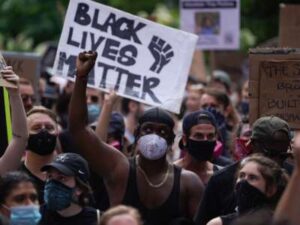
Ashley Smith: After the police murder of George Floyd, the U.S. exploded in protest, becoming the biggest wave of mass demonstrations in U.S. history with as many as an estimated 26 million people marching across the country. Republicans and Democrats launched a backlash against the movement. What have they argued and done?
Alec Karakatsanis: It’s important to underscore that it’s not just Republicans behind the backlash. It’s a bipartisan establishment assault on the movement that emerged in the decade before 2020. That struggle aimed to reduce the size and power of the punishment bureaucracy, the term I use to describe the institutions the government uses to repress people and the for-profit industries parasitic on them.
That bureaucracy’s role is to control and manage inequality, targeting the most oppressed in our society, from poor people to people of color to people with disabilities and immigrants. It also represses the people involved in social movements that struggle for a more equal society in order to prevent those movements from achieving popular power. Both parties denounced the social movement’s demand to decrease investment in the bureaucracies of repression and increase investment in systems of care.
They used three main tactics. First, they whipped up a frenzy over retail theft and street crimes, harms mainly associated in the public imagination with poor and marginalized people. A lot of this was not founded in facts. For instance, the supposed epidemic of shoplifting turned out to be a lie. It wasn’t going up nationally at all.
They used that fiction to deflect attention from the crimes perpetrated by police, prison guards, bankers, pharmaceutical executives, tax evaders, polluters, and health insurance companies. These cause far more death, injury, and harm to our safety than crimes committed by poor people. For example, FBI figures for all property crimes combined in the United States are dwarfed by estimates of corporate wage theft.
Second, as discussed at length in Copaganda, they claimed that crimes committed by marginalized people are increasing across the country. This fearmongering tricked lots of people into thinking that crime is going up. It’s actually plummeted to historic lows.
Third, liberal and conservative pundits and media claimed that the only solution to their manufactured lie of increasing crime is more investment in the punishment bureaucracy. So, dozens of cities expanded budgets for police and prisons each year since the killing of George Floyd.
Trump in particular has dramatically increased funding of the surveillance state. And he’s deploying its institutions like the National Guard, Immigration and Customs Enforcement (ICE), and Customs and Border Protection (CBP) to collaborate with the police in city after city to crush marginalized people and political opposition.
How do these two parties carry out the same project in different ways?
Republicans deploy one set of arguments, experts, and myths to make their case on outlets like Fox News. They use racist, jingoistic, and misogynistic propaganda that demonizes oppressed people like immigrants, Muslims, poor people, the unhoused, and those with disabilities. They make a straightforward authoritarian case that some people must dominate others.
Because that’s so easy to see for many liberals, I focus on exposing the Democrats and their liberal establishment proponents. They use their own set of arguments, experts, and myths in outlets like The New York Times, The Atlantic, and NPR to make the case for the punishment bureaucracy to professional class elites.
Take the example of body cameras. The Democrats and liberal media offered them to make police more “accountable” after their 2014 murder of Michael Brown in Ferguson, Missouri.
That was shocking. Previously, the police, prosecutors, and the surveillance industry had been clamoring to get body cameras. But they had failed to convince liberal city governments to invest billions of dollars in what would be the greatest expansion of police surveillance in history. Prosecutors and police wanted cameras to collect evidence to coerce guilty pleas from poor people to make the unprecedented assembly line of millions of arrests and profitable fees move more quickly.
They also wanted the cameras for surveillance. They wanted every cop in the U.S. to have a camera that they can control. They control the angle, when it’s turned on, how its video is edited, and when it’s released.
They wanted to be able to release a video right away when it served their interests. Or they wanted to be able to withhold it for years when it didn’t, like Rahm Emanuel did in the case of the police murder of Laquan McDonald in Chicago.
The police can also use these cameras to repress protest movements. They can scan a crowd with their camera and then connect it to facial and voice recognition databases and AI to identify targets for arrest. This surveillance industry is now worth tens of billions of dollars.
After the killing of Michael Brown in Ferguson, the surveillance industry pitched body cameras to Democrats as a tool of “accountability and transparency.” The Democrats and the liberal media jumped on board.
In my book, I document many other examples of how the Democrats and news outlets like The New York Times justify all this as progressive and even compassionate. Just look at how the Times covers surveillance. The paper portrays China’s use of video surveillance as authoritarian. But in the U.S., it depicts body cameras as a tool for social justice.
Both parties demonize demands like defund and abolish as “woke.” They claim that any legislation that shifts funding from police to social services is unpopular. What is wrong with their argument?
First of all, the truth is that proposals to redirect money from police to care services are among the most consistently popular in modern American history. Over the last 37 years, Gallup has asked people, in so many words: “What is your preferred approach to crime and public safety? Do you want to invest in policing and prisons? Or do you want to invest in social services, education, healthcare, housing, and similar programs?”
Every time, a supermajority of people say they want to invest in such programs over the punishment bureaucracy.
But the media reports the exact opposite. How do they get away with it? They attach a label like “defund” — which both Republicans and Democrats demonize and strip of real content through superficial coverage — to popular policies to trick people into turning against substantive policies they support.
Recently, left-wing politicians like New York Rep. Alexandria Ocasio-Cortez dismissed demands like “defund” by saying “woke 1 was crazy.” New York City Mayor Zohran Mamdani defended her, saying that politicians can change their positions and that he also didn’t support the defunding of the police. Why have they done this? What’s the problem with their arguments?
Their statements are dangerous, and it’s part of a growing pattern. In my Copaganda Newsletter, I document how the liberal establishment has openly advocated repressive institutions.
For example, Sen. Chris Murphy (Connecticut) and other Democrats taunted the Trump administration last year for not deporting enough people. They’ve repeatedly gone so far as to boast that their party was actually better at enforcing immigration laws and getting tough on crime.
Mamdani gave credit to billionaire police commissioner, Jessica Tisch, for bringing crime to record lows. This is absolutely absurd. The truth is that crime is down all across the United States in city after city that Jessica Tisch has nothing to do with.
Everybody who studies the evidence knows that the things that determine how much we hurt each other in a society are the big features of the society — the levels of inequality and poverty, the accessibility of housing and health care, the scale of loneliness and isolation, demographic and cultural trends, the increase or decrease in toxic masculinity, the availability of early childhood education, and so on. These are the things that affect how much we harm each other.
Little tweaks to the New York City Police Department or the largely similar policies across U.S. police departments have nothing to do with these trends. Whether there are twelve or eight cops on this or that beat and whether the punishment for some crime is seven years or four do not lower such social harms. As I explain in Copaganda with a deep discussion of the research, this has all been scientifically studied and documented.
Incarceration is also criminogenic. It actually leads to more crime, much of it done by cops and prison guards themselves. And such spending comes at the expense of social services. Our levels of incarceration actually decrease overall life expectancy by hundreds of millions of life years.
So, when Mamdani gives credit to Tisch or when Ocasio-Cortez dismisses a whole category of popular demands as “woke 1,” they are reinforcing far right mythologies and lending tacit support to the punishment bureaucracy. Regardless of their intentions, they are telling the public that these far right policies of targeting the poorest people in our society, arresting people, and deporting more people keep everyone safe. That’s blatantly not true.
In doing so, they are making it harder for themselves to challenge the far right and punishment bureaucracy on anything. Mamdani boosted the credibility of Tisch by saying she was responsible for public safety. After that, it will be easier for her to force him to adapt to her authoritarian program or to have leverage against him.
Mamdani and Ocasio-Cortez have also undermined the left and social movements. Ocasio-Cortez did that when she essentially said, “Oh yeah, a few years ago I said some really stupid stuff that I no longer believe.” That discredits a popular and righteous struggle that shifted the entire debate about repression in a progressive direction.
In the process, Ocasio-Cortez opened the door for other left politicians to adopt the bipartisan support for expanding funding for police and ICE. Already, many Democrats have accepted the lie that body cameras and “training” hold their agents accountable and based on that mistaken belief voted for more, all-time record funding for both of these repressive institutions.
Worst of all, Mamdani and Ocasio-Cortez’s statements have undermined the left’s electability and strengthened that of the authoritarian right. Once the electorate buys the argument that repression keeps us safe, they’re not going to vote for flip-flopping fakers. They’re going to vote for the full-throated right. And even if politicians sneak out wins after conditioning an electorate in that way, it becomes impossible to then push an anti-repression agenda contrary to how they framed their campaigns.
Progressive politicians should not be lending credibility to the punishment bureaucracy when both parties have dramatically expanded policing, unleashed ICE and CBP, and greenlit mass surveillance with Flock cameras and AI. Instead, progressives should expose how such government repression props up our society’s growing inequalities.
Such positions have been given intellectual ballast by academics who make the case for the left to support policing and even incarceration. What’s their argument and what are some of its problems?
In my newsletter and book, I critique “socialist” Harvard professors Adaner Usmani and Christopher Lewis for aiding and abetting the punishment bureaucracy. They make what they claim is a socialist case for the greatest expansion of policing in modern world history.
They propose adding 500,000 cops to the United States and pass it off as “progressive.” Paul Heideman cites their work in his most recent and incoherent Jacobin article on “carceral minimalism.” As I show, it’s just a bunch of nonsense strung together by professors who are willing to lend their name and gravitas to ideas that flat-earther police unions advocate.
They ignore the social costs of dramatically expanding policing and surveillance. I document these in my book — increased death, stepped up crime rates, lower life expectancy, higher infant mortality, extraordinary reductions in privacy, dramatic escalation of police brutality and incarceration, and an expansion of the government’s ability to crush social movements.
This last one is most important for the left. Remember, the policing bureaucracy has targeted every major progressive struggle in modern US history from the suffragette to the labor, anti-war, civil rights, Indigenous, disability justice, climate justice, and Palestine solidarity movements.
The professors’ call for half a million more cops will empower the state to target today’s struggles for reforms like universal health care and a more equal society. Any progressive that makes such a case is undermining their own cause. It’s not a serious argument; it’s intellectuals shooting themselves and all of us in the foot.
The backlash seems to be ascendant. What do mass policing and incarceration look like today? What should we do to resist the backlash?
We’re living in a time with nearly the highest incarceration in world history. Even though the U.S. rate of incarceration has gone down a little over the last 15 years, we’re still putting human beings in cages at five times our own historical average, about five to 10 times other comparable countries, and Black people at rates six times the rate of South Africa at the height of apartheid. The U.S. jails 10 million people a year.
Moreover, with the unprecedented expansion of the surveillance industry and its integration into local, state, and federal police, the government now has an unprecedented capacity to trap and surveil marginalized people and dissidents. That local policing capacity has all been deployed through DHS and ICE to arrest, imprison, and deport immigrants.
Because of recently passed laws, the Department of Homeland Security’s detention budget alone is now going to be 50 percent larger than the entire federal prison system! We all saw the deadly impact of ICE and CBP deployments in Minneapolis, where their agents killed Renee Good and Alex Pretti in cold blood.
In the wake of these crimes, the Democrats did not even demand cuts to the vast increases in ICE’s budget for enforcement or the construction of new concentration camps. In fact, they’re calling for more resources for ICE to get body cameras and more “training.”
That’s not going to stop this reign of terror. The man who shot Good was a trainer, and he was videotaping himself as he shot her. Even now, the Democrats are collaborating with the Republicans in increasing the size and power of the punishment bureaucracy.
Instead of lying to people about what these institutions do, we need to come together to resist both authoritarian institutions and the cultural mythologies that enable them to thrive.
Press freedom is under attack
As Trump cracks down on political speech, independent media is increasingly necessary.
Truthout produces reporting you won’t see in the mainstream: journalism from the frontlines of global conflict, interviews with grassroots movement leaders, high-quality legal analysis and more.
Our work is possible thanks to reader support. Help Truthout catalyze change and social justice — make a tax-deductible monthly or one-time donation today.




+ There are no comments
Add yours